


Hey - it’s Alex!
I’ve written 15+ deep dives on GTM over the last year. ICP, positioning, messaging, demos, outbound, pricing, channels, and more.
But here’s the thing: no one has read all of them.
And even if you did, the episodes were published separately. Each one goes deep into one topic. But none of them show how everything connects.
So today, I’m putting your entire GTM foundation on one page.
7 building blocks. For each one: the key insight, a self-check question, and the link to the full deep dive.
This is the episode to bookmark.
In case you missed the last 3 episodes:
✅ Pricing Guide 101
✅ 8 GTM Infographics for SaaS/AI Founders 2026
✅ The GTM Audit Playbook
A quick word from our sponsor: I include only sponsors I would personally recommend.
📢 “When I think of revenue, I think of Attio.” Shreman Shrestha, Head of Business
Granola’s revenue motion runs on Attio. Here’s what that adds up to:
Zero missed leads and 10X faster access to customer context
Lead triage 83% faster
5 hours saved per week with automated updates
📢 Pitch: Your next deck: sleek, on-brand, and ready in seconds

Most AI presentation tools hand you a generic deck you’ll spend hours fixing.
Pitch Agent is different. It builds directly from your team’s brand-approved templates, so the first draft already looks the part.
Type a prompt, drop in context, and get a polished, editable deck in seconds.
Chat with Pitch Agent to sharpen the narrative, restructure slides, or tailor content for individual clients. Every finished deck ships on a shareable link that tracks how your audience engages so you know what’s resonating and how to follow up.
Let’s get into it. 👇👇
The GTM Foundation System
Don’t make the mistake of treating GTM like separate pieces. ICP here. Positioning there. Channels somewhere else.
In reality, your GTM is a chain of decisions. Each block depends on the one before it.
❌ If the ICP is unclear, positioning breaks.
❌ If positioning breaks, messaging gets vague.
❌ If messaging is vague, your demos, content, outreach feel generic.
❌ When everything is generic, you don’t win deals.
Fix the upstream problem, and 3 downstream problems disappear.
Here’s the system:
ICP → Positioning → Messaging → Collaterals → Channels & Tactics → Sales Process & Demos → Pricing
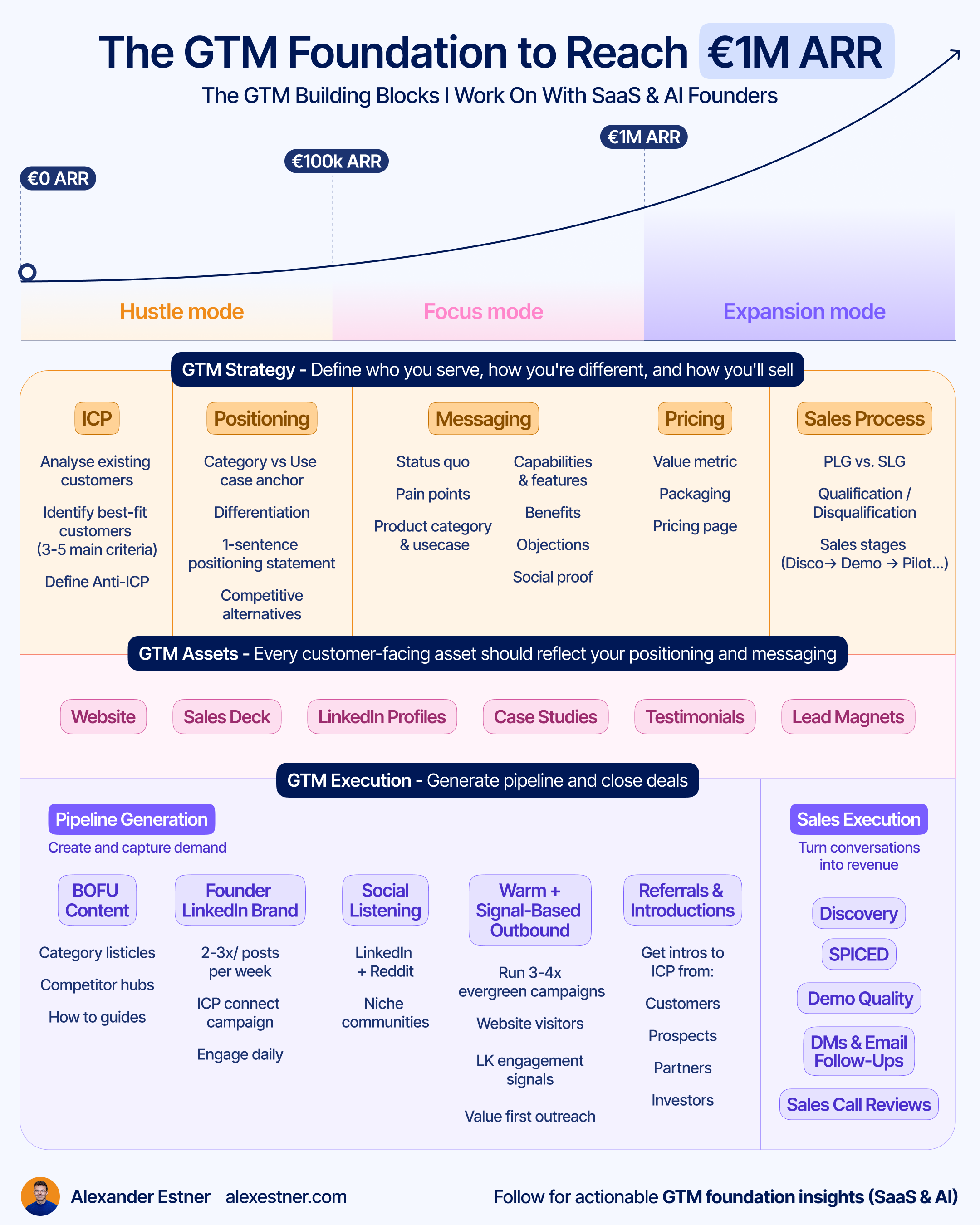
1️⃣ ICP (Who You Sell To)
The insight: I see most founders define their ICP too broadly.
“B2B SaaS companies with 10-200 employees” is not an ICP.
A real ICP includes 3-5 firmographic/technographic attributes, the specific persona, the buying trigger, AND the Anti-ICP (who you should not target).
The founders who grow fastest are the ones who say no to the most prospects.
Self-check: Can you describe your best-fit customer with 3-5 specific attributes, and can you name the event that triggers them to buy?
If not, start here.
2️⃣ Positioning (What You Are)
The insight: Positioning is a founder’s bet.
You decide:
what your product is,
who it’s for,
and what alternative it replaces.
If buyers can’t mentally classify you in 5 seconds, they can’t buy you.
Confused buyers don’t book demos. They ignore you.
Don’t wait for perfect data before positioning. Positioning creates the data.
Bad positioning beats no positioning. Every time.
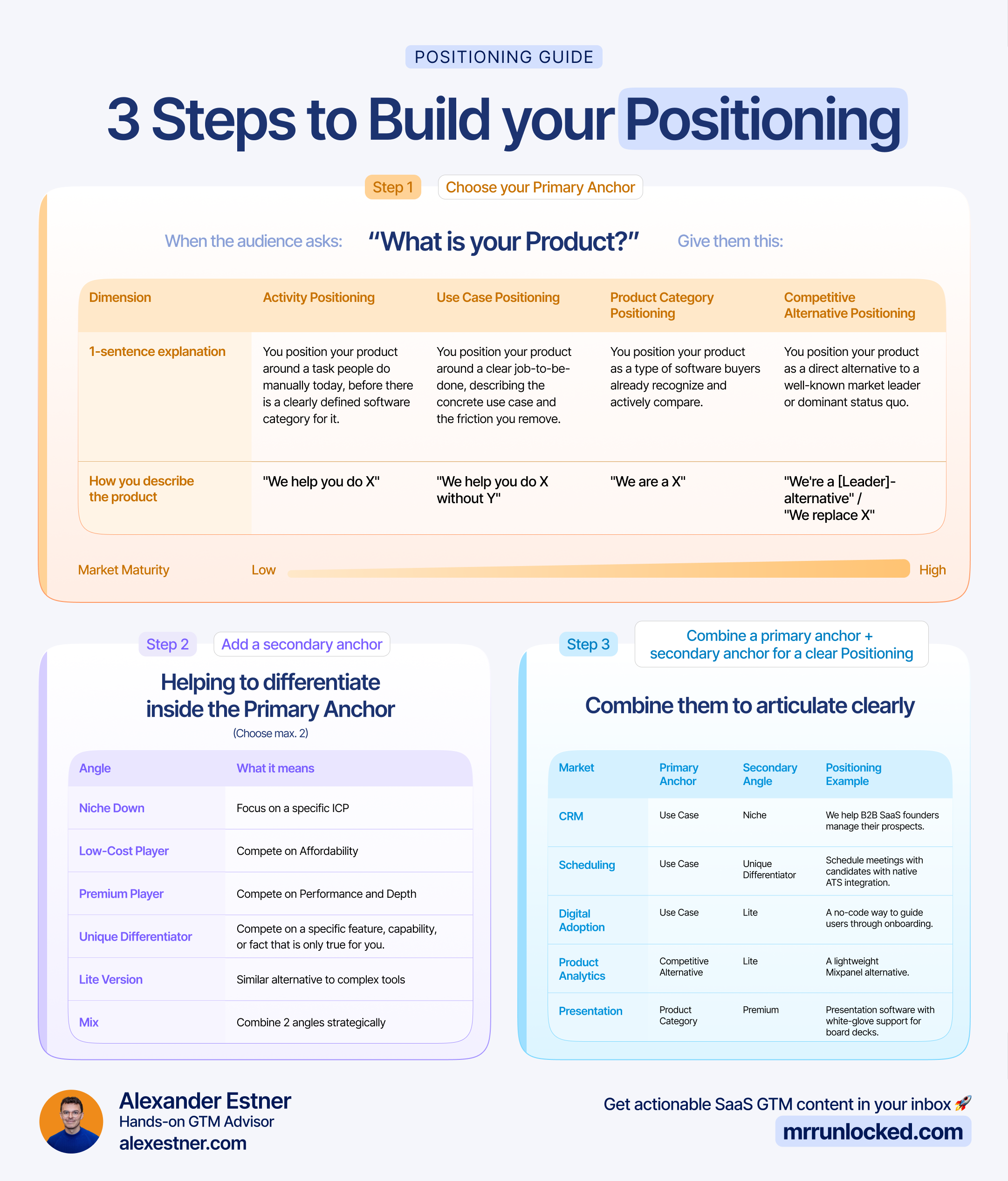
Self-check: Can you explain what you are in one sentence, without rambling?
If a stranger asks “What does your company do?” and you need more than 10 seconds, you have a positioning problem.
3️⃣ Messaging (How You Communicate It)
The insight: Great messaging uses the customer’s language, not yours.
It focuses on one core outcome/workflow/jobs-to-be done.
And it’s consistent everywhere: website, sales calls, LinkedIn, emails, ads.
The most common mistake I see:
❌ Founders use different messages across every channel. Different storyline on the homepage, different pitch in demos, different story on LinkedIn.
That’s not creative. That’s confusing.
Repetition builds clarity. Don’t reinvent the message for every channel.
(I’m not talking about copy/words. I’m talking about messaging. For sure, you can use different words across different channels and different stages of the funnel)
Self-check: If I put your homepage hero, your sales deck, and your LinkedIn profile next to each other, would they tell the same story?
4️⃣ Collaterals (The Assets That Sell When You’re Not in the Room)
The insight: Your collaterals are your GTM on autopilot. Your website, case studies, sales deck, LinkedIn profiles, lead magnets. These are the things buyers look at before, during, and after talking to you.
Here’s what I see constantly: the positioning and messaging is clear (on paper), but the website still says something different. The sales deck opens with a company history slide. The LinkedIn profile talks about the founder’s background instead of the buyer’s problem.
Your collaterals need to tell the same story as your messaging.
Same ICP. Same pain. Same value prop.
Adapted for the format, but the same core narrative.
Self-check: Pull up your website, your sales deck, your LinkedIn profile, and your last case study. Do they all tell the same story? If not, your collaterals are working against you.
👉 GTM Foundation Part 2: Channels & Collaterals
👉 The Founder & Team LinkedIn Playbook
👉 SaaS Lead Magnets That Actually Convert
5️⃣ Channels & Tactics (Where You Show Up and How You Create Conversations)
The insight: Early-stage founders spread across too many channels. LinkedIn, Google Ads, SEO, partnerships, events, communities, cold email. All at once. None working well.
Every channel requires depth to work. LinkedIn takes 3-6 months of consistent posting. Outbound needs signal tracking and message iteration. SEO takes 6-12 months. At 20% effort, nothing compounds.
Master 1-2 channels before adding a third.
And within each channel, the tactic and execution matter.
In 2026, here are the channels I would bet on:
Organic LinkedIn (Founder & Team Personal Brands)
Referrals & warm intros
Signal-based/ warm outbound
Social listening
BOFU content
(P.S. Channel selection always depends on your ACV, market maturity, target audience, founder/team skills)
Self-check: Which 1-2 channels drive 80% of your pipeline today? If the answer is “I’m not sure” or “we’re testing everything,” you’re spreading too thin. And for your main outbound campaign: can you name the specific signal that triggers it?
👉 GTM Foundation Part 2: Channels & Collaterals
👉 8 Must-Have Signal-Based Outbound Campaigns
👉 The Founder & Team LinkedIn Playbook
6️⃣ Sales Process & Demos (How You Convert Interest Into Revenue)
The insight: Most weak demos are not demo problems. They’re GTM problems.
❌ If your ICP is unclear, your discovery stays superficial.
❌ If your positioning is vague, you can’t handle “How are you different?”
❌ If your messaging doesn’t resonate, the buyer understands the features but never understands why it matters.
The demo is just the live expression of your GTM clarity.
Fix the foundation, and the demo improves automatically.
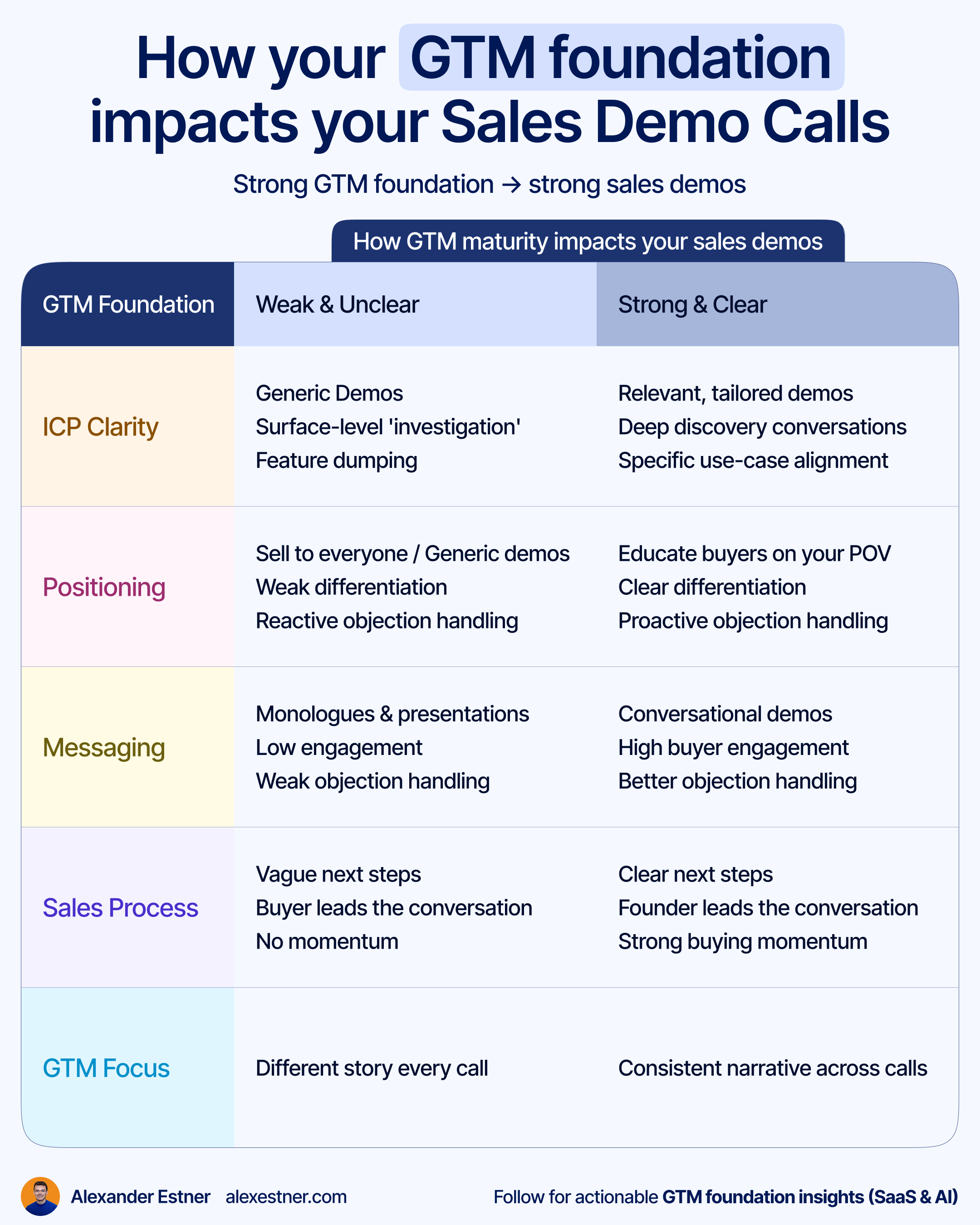
But the demo is also just one part of a broader sales process.
What are the typical steps you guide your buyers through
How you qualify leads
How you structure discovery
How you follow up
How you create urgency
Founder-led sales at the early stage means you ARE the process. And that process needs to be repeatable before you can hand it off.
Self-check: After your last 5 demos, did the buyer clearly understand what you do, who it’s for, and why it’s different from what they use today? And do you have a defined next step for every call, or do your demos end with “Let me know what you think”?
If not, the demo isn’t the problem. Go back to blocks 1-3.
7️⃣ Pricing (How You Capture Value)
The insight: Pricing is 80% about the right structure. Not the number on the page. The structure is what determines how your pricing scales with the value your customer gets: per seat, per usage, per feature tier.
Get the structure wrong and you’ll either leave money on the table or create friction that kills deals. Get it right, and pricing becomes a growth lever, not just a number.
Most founders underprice. Not because the market can’t pay more. Because they lack confidence in their positioning. When you’re not sure what makes you different, every price feels too high. The founders who raise prices almost always wish they had done it sooner.
And if you’re between €0 and €1M ARR: don’t overcomplicate it. One value metric. You can build a sophisticated pricing model later. Right now, simplicity wins.
Self-check: When was the last time you raised your prices? If the answer is “never” or “I’m not sure we can,” you’re probably underpricing. And does your pricing structure actually scale with the value your customer gets?
The System View: Why the Order Matters
Here’s what most founders miss:
These 7 blocks are not independent topics. They’re a chain.
When the chain works: ✅ Clear ICP → Sharp positioning → Resonant messaging → Strong collaterals → Focused channels → Great sales process → Confident pricing
When it breaks: ❌ Vague ICP → Generic positioning → Inconsistent messaging → Weak collaterals → Too many channels → Unstructured sales process → Underpricing
Every GTM problem I see traces back to a break somewhere in this chain. And 80% of the time, the break is in the first 3 blocks.
So before you invest in better outbound tools, demo coaching, or a pricing consultant, ask yourself:
Is my ICP actually clear? Is my positioning actually sharp? Is my messaging actually consistent?
If yes, move downstream.
If no, fix the foundation first.
That’s the system.
📚 Your GTM Reading List (All Deep Dives)
Here’s every episode referenced above, in the order I’d read them:
1️⃣ GTM Foundation Part 1: ICP, Positioning & Messaging
2️⃣ The Ultimate Positioning Guide (+ Worksheet)
3️⃣ GTM Foundation Part 2: Channels & Collaterals
4️⃣ The Founder & Team LinkedIn Playbook
5️⃣ SaaS Lead Magnets That Actually Convert
6️⃣ 8 Must-Have Signal-Based Outbound Campaigns
7️⃣ The GTM Foundation Behind Great Sales Demos
8️⃣ SPICED Sales Engine (+ Granola Templates)
9️⃣ GTM Foundation Part 3: Pricing & Sales Motion
🔟 The Pricing Guide 101
Plus, of course: The GTM Playbook to €1M ARR
Bookmark this episode. Come back when something breaks. Start with block 1.
Happy growth
3 ways I help founders build a strong GTM foundation 👇
If you’re somewhere between €0 → €1M ARR, I can help you with your GTM.
1️⃣ Free GTM Foundation Library
→ 50+ resources (guides, templates, frameworks)
2️⃣ 7-day GTM Clarity Sprint
→ 360° assessment + 6-month action plan: Your GTM blind spots revealed
3️⃣ 1:1 GTM Advisory
→ Work directly with me to build your GTM