


Hey - it’s Alex!
Over the last 3+ years, I’ve audited the GTM foundations of 30+ early-stage B2B SaaS founders.
And here’s the pattern I see:
Most founders have a GTM clarity problem.
They have a product. They have customers. They even have revenue.
But when I ask simple questions about their GTM, things fall apart fast.
Today, I’m opening up my playbook.
I’ll walk you through the exact audit I run with founders, step by step.
The questions I ask.
The patterns I always find.
And the fixes that actually move the needle.
Think of it as a GTM self-assessment you can do in one afternoon.
Want me to run this audit for you? I do a 360° assessment of your current GTM + build you a custom 6-month GTM action plan, delivered in <7 days.
In case you missed the last 3 episodes:
✅ 8 GTM Infographics for SaaS/AI Founders 2026
✅ The GTM Foundation Behind Great Sales Demos
P.S. You love playing Padel? Then check out my 7-day Padel Workation for Founders, Solopreneurs, and GTM operators.
A quick word from our sponsor: I include only sponsors I would personally recommend.
📢 “When I think of revenue, I think of Attio.”
Granola runs their entire revenue motion on Attio. Agents score and enrich leads, product signals sync to every record, and workflows route each prospect straight to the right rep. Nothing slips.
Here’s what that adds up to:
Zero missed leads and 10X faster access to customer context
Lead triage 83% faster
5 hours saved per week with automated updates
Fast-growing teams like Granola scale on Attio. Are you one of them?
📢 Pitch — Pitch Agent is the missing AI layer for your presentation workflow

Most AI slide tools are fast but not great at staying on brand. Pitch Agent is different. It builds from your own approved templates, so speed and quality are no longer a trade-off. Prompt it, stress-test your narrative, generate follow-up emails from your deck, and deliver everything via live links with built-in audience analytics.
One assistant, one platform, your entire presentation lifecycle.
Why Most GTM “Fixes” Don’t Work
Here’s something I’ve noticed across almost every founder I’ve worked with:
They start fixing the wrong thing.
❌ “Our outbound isn’t working” → So they buy a new tool or add more leads.
❌ “Our demos don’t convert” → So they take a sales course.
❌ “We’re not getting inbound” → So they hire a content person.
But most of the time, the root cause sits upstream.
The outbound fails because the ICP is unclear.
The demos fail because the positioning is weak.
The inbound fails because the messaging doesn’t resonate.
That’s why I always start with an audit before I fix anything.
Because the symptom is rarely the problem.
The 6-Part GTM Audit
When I sit down with a founder, I run through 6 areas. Each one builds on the one before.
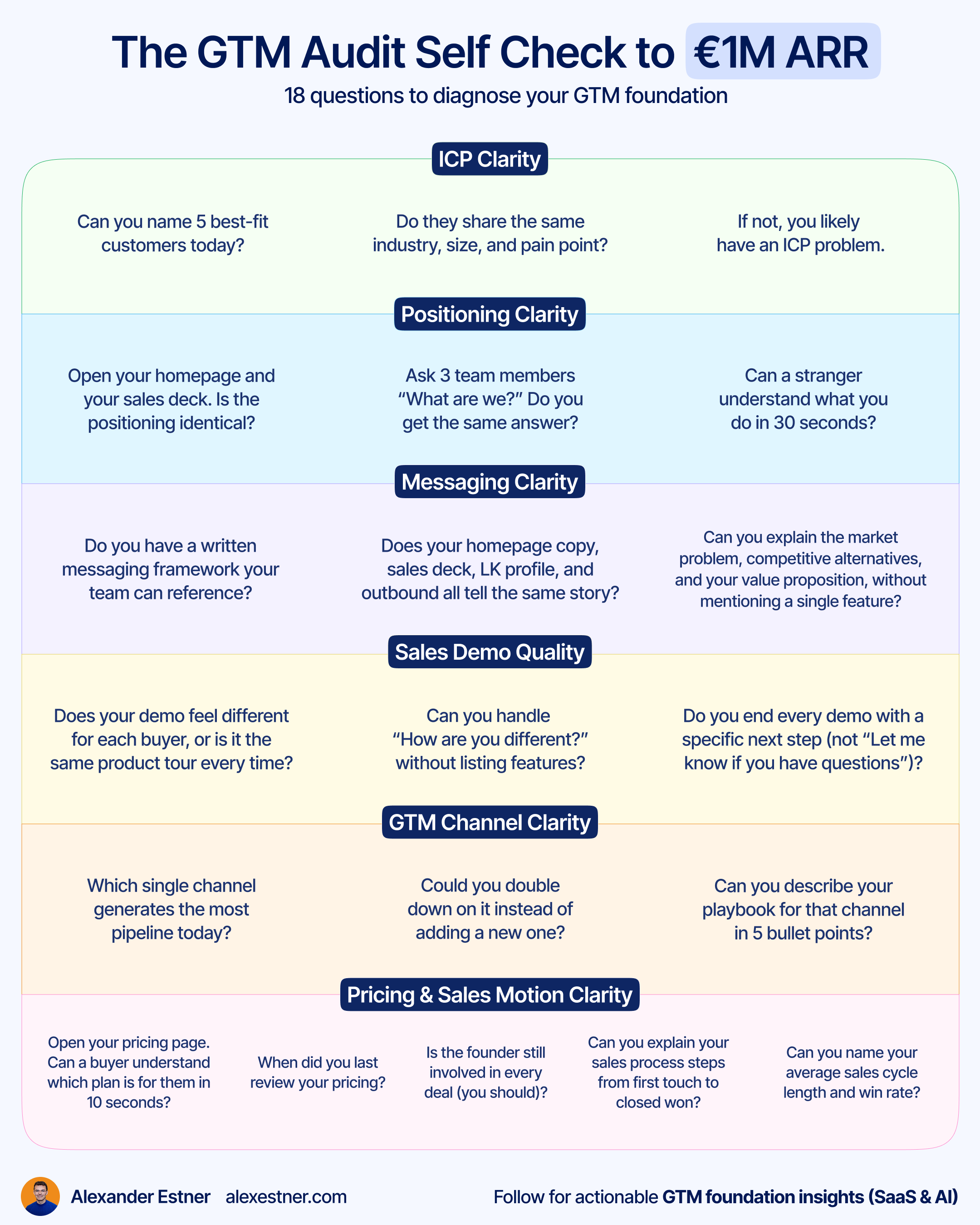
If you get the first 3 right, everything downstream gets easier.
If the first 3 are broken, nothing downstream will fix it.
1. ICP Clarity
The first question I ask every founder:
“Describe your ideal customer in one sentence.”
Here’s what I usually hear:
❌ “We sell to companies with 50 to 500 employees.”
❌ “Our ICP is mid-market SaaS.”
❌ “We target anyone who has this problem.”
That’s not an ICP. That’s a TAM.
A strong ICP answers:
✅ What type of company? (industry, size, stage, business model)
✅ Who is the buyer and champion? (role, seniority, day-to-day pain)
✅ What triggers the buying process? (critical events)
✅ What makes them a best-fit customer? (fast sales cycles, low churn, high usage)
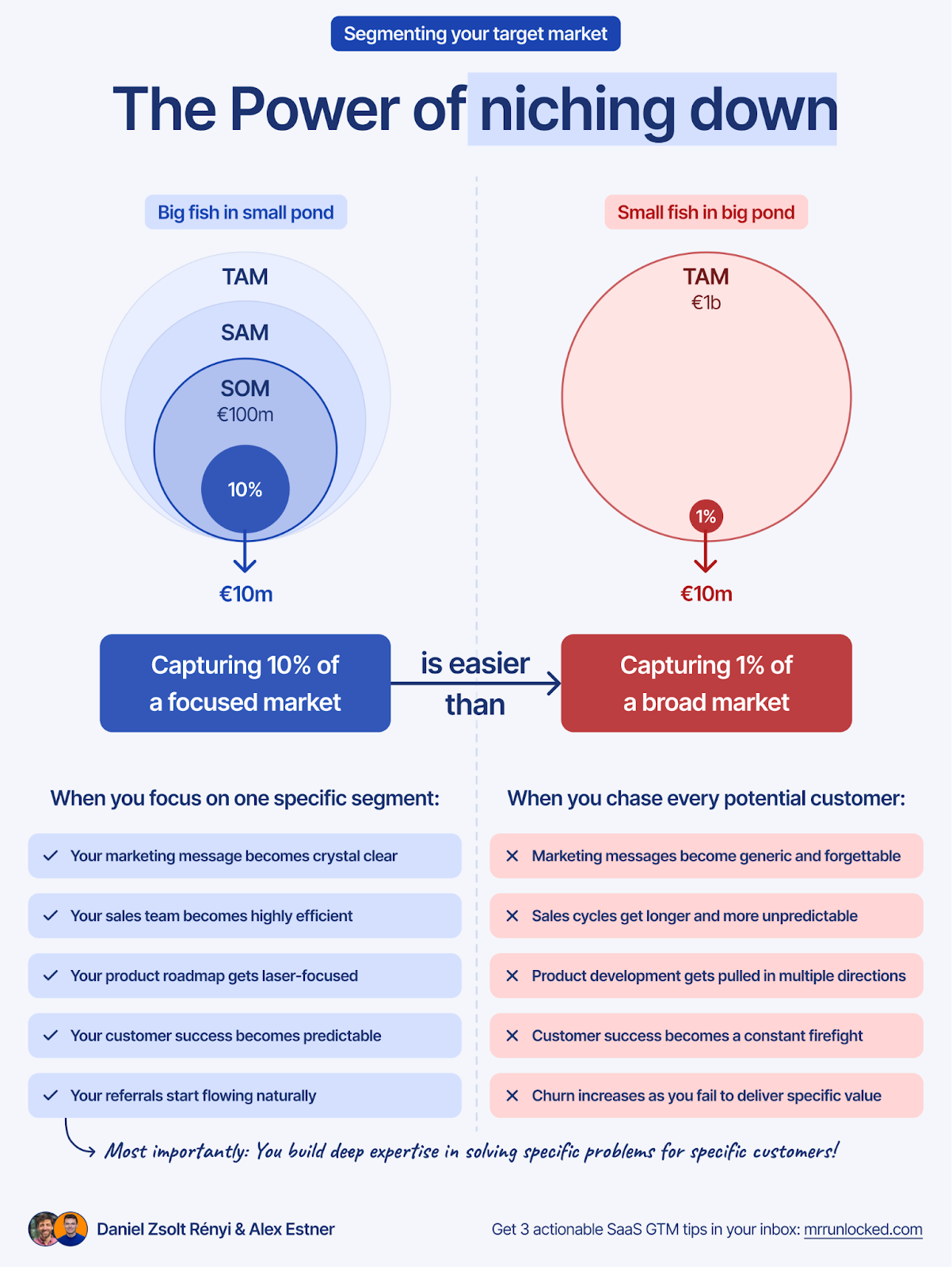
The best early-stage companies don’t target everyone. They become extremely relevant to a specific segment before expanding.
The pattern I always find: Founders who struggle with outbound, demos, or content almost always have a vague ICP. Fix the ICP, and 3 other problems disappear.
Quick self-check:
Can you name 5 best-fit customers today?
Do they share the same industry, size, and pain point?
If not, you likely have an ICP problem.
→ Deep dive: GTM Foundation Part 1: ICPs, Positioning & Messaging
2. Positioning Clarity
The second question:
“What are you?”
If the answer takes longer than 10 seconds, we have a problem.
I wrote an entire episode on this, but here’s the short version:
Positioning is two decisions:
Primary anchor: What is your product? (Activity, Use Case, Product Category, or Competitive Alternative)
Secondary angle: Why you? (What makes you different?)
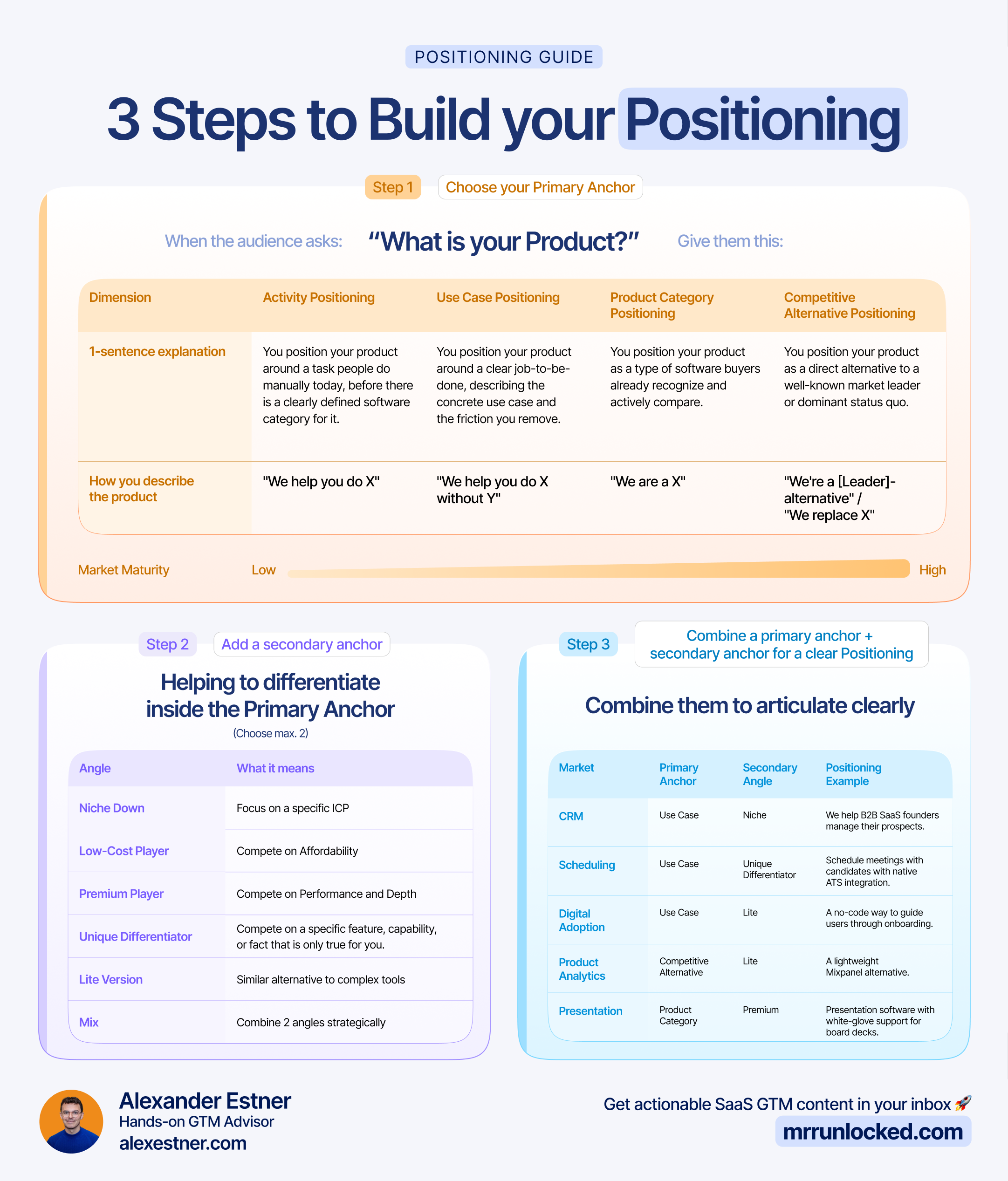
Most founders try to sound differentiated before they’ve become understandable.
But buyers who can’t classify you will never compare you. And buyers who can’t compare you will never buy you.
The pattern I always find: When I review their homepage, LinkedIn profiles, and sales deck side by side, I often see two completely different positioning stories. That’s a red flag. If your own team can’t agree on what you are, your buyers definitely can’t.
Quick self-check:
Open your homepage and your sales deck. Is the positioning identical?
Ask 3 team members “What are we?” Do you get the same answer?
Can a stranger understand what you do in 30 seconds?
→ Deep dive: The Ultimate Positioning Guide
3. Messaging Clarity
The third question:
“Do you have a messaging framework?”
Most founders don’t. They go straight to writing homepage copy, sales emails, and pitch decks, without defining what they actually want to say first.
Here’s the thing most people miss:
Messaging is NOT copy.
Messaging = the main points you want to communicate to your customers.
Copy = how you communicate it. The exact words.
Messaging defines your copy. Copy changes based on the channel, medium, and buyer stage. But the messaging stays the same.
Without a messaging framework, every time you write an email, build a landing page, or pitch your product, you use different words, different narratives, and different ways to communicate, you basically start from zero every time.
A strong messaging framework answers 5 questions:
✅ The Market — What’s changing? What’s the status quo and what’s broken about it?
✅ The ICP — Who’s most affected by this problem?
✅ The Competitive Alternatives — What are they doing today instead? What are the limitations?
✅ Your Product — What can customers do with your product that they can’t without it? (Capabilities, not feature lists.)
✅ The Value Proposition — What’s in it for them? What results do you drive? What social proof do you have?
Once you have this framework, it becomes the foundation for everything: your homepage, your sales deck, your outbound, your demos.
Here’s what a founder recently said about it.

The pattern I always find: Founders who skip the messaging framework end up with a homepage that says one thing, a sales deck that says another, and outbound emails that say something completely different. Three assets, three stories, zero consistency.
Quick self-check:
Do you have a written messaging framework your team can reference?
Does your homepage copy, sales deck, LK profile, and outbound all tell the same story?
Can you explain the market problem, competitive alternatives, and your value proposition, without mentioning a single feature?
→ Deep dive: The Ultimate SaaS Messaging Framework
→ See it in action: High-Converting SaaS Homepage and High-Converting Sales Deck
4. Sales Demo Quality
The fourth question:
“Let me review your last 3 sales demo calls?”
Here’s something most people don’t realize:
Your demo quality is usually a reflection of your GTM quality.
I’ve reviewed 50+ founder-led demos. And weak demos are almost never a demo problem.
They’re a GTM clarity problem.
❌ If your ICP is vague, your discovery stays superficial.
❌ If your positioning is unclear, you can’t handle “How are you different from X?”
❌ If your messaging is feature-first, your demo becomes a product tour.
Great demos are operationalized GTM clarity. They break down into 4 layers:
✅ ICP clarity → You ask deep, relevant questions. You adapt the demo to their use case.
✅ Positioning clarity → You explain what you are and why you’re different, in 30 seconds.
✅ Messaging clarity → You lead with the painful workflow, not the feature list.
✅ Process clarity → You guide the buying journey with clear next steps.

The pattern I always find: Founders who “need to improve their demos” usually need to improve their GTM foundation first. After that, work on your sales demo skills.
Quick self-check:
Does your demo feel different for each buyer, or is it the same product tour every time?
Can you handle “How are you different?” without listing features?
Do you end every demo with a specific next step (not “Let me know if you have questions”)?
→ Deep dive: The GTM Foundation Behind Great Sales Demos
→ Learn how to run great Sales Demos with my Sales Demo Toolbox
5. Channel Focus
The fifth question:
“How many GTM channels are you running right now?”
If the answer is more than 2, we usually have a problem (if you’re in Focus mode from 100k€ to the first million ARR).
I see this constantly:
❌ “We do outbound, LinkedIn content, SEO, partnerships, and PPC.”
Each channel works differently, takes time to master, and eats up resources.
At €0 to €1M ARR, you don’t have the bandwidth to run 5 channels well. You’ll run all 5 badly.
✅ The fix: Pick 1-2 channels. Get it to work. Add more only after the first ones are producing predictable results.
The pattern I always find: Founders who spread across 4+ channels usually have none that work consistently. The founders who focus on 1-2 channels and master it are the ones who hit €1M ARR fastest.
Quick self-check:
Which single channel generates the most pipeline today?
Could you double down on it instead of adding a new one?
Can you describe your playbook for that channel in 5 bullet points?
→ Deep dive: GTM Foundation Part 2: Channels & Collaterals
6. Pricing & Sales Motion
The sixth question:
“Can you explain your pricing in 30 seconds?”
Early-stage pricing doesn’t need to be perfect. It needs to be clear enough to NOT stop you from growing.
Here’s what I look for:
✅ Does the value metric make sense? (What do you charge for?)
✅ Is it easy to understand? (Can a buyer the pricing page?)
✅ Is it iterative? (Are you reviewing pricing every quarter?)
And on the sales motion side:
✅ Is the founder still involved in sales? (They should be.)
✅ Is there a clear process from first touch to close?
✅ Do you know your sales cycle, win rate, and average deal size?
The pattern I always find: Founders either overcomplicate pricing (4 tiers with feature gating they can’t justify) or they haven’t touched pricing since day 1. Both hurt growth.
Quick self-check:
Open your pricing page. Can a buyer understand which plan is for them in 10 seconds?
When did you last review your pricing?
Is the founder still involved in every deal (you should)?
Can you explain your sales process steps from first touch to closed won?
Can you name your average sales cycle length and win rate?
→ Deep dive: GTM Foundation Part 3: Pricing & Sales Motion
After the Audit: What Usually Happens
After running this audit with a founder, the result is almost always the same:
The problem is not that they need more tools, more channels, or more people.
The problem is that 2 or 3 foundational elements are unclear. And everything downstream is suffering because of it.
Here’s the typical priority order:
Fix the ICP. Everything else depends on it.
Fix the positioning. Make it understandable before you make it unique.
Build the messaging framework. It’s the foundation for every customer-facing asset.
Once those 3 are clear: optimize demos, channels, and pricing.
That’s it. No magic. Just clarity.
Focus beats complexity. Every time.
Want Me to Run This Audit For You?
I run 360° GTM audits with early-stage B2B SaaS/AI founders (€0 to €1M ARR).
Here’s what you get:
✅ A complete assessment of your current GTM foundation
✅ A custom 6-month GTM action plan — specific to your stage, ICP, and channels
✅ Delivered in less than 7 days
No fluff. No long-term commitment. Just clarity on your next GTM moves.
Happy growth.
Alex
3 ways I help founders build a strong GTM foundation 👇
If you’re somewhere between €0 → €1M ARR, I can help you with your GTM.
1️⃣ Free GTM Foundation Library
→ 50+ resources (guides, templates, frameworks)
2️⃣ GTM Audit
→ 360° assessment + 6-month action plan: Your GTM Blindspots revealed
3️⃣ 1:1 GTM Advisory
→ Work directly with me to build your GTM
Smart way for reps to know if you can differentiate