


Hey - it’s Alex!
Today, we’ll dive deep into positioning. After working with 30+ early-stage founders over the last 3 years, I’ve noticed that strong vs. weak positioning sets the foundation for your GTM success.
What You’ll Get Inside This Episode
✅ A 3-step framework for choosing the right positioning anchor
✅ A clear decision tree (Activity vs Use Case vs Category vs Alternative)
✅ Differentiation angles that actually work
+ a Bonus: A practical worksheet to define your positioning
👉 Shortcut: Access the Ultimate Positioning Guide
In case you missed the last 3 episodes:
✅ 10 Quick GTM Fixes you can ship this week
✅ Homepage Teardown: What 6 Top SaaS Companies get Right (and Wrong)
✅ Insights from 15+ GTM audits
A quick word from our sponsor
📢 Attio — Your CRM wasn’t built for how fast you need to move

Attio is the AI CRM that flexes with your GTM strategy, not the other way around. Connect your email and calendar, and Attio instantly builds your CRM.
Then Ask Attio anything:
Ask “What’s the latest on this deal?” and get comprehensive answers with suggested next steps
Prep for calls in seconds, with context from across your entire business
Keep your pipeline up to date automatically
Ready to move faster?
👉 Reach 27.000+ SaaS operators with sponsored content. Sponsor the next newsletter.
Let’s get into it. 👇👇
Last month, I had 8 intro calls with founders.
Most of them had a solid product.
Some even had decent traction.
But when I asked: “What are you building?”
More than half gave me a 3-minute explanation.
And after 3 minutes… I still couldn’t clearly explain it back to them 😇.
If I don’t get it in 30 seconds, your buyers won’t either.
That’s a positioning problem.
1️⃣ You need to take a positioning bet
One of the biggest GTM mistakes I see early-stage founders make:
❌ They wait for perfect data before positioning.
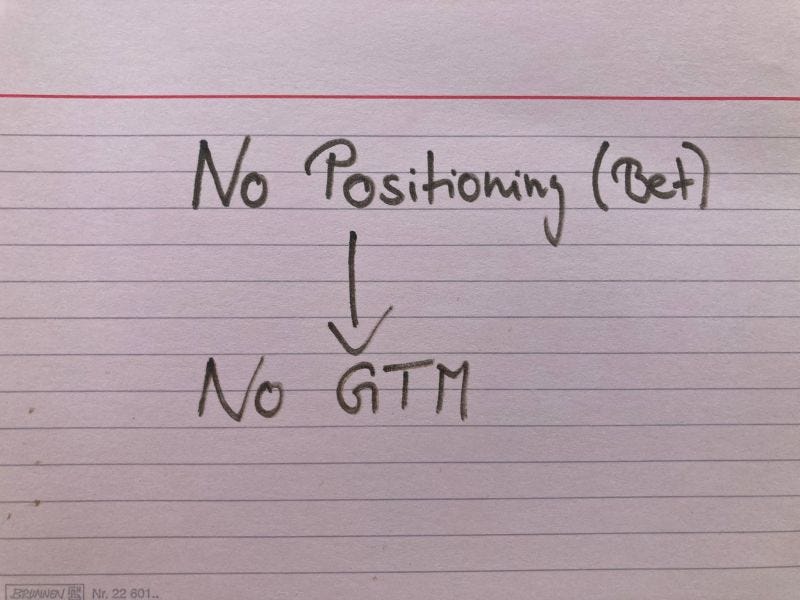
But positioning creates the data.
The moment you decide:
what your product is
👉 “We are X”who it’s for
👉“We help X”who you compete against
👉 “Instead of solution Z”
Everything sharpens:
→ Clear ICP targeting
→ Better messaging
→ More focused sales calls
→ Smarter roadmap decisions
→ Content ideas that actually convert
→ Competitors you can clearly position against
Yes, it’s a bet.
Yes, it might be wrong.
But: Positioning isn’t about being right.
It’s about having something to test.
Bad positioning beats no positioning. Every time.
Quick check: If I asked you right now: “What are you?”
Could you answer in one sentence without rambling?
2️⃣ The 3-Step Positioning Framework
Positioning is two decisions layered together:
Choose your Primary Anchor (What are you?)
Add a Secondary Angle (Why you? Your Differentiation)
Combine both into a clear statement
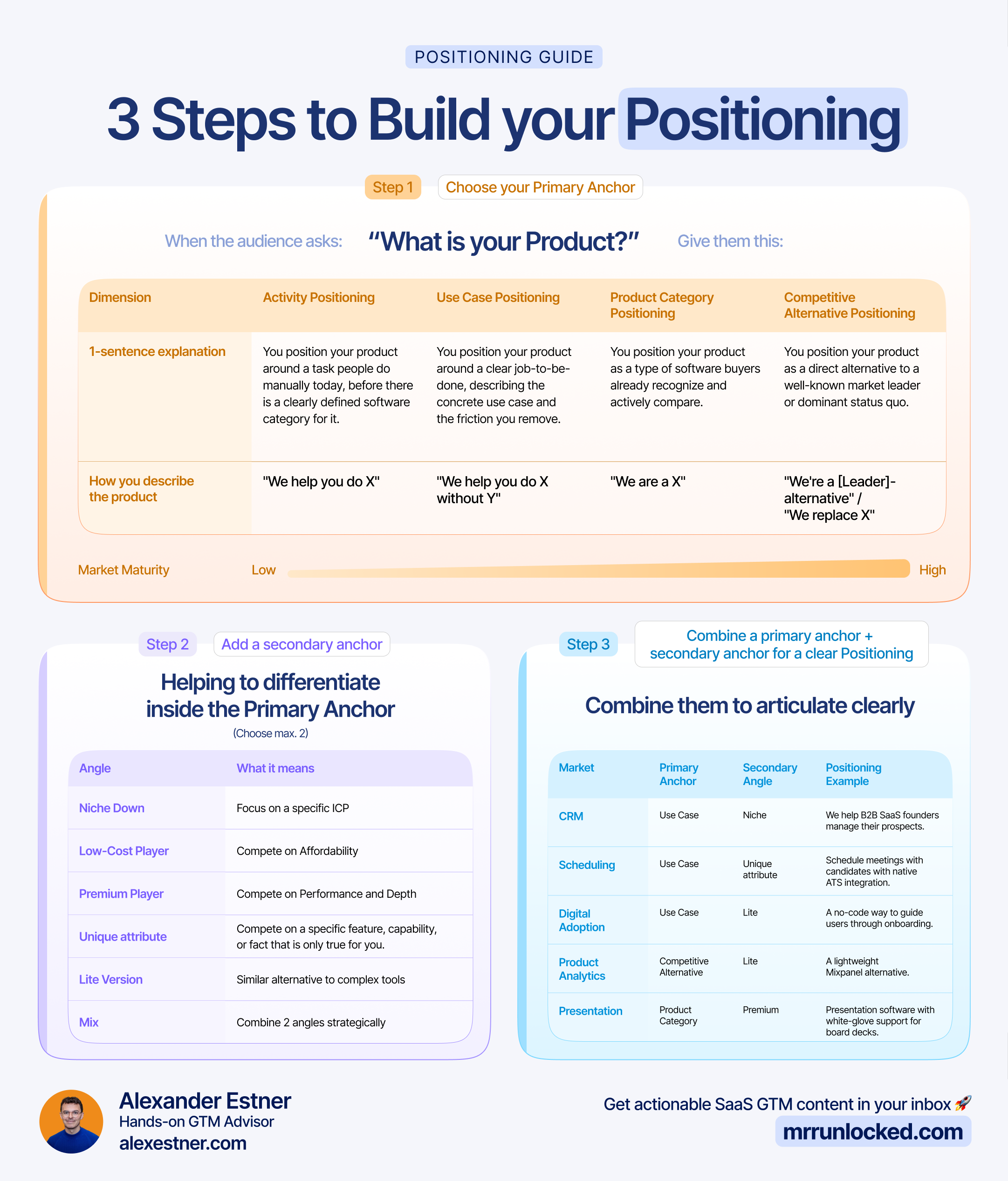
This is the core of the framework in the full guide.
This framework is my attempt to structure and operationalize these ideas for early-stage SaaS founders
Let’s break it down.
Step 1: Choose Your Primary Anchor
Your primary anchor answers:
“What is your product?”
If buyers can’t mentally classify you, they can’t buy you.
Confused buyers don’t ask for demos. They ignore you.
There are 4 options.
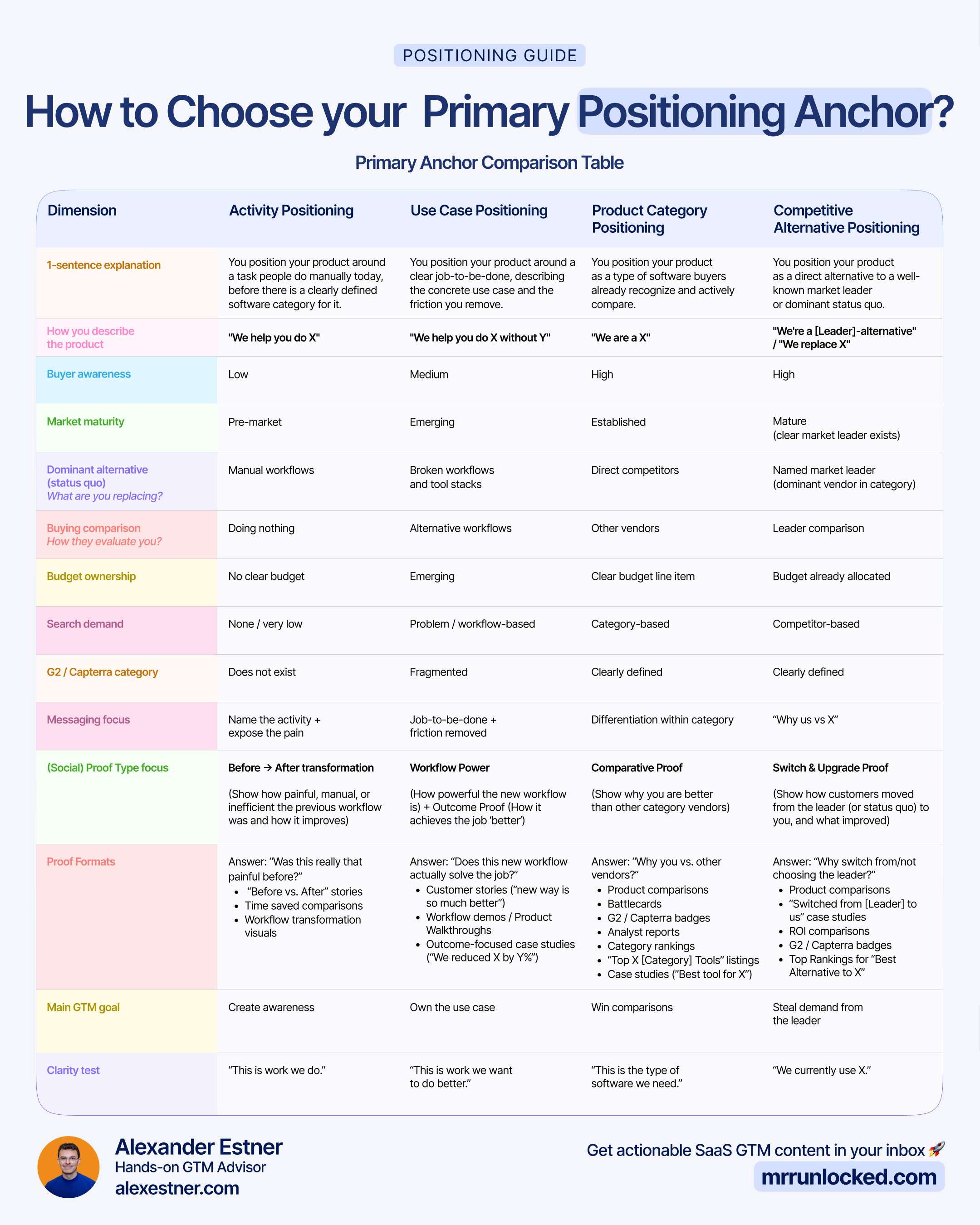
1) Activity Positioning
You frame your product around a manual activity people do today.
“We help you do X.”
Best when:
• Market is early/ not existing
• No clear category exists
• People still use spreadsheets, Slack, Notion, etc.
Main GTM goal: Create awareness.
2) Use Case Positioning
You position around a clear job-to-be-done.
“We help you do X without Y.”
Buyers can describe the problem, but not the category.
Best when:
Market is emerging
Product categories are emerging / fragmented
You replace broken workflows
Main GTM goal: Own the use case.
3) Product Category Positioning
You position your product as a type of software that buyers already recognize and actively compare.
“We are a X.”
Buyer awareness is high. They already:
• Google the category
• Compare vendors
• Check G2
Main GTM goal: Win comparisons (with differentiation inside the category).
4) Competitive Alternative Positioning
You position yourself directly against a dominant leader.
“We are a [Leader] alternative.”
Only use this when:
• market maturity is very high + a market leader clearly dominates
• You have a strong wedge
Main GTM goal: Steal demand from the leader.
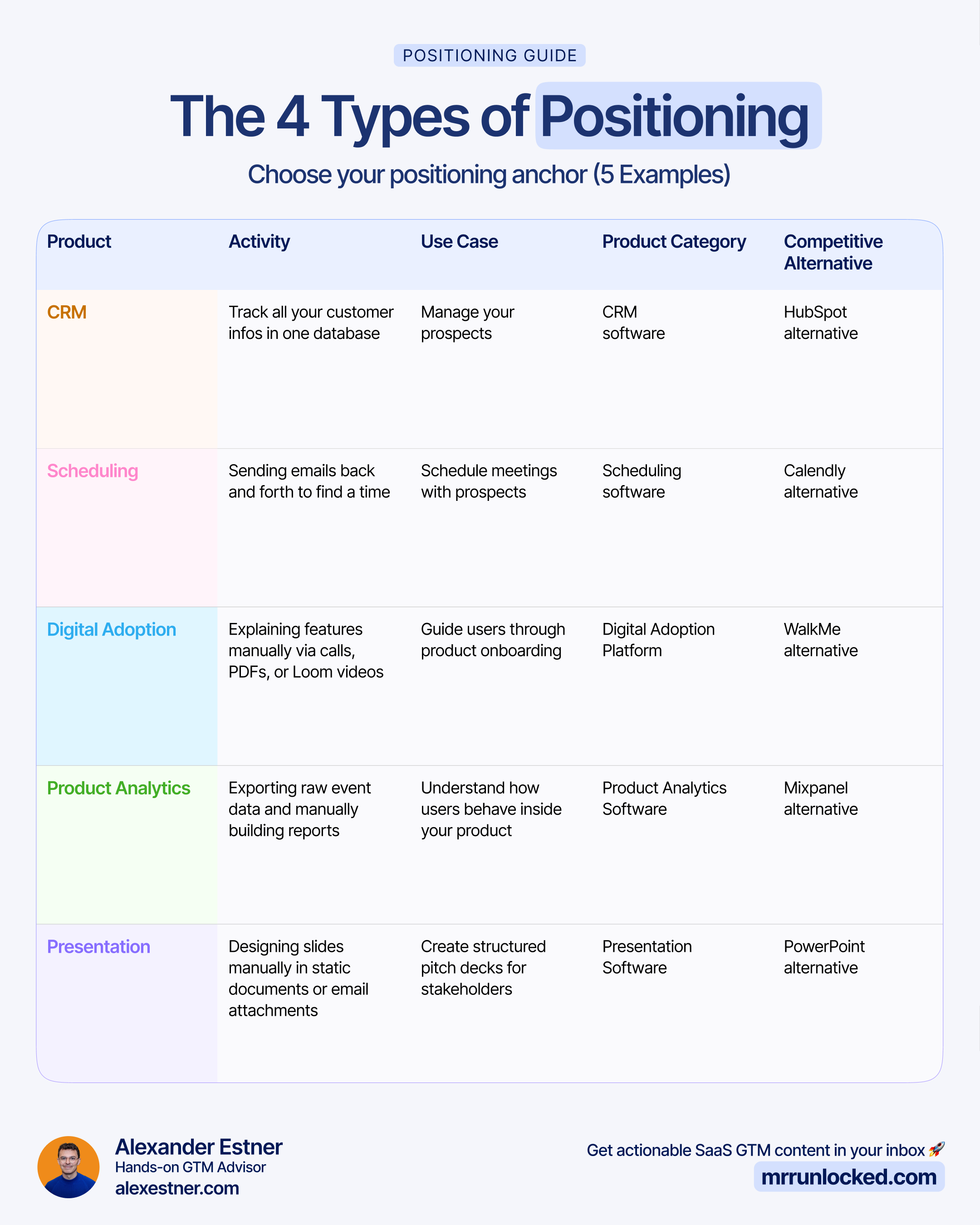
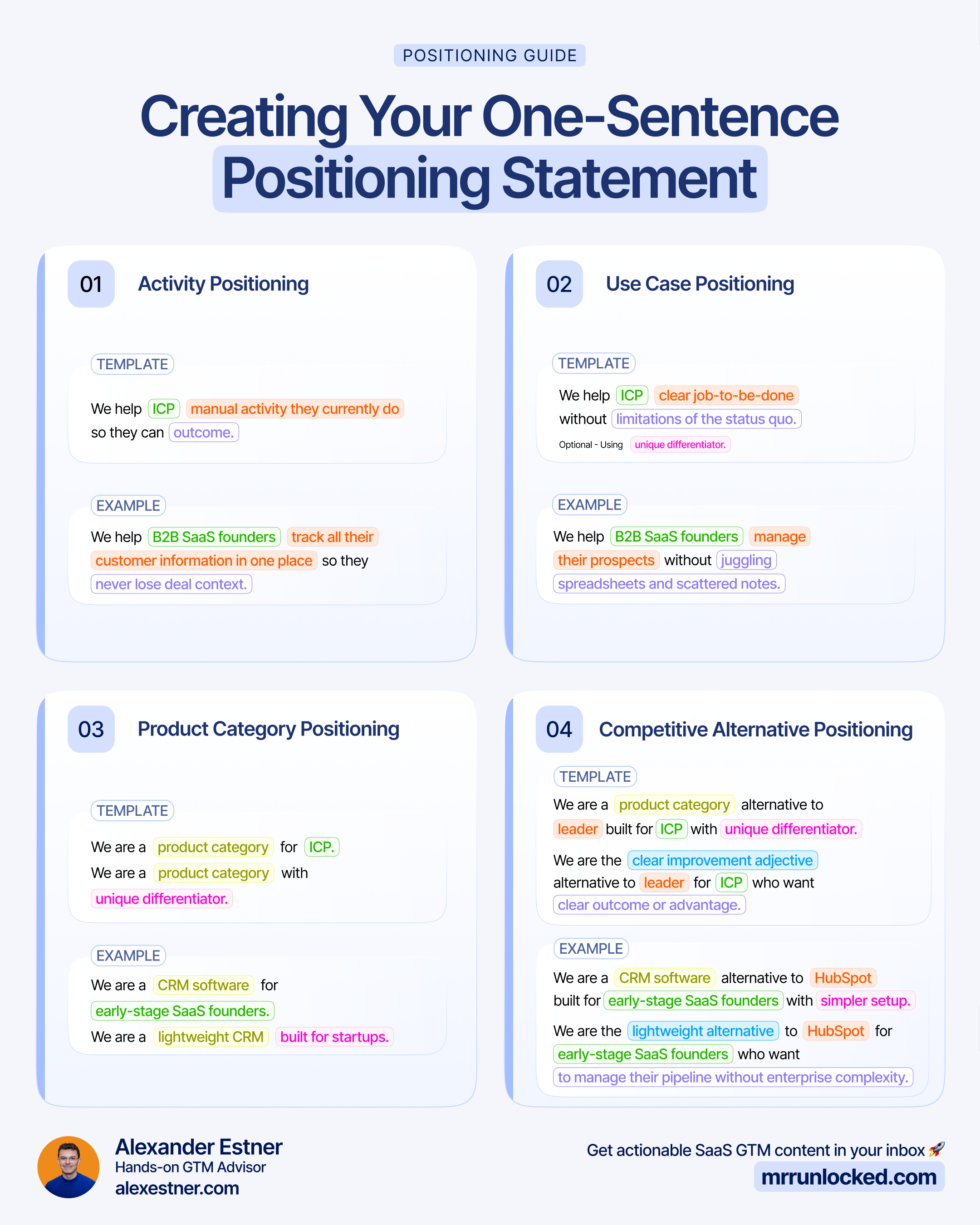
The 4 types of Positioning (Examples)
Let’s have a look at how you can position the same product with the 4 types of positioning anchors.
How to Choose the Right Primary Positioning Anchor (Decision Tree)
Choose your Primary Anchor based on how buyers think today, not how you want them to think.
Use the decision tree below to choose the right anchor (simplified from the full decision tree in the guide).
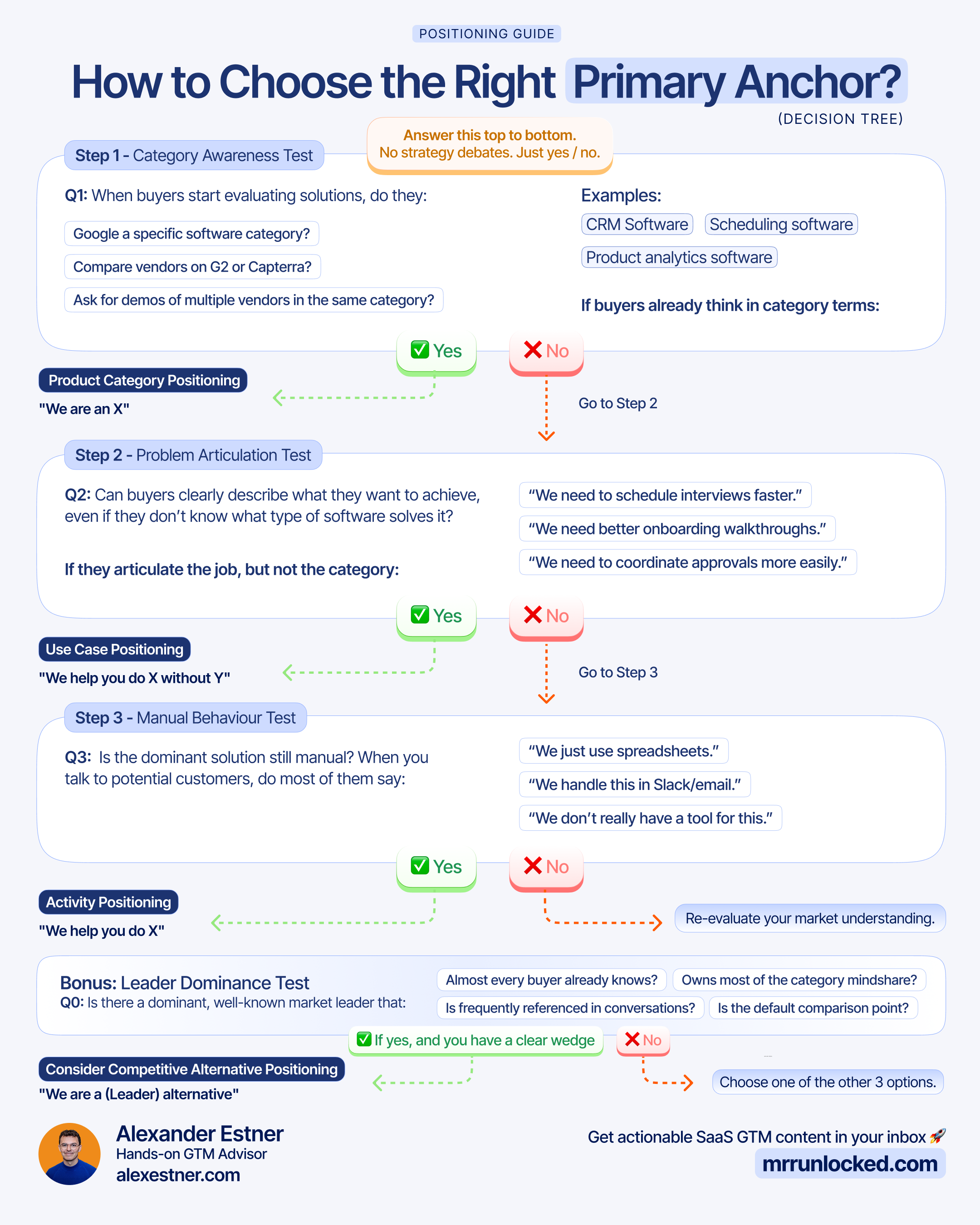
If you answered the questions top to bottom, you should be able to choose the best fit for you.
But here’s the thing.
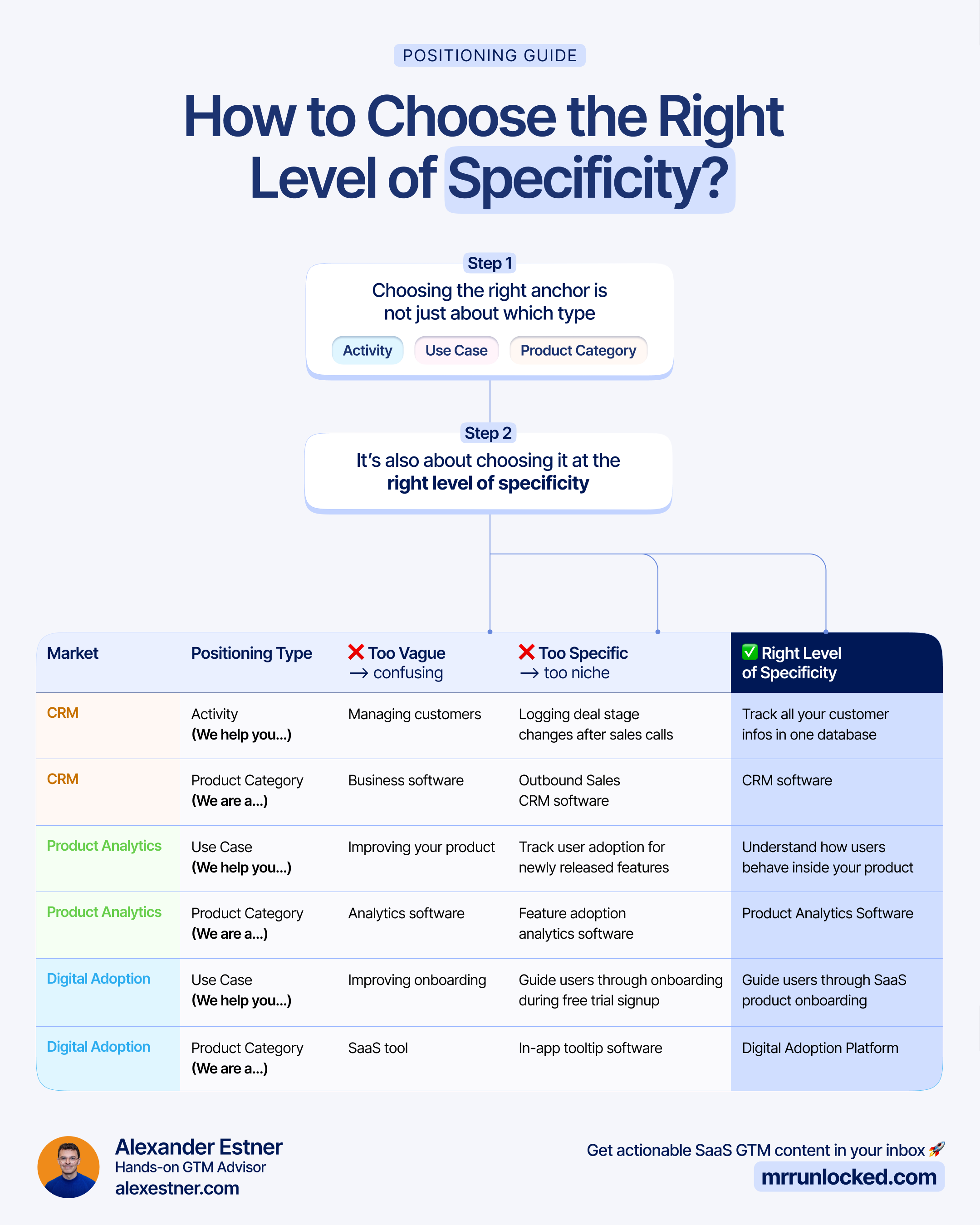
How to Choose the Right Level of Specificity
Choosing the right anchor is not just about which type (Activity, Use Case, Product Category).
It’s also about choosing it at the right level of specificity.
Too vague → Confusing
Too specific → Too niche/ Small target audience
Right level → Clear & defensible
Step 2: Add a Secondary Positioning Anchor (Differentiation)
Your primary anchor classifies you.
Your secondary anchor differentiates you inside the chosen anchor.
What makes you meaningfully different from alternatives?
On what dimension do you compete?
You can choose max 2 real differentiators:
☐ Niche Down (If Niche → Who exactly?)
☐ Low-Cost Player (If Low-Cost → Compared to what?)
☐ Premium Player (If Premium → What makes you superior?)
☐ Unique Attribute (If Unique Attribute → What is ONLY true for you?)
☐ Lite Version (If Lite → What complexity are you removing?)

Step 3: Combine Primary + Secondary Anchors
Combine a primary anchor + secondary anchor for a clear positioning.
Strong positioning = Primary Anchor + Secondary Angle
Examples:

If you made it this far, you already understand more about positioning than most founders.
To make it easier for you to craft your positioning, I’ve created a Free Notion Positioning Worksheet for you.
My positioning thinking is heavily influenced by April Dunford, Fletch PMM (with Anthony Pierri & Rob Kaminski), Rob Walling, combined with hands-on work with 30+ SaaS founders.
This guide is my attempt to turn those ideas into something practical.
3️⃣ The Positioning Worksheet
The positioning worksheet comes with 2 sections:
Understand the market
About you (How you position yourself in the market)
This is where the real work happens.
You’ll define:
• Your ICP
• The Usecase (jobs-to-be-done)
• The core problem
• The alternative solutions + dominant status quo
• The key limitations of that status quo
• Your primary anchor
• Your secondary anchor
• Your competitive differentiator


Instead of guessing your positioning from this newsletter, use the full framework properly. I’ve compiled everything into one structured asset: The Ultimate Positioning Guide.
The Ultimate Positioning Guide + Worksheet
Inside the guide, you’ll get:
✓ Full decision tree
✓ Anchor comparison table
✓ Worksheet (Notion version)
✓ Internal positioning templates
✓ Market-facing statement templates
✓ 6 common positioning mistakes
✓ Positioning health check (self-assessment)

The goal is that you have clarity around your positioning.
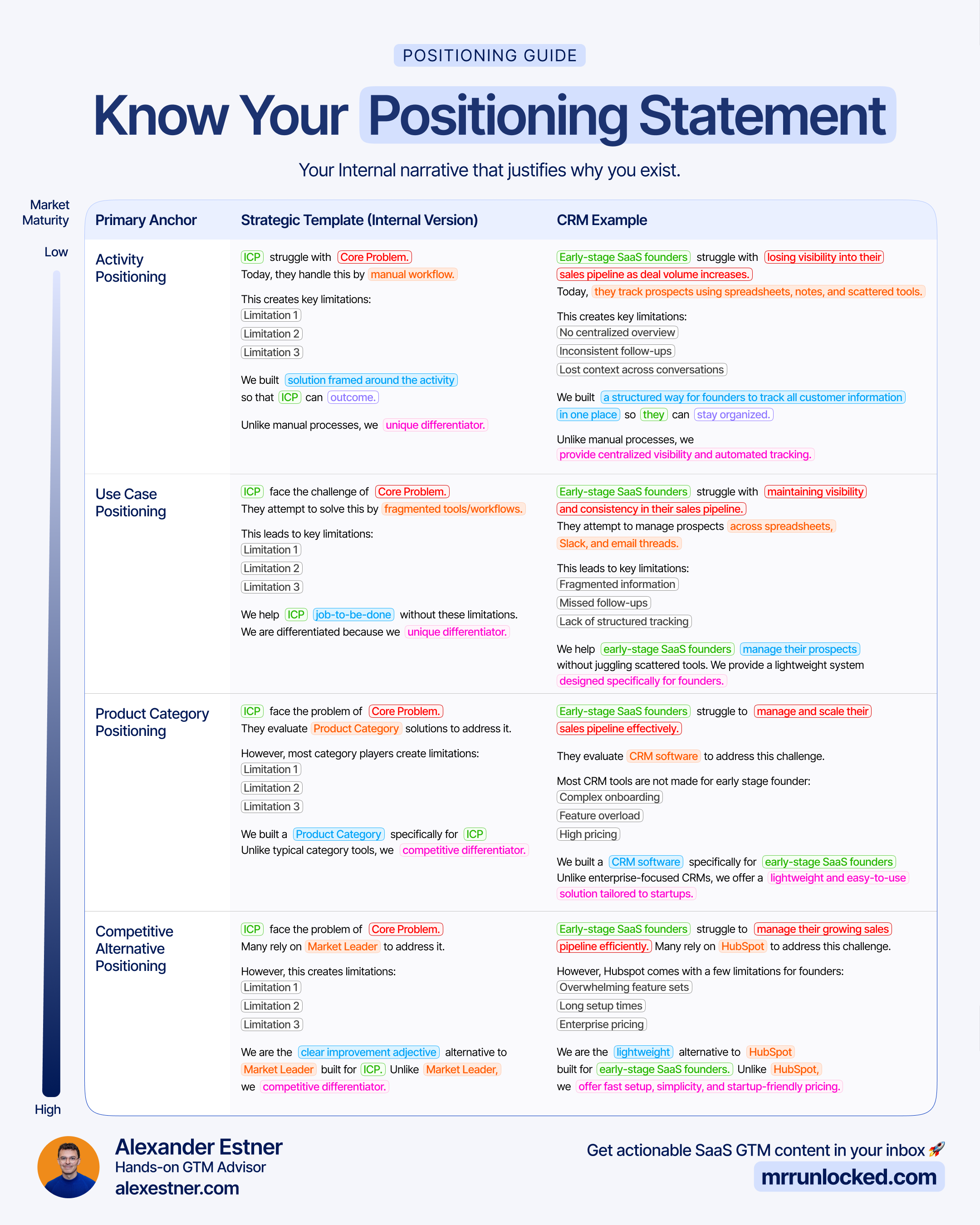
This means internal and external positioning statements.
I hope today’s content helps you better position your product in the market.
If you’re serious about fixing your GTM foundation:
Don’t just tweak your homepage headline.
Do the strategic work.
Okay, that’s it for today.
See you in 2 weeks.
Reply to this email and send me your positioning statement. I’ll give you feedback.
3 ways I help founders build a strong GTM foundation 👇
1️⃣ Use my free GTM library with 50+ free resources (guides, templates, workbooks, and tools) to build a strong GTM foundation (helped 5000+ SaaS leaders)
2️⃣ Get a 360° GTM audit of your status quo + a custom 6-month action plan
3️⃣ Work 1-on-1 with me - GTM Advisory for SaaS founders from €0 to €1 million ARR