


A quick word from our sponsor: I include only sponsors I would personally recommend.
📢 Attio — the AI-native CRM for GTM

Attio is the AI-native CRM with built-in enrichment, flexible workflows, and fast setup. Connect your email and calendar, and Attio instantly builds your CRM.
Their new “Ask Attio” agent changes how you run your CRM: Prep for calls in seconds, update fields automatically, get deal summaries with one click
📢 Codewords — Words in, working agents out

CodeWords is the AI-powered automation platform that turns plain English into production-ready workflows. Describe what you want automated, and Cody builds, tests, and deploys it for you — no code, no canvas, no maintenance.
Build workflows by chatting with Cody
Connect to 2,800+ apps like Slack, Gmail, Notion, HubSpot, and Google Sheets
Let Cody debug, optimise, and keep everything running 24/7
Hey - it’s Alex.
Over the past few months, I have reviewed 50+ founder-led demos across B2B SaaS and AI companies.
And honestly?
The same patterns repeat over and over.
Most founders don’t lose deals because of a weak product.
They lose deals because they lose control of the buying process.
❌ No structure.
❌ Weak discovery.
❌ Feature dumping.
❌ Presentation.
❌ No clear next step.
And all of them lead to the same problem:
❌ Lost momentum.
That’s the real job of a great demo (Not presenting features).
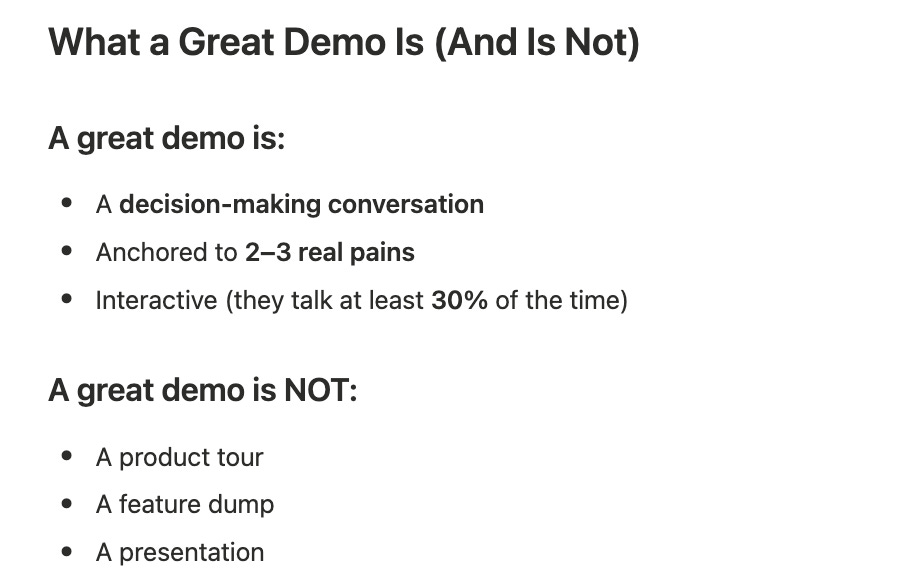
Because a great sales demo is:
✅ a decision-making conversation
✅ creating buying momentum.
So today, I’ll break down the 6 most common sales demo mistakes I see and how to fix them.
👉 The B2B SaaS Sales Demo Toolbox for founders & sales teams
(50% OFF with the code ‘mrrunlocked50’).
After reviewing 100+ demos over the past few years, I’ve consolidated everything I’ve learned into a practical B2B SaaS Sales Demo Toolbox.

In case you missed the last 3 episodes:
✅ The BOFU Content Playbook 2026
✅ 8 Founder-led Signal-Based Outbound Campaigns
✅ How to turn Granola into your full-cycle sales engine using SPICED
What Great Sales Demos Actually Do
I believe great demos follow a very simple chain:
Discovery → Relevance → Engagement → Momentum → Deals
If one breaks, the deal slows down.
Weak discovery? → Low relevance.
Low relevance? → Less engagement.
Less engagement?→ Less buying momentum.
Once momentum disappears, deals stall.
1️⃣ No Structure → You Lose Control
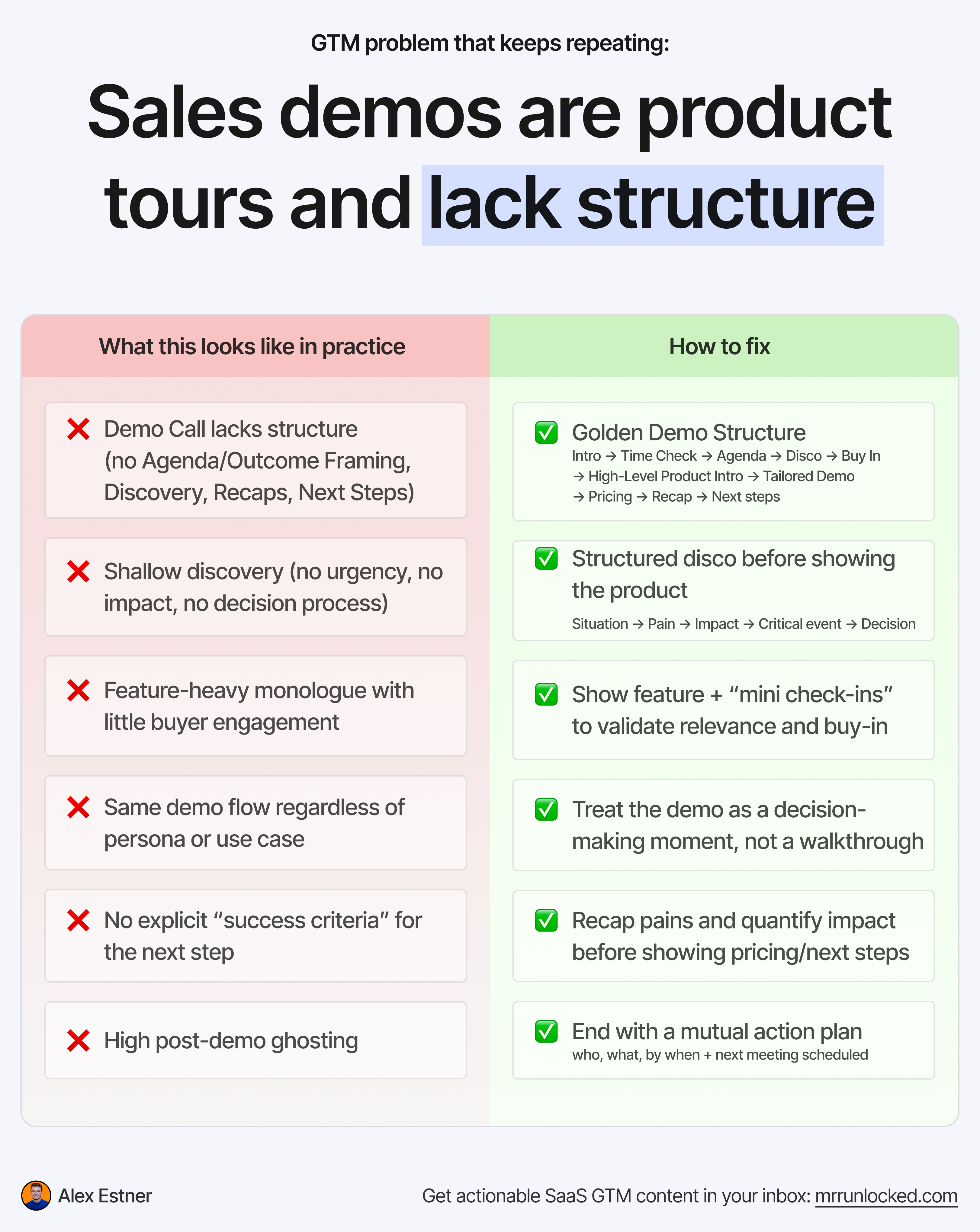
One of the biggest patterns across the reviews:
❌ missing agenda
❌ missing outcome framing
❌ abrupt transitions
❌ rushing the last 5 minutes
❌ no time reserved for next steps
Then suddenly:
“I’ll send you something.”
And this is exactly why I keep repeating:
If you skip steps, you lose control.
If you lose control, you lose deals.
How to fix it
Follow the golden 10-step Demo structure every single time:
Intro
Time Check
Agenda
Discovery
Buy-In Summary
High-level Product Framing
Tailored Demo
Pricing
Recap
Next Steps
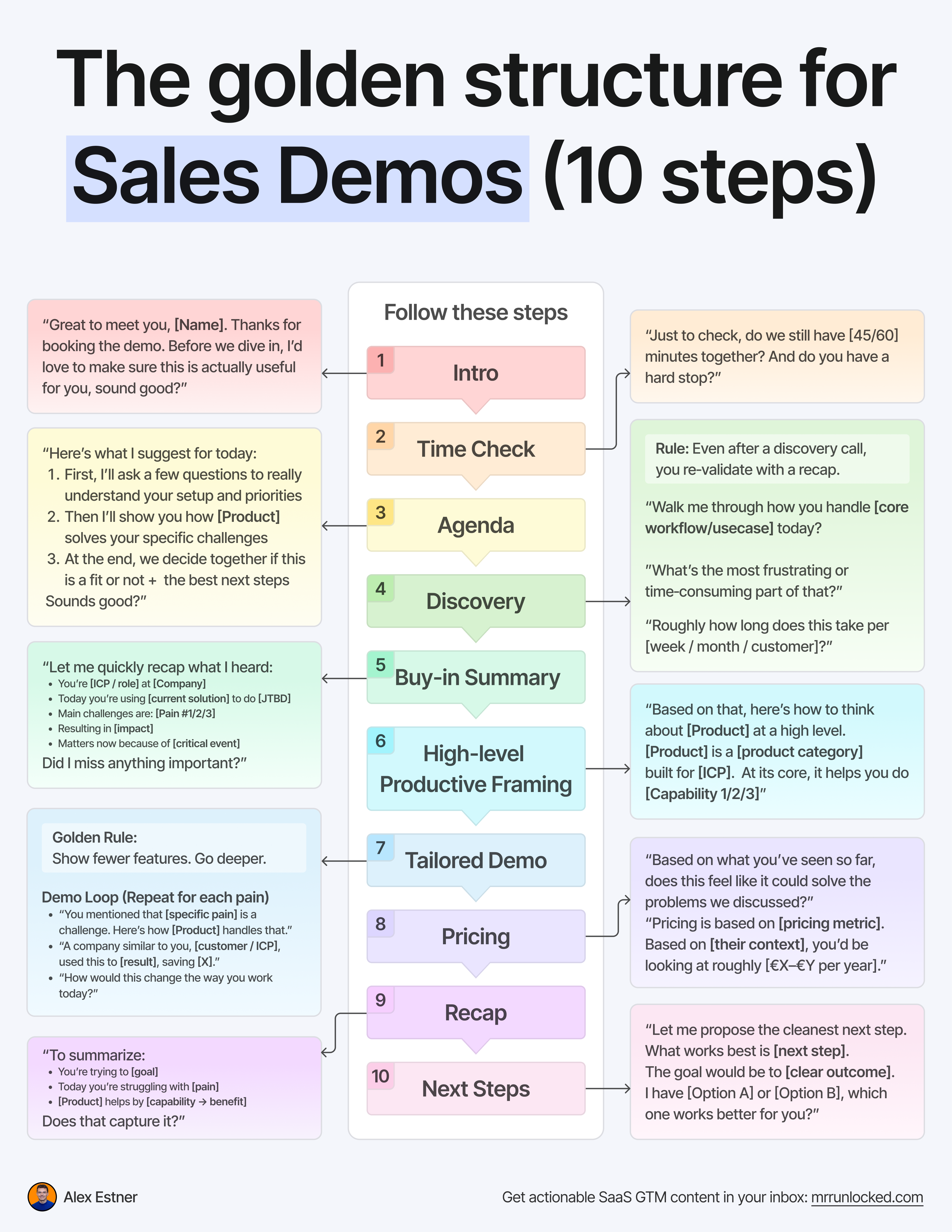
Simple framing example:
“By the end, we’ll know if this is a fit or not — and if yes, what the best next step is.”
A structured demo feels calmer. More professional. More trustworthy.
And ultimately, makes you more confident.
2️⃣ Weak Discovery → Generic Demo
This is probably the biggest mistake I see.
Founders ask 3–4 surface-level questions…
…and then immediately jump into screen share.
The result?
❌ A generic demo that could have been shown to literally anyone.
❌ Less engagement from the buyer (as parts are not relevant to them)
❌ Cognitive overload for the buyer (as they need to translate your product features into how this might fix their problem and fit into their workflow)
And yes, I know you think now:
“Prospects just want to see the product.”
No.
Prospects want relevance. And relevance comes from discovery.
That’s why one of the core rules in my sales demos is:
Discovery creates relevance.
Relevance creates engagement.
Engagement creates momentum.
Across almost all demo reviews, the same discovery gaps were repeated:
❌ no deep understanding of the current workflow
❌ no quantified impact
❌ no urgency (“Why now?”)
❌ no decision process and stakeholder clarity


How to fix it
No pain point? No demo.
Run proper SPICED discovery before demoing anything:
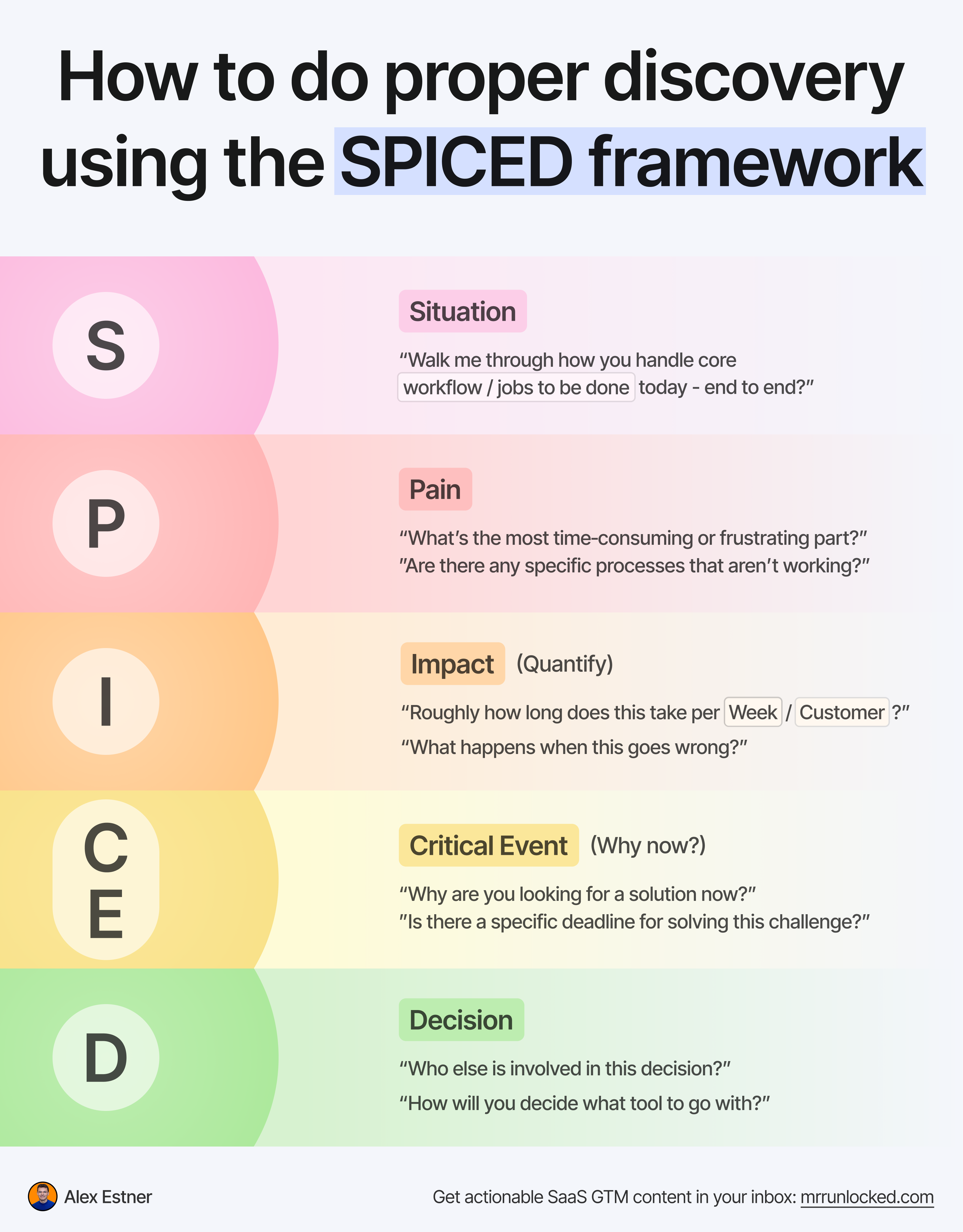
Situation
“Walk me through how you handle [workflow] today — end to end.”
Pain
“What’s the most frustrating or time-consuming part?”
Impact (Quantify)
“How long does this take per week/customer/task..?”
“What happens when this breaks?”
Critical Event
“Why are you looking for a solution now?”
Decision
“Who else is involved in the decision?”
I’m not saying that you need to cover all of these points in the discovery section of the demo, but all points need to be addressed throughout your demo call.
And ‘Situation’ and ‘Pain’ need to be discovered before any product demo.
3️⃣ No Buy-In Summary Before the Demo
This is massively underrated.
As said above, most founders do a ‘discovery’…but never validate whether they actually understood the buyer correctly.
So the prospect stays passive.
And the demo lands weak because the buyer never fully bought into:
the problem
the urgency
or your framing of the situation.
One of the strongest patterns across the coaching reviews:
❌ no summarizing
❌ no validation from the prospect
❌ abrupt shift into demo
How to fix it
Before showing the product, always do a Buy-In Summary.
Summarize:
their current workflow/ current solution
top pains
desired outcome
quantified impact
urgency
Something like:
“Let me quickly recap what I heard, and you tell me if I got this right.
You’re [ICP / role] at [Company]. Today you’re using [current solution / workaround] to do [JTBD].
The main challenges are:
[Pain #1]
[Pain #2]
[Pain #3]
This results in [impact: time, cost, risk, missed opportunity]. And the reason this matters now is [critical event].
Did I miss anything important?”
“If that’s accurate, I’ll show you only the parts that matter for those priorities — and ignore the rest.”
And most importantly: WAIT.
Let them confirm.
This is the transition from: discovery → into demo.
If they don’t confirm, go back to discovery:
“If they don’t agree with your summary → do not demo, instead go back to discovery.”
That’s such an important rule.
4️⃣ Feature Dumping Instead of Tailored Demos
This kills demos all the time.
Founders think:
“The more features I show, the more value they’ll see.”
Usually, the opposite happens. More features ≠ more value.
The buyer gets overwhelmed.
Momentum slows down because they now need to mentally translate:
your features
into their workflow
into their business impact
And most buyers never do that translation themselves.
In more than 65% of the demos I reviewed, the same issues:
❌ broad platform tours
❌ showing 10+ features
❌ no prioritization
❌ no connection to actual pain and current way of working
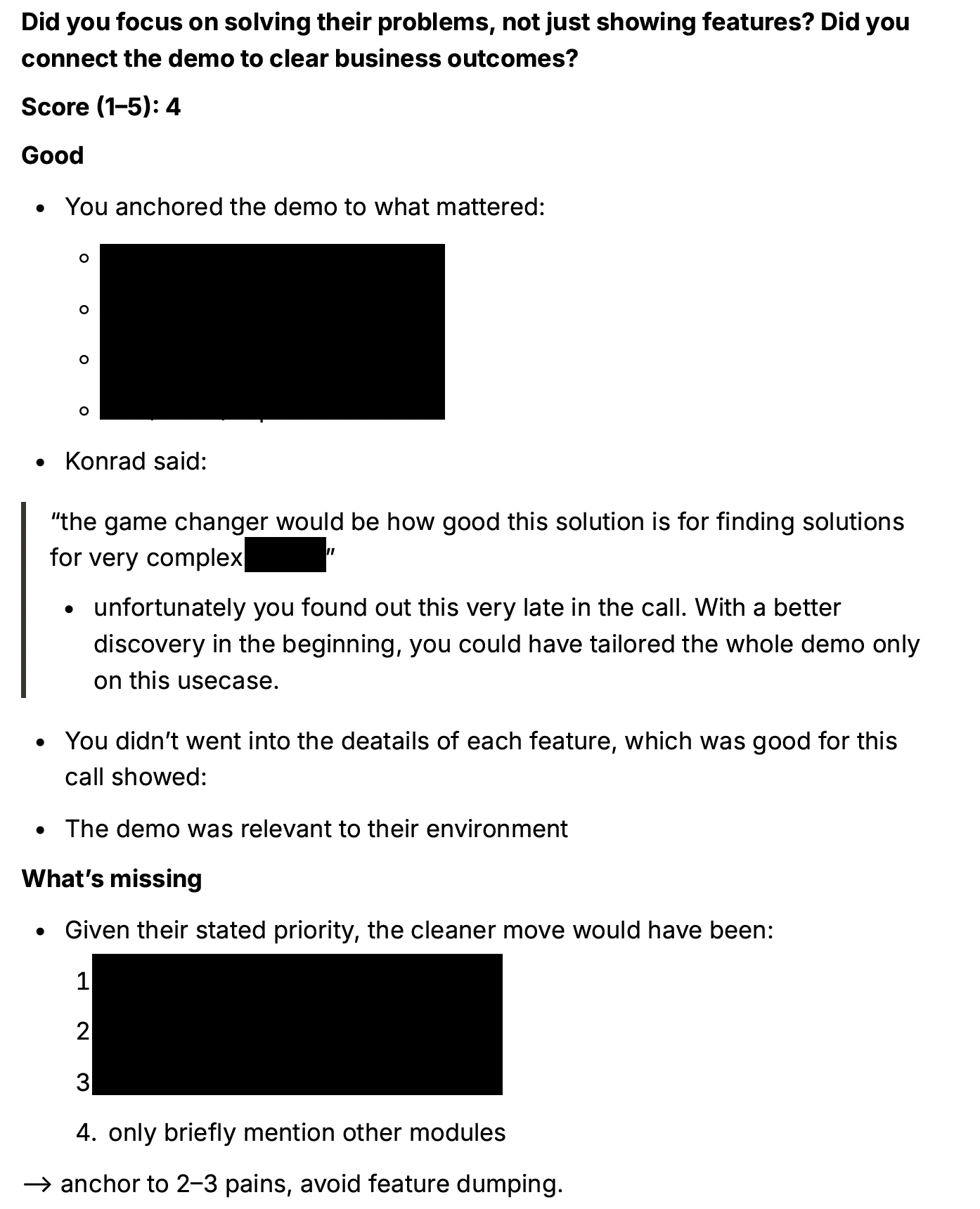
One coaching note summarized it perfectly:
“3 focused workflows would have been stronger than a broad platform tour.”
How to fix it
✅ Show fewer features.
✅ Go deeper.
✅ Connect features with their pain points.

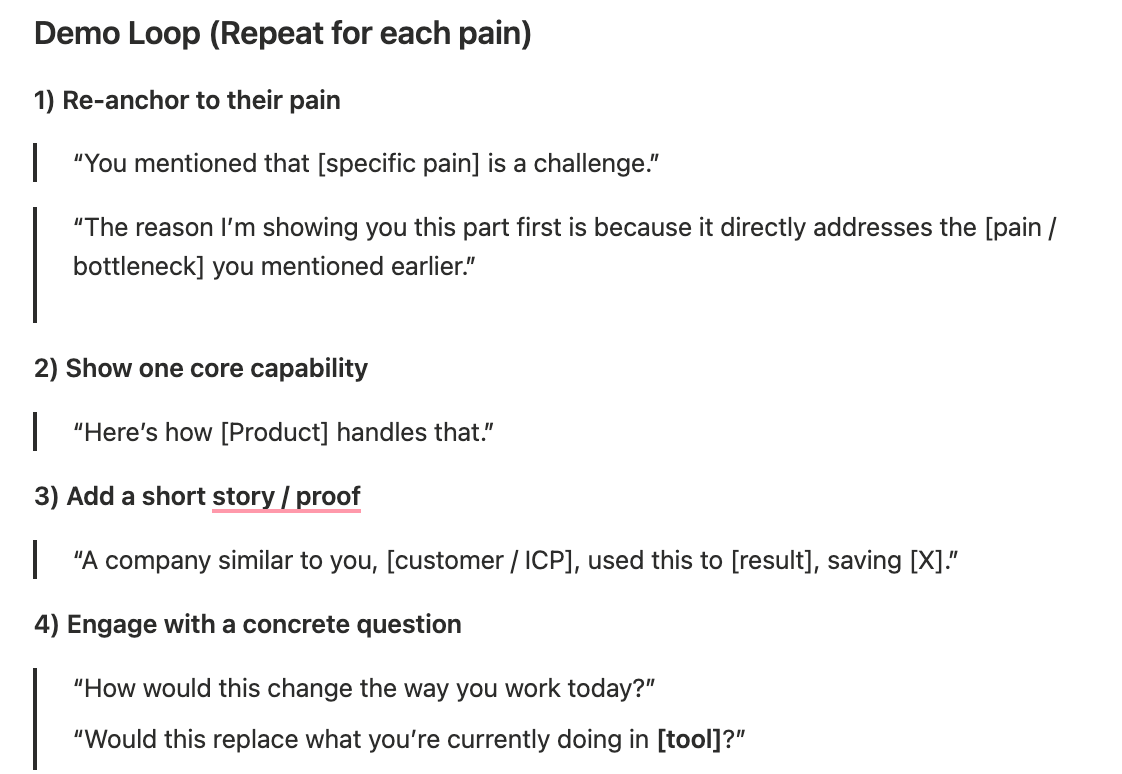
The best demos repeat the same loop:
Re-anchor to their pain
Show one core capability
Share one short customer story
Ask one concrete engagement question
Example:
“You mentioned onboarding of new team members is painful.
Here’s how other HR teams use (productname) to reduce the manual workload, as (productname) automatically creates user accounts for new team members.”
Then ask:
“Would this replace your need to manually keeping track of user accounts in your spreadsheet?”
That’s a tailored demo.
Not a product tour.
5️⃣ Weak Storytelling & No Proof
This one can make your demo 10x better.
Storytelling creates belief.
Buyers don’t buy software just because of features. They need to believe you.
They buy when they believe:
this problem matters
your solution actually works
companies like them succeeded with it
Without proof, demos stay theoretical.
With proof, buyers start imagining themselves succeeding with your product.
Common patterns I see:
❌ no customer story
❌ no proof point
❌ no before vs after
❌ no quantified outcome
❌ not connected to the actual workflow/data of the customer
How to fix it
The best demos use short customer stories throughout the demo.
I believe there are a few ways you can use:
✅ Take their real data/workflow
“Let’s quickly take your set-up, so you can imagine how [feature] would work for you”
So instead of a generic demo, use their reality.
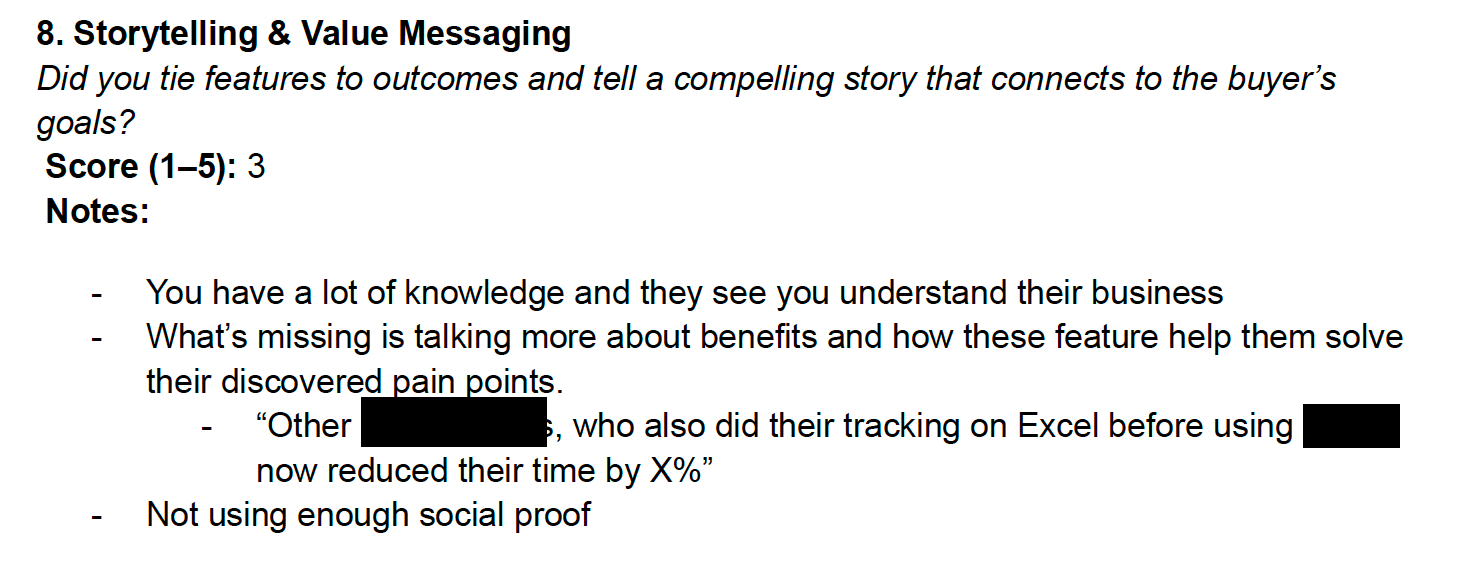
✅ Use customer stories
“A company similar to you, [customer / ICP], used this to [result], saving [X].”
Or:
“We have a few other [customer types] with also [attributes] who now run their [core workflow] with [your product], and they mainly value X”
✅ Compare to the current way
“Okay, imagine you’re doing your [workflow/task/job to be done], so instead of now doing with [current way of working], you can [better way with your product]”

Or:
“A lot of teams switched from [competitor tool] to [your product] because they ...”
✅ Reference something they mentioned earlier
“You mentioned earlier that [person X] struggles with [pain point]. This feature will enable you to finally have a single source for your KPIs — something your [specific people/team members] can all trust.”
It’s social proof. It’s trust. It will help you close deals.
P.S. Use your existing customers proactively throughout the sales process:
During the demo (see above)
added as case studies in the follow-up email
optional: offer prospects a talk with your existing customers
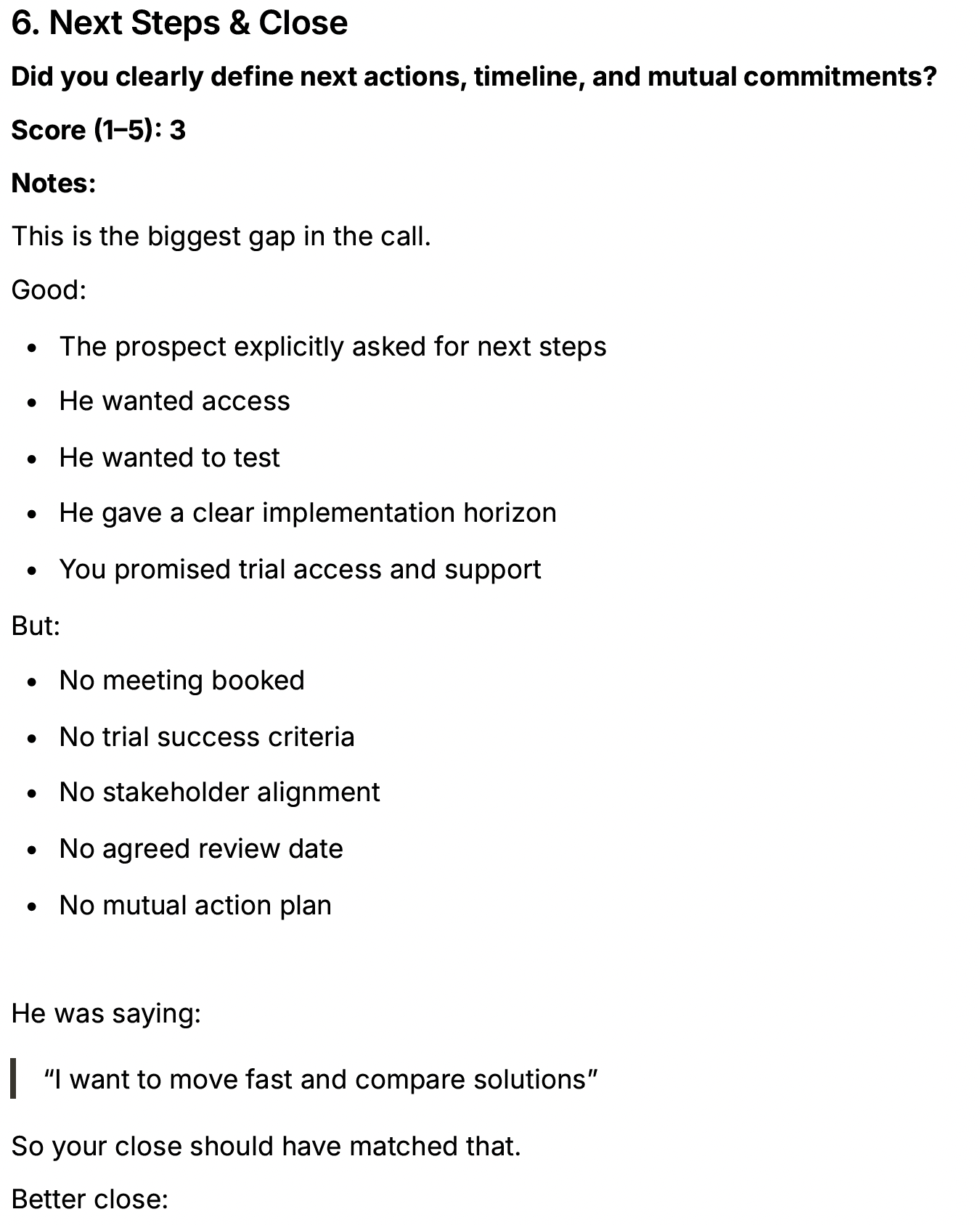
6️⃣ Passive Closing → Dead Pipeline
This is another huge pattern I see when reviewing sales demos.
Founders end demos with:
“Happy to send a trial.”
“Okay talk internally and then send me an email about next steps.”
“I’ll send some information later via email.”
That way, you lose control of the next steps.
❌ No calendar invites.
❌ Waiting for the buyer to “get back to us.”
❌ No mutual action plan / suggested next steps
How to fix it
Own the next step.
Your job is to guide them throughout the process.
Remember, you sell your product every day. You know what’s the best way to evaluate your product.
So guide them.
✅ Important: The next steps always need to be mutually agreed upon.
Based on their current situation, urgency, and decision process, you suggest the next best step. These can be steps like:
14-day free trial starting next Monday
product deep dive with XY team
Technical deep dive
business case/pricing review call
Onboarding Kick Off
Then you need to get their buy-in for this.
Say something like:
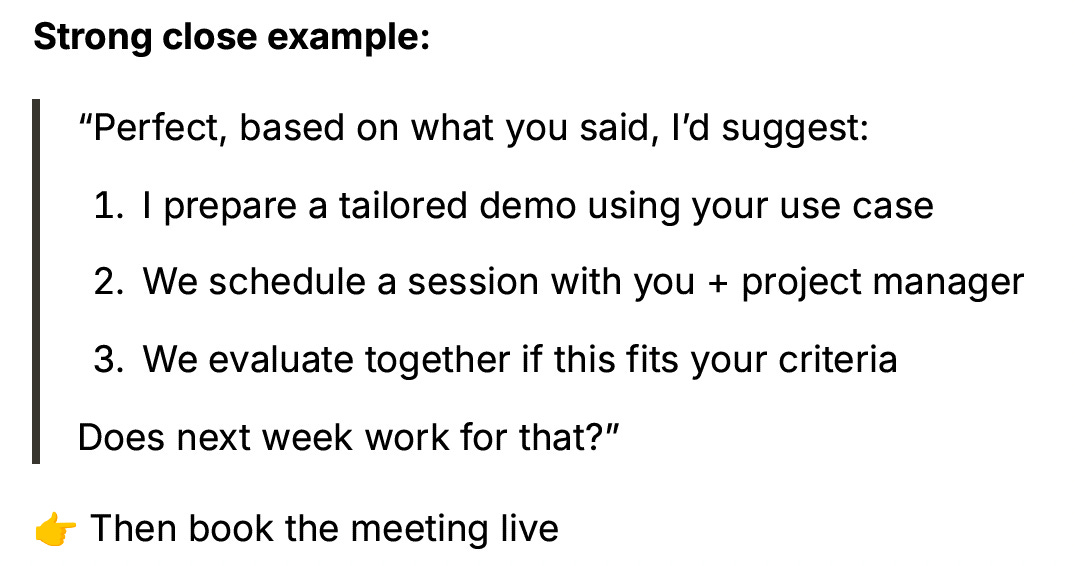
“Before we wrap up, let me propose the cleanest next step.
Based on deals like yours, what works best is [next step — e.g. technical deep dive / stakeholder call / pilot].
The goal would be to [clear outcome].
I have [Option A] or [Option B] — which works better?”
Every single demo should end with:
✅ a clear recommendation
✅ a calendar invite
✅ defined stakeholders
✅ timeline
✅ success criteria
One of my favorite recommendations:
“Every demo ends with a calendar invite.”
Additional relevant content
👉 Meeting Note Taker Templates for Discovery and Demo Call (applying SPICED)
👉 Email Templates for Demo Call Follow Ups
Final Thought
After reviewing 100+ demos over the last few years, I think great demos are mostly about:
✅ structure
✅ relevance
✅ engagement
✅ belief
✅ momentum
The best founders don’t present software.
They guide buying decisions.
And the founders who create the most buying momentum…
usually win the deal.
See you in 2 weeks.
3 ways I help founders build a strong GTM foundation 👇
1️⃣ Free GTM Foundation Library
→ 50+ resources (guides, templates, frameworks)
2️⃣ GTM Audit
→ 360° assessment + 6-month action plan: Your GTM Blindspots revealed
3️⃣ 1:1 GTM Advisory
→ Work directly with me to build your GTM