


Hey - it’s Alex,
I’ve noticed something across most early-stage teams:
They don’t fail because of GTM tactics.
They fail because their GTM doesn’t match their stage.
So they:
hire sales too early
test 5 channels at once
constantly change their messaging
…and nothing compounds.
Not because GTM doesn’t work.
But because they’re solving the wrong problem.
What I’ve learned:
Before you think about how to grow,
you need to understand where you are in GTM
Because what works in one stage will break you in another.
You can not apply the same GTM playbook to completely different stages.
In case you missed the last 3 episodes:
✅ The Ultimate Partnership Guide for Founders
✅ 17 must-have questions about your GTM
✅ The Ultimate SaaS Positioning Guide
A quick word from our sponsor
I only include sponsors that I would recommend personally. If you’re interested in reaching 28,000+ SaaS operators, sponsor the next newsletter.
📢 lemlist — The outbound platform that books meetings, not bounces

lemlist is the multichannel outbound platform built for sales teams who need real pipeline, not just activity metrics.
Connect intent signals, personalize at scale, and send sequences that actually get replies.
Build email + LinkedIn sequences in minutes, with AI that sounds like you.
Trigger outreach based on timing signals, not guesswork
Track every reply, click, and booked call in one dashboard
Want to make your direct motion work before you try to scale it?
📢 Attio — the AI-native CRM for GTM

Attio is the AI-native CRM with built-in enrichment, flexible workflows, and fast setup. Connect your email and calendar, and Attio instantly builds your CRM.
Their new “Ask Attio” agent changes how you run your CRM: Prep for calls in seconds, update fields automatically, get deal summaries with one click
Let’s get into it. 👇👇
The Foundation (Why Most GTM Breaks Early)
Before we talk about stages, there’s one thing most teams get wrong.
They treat GTM like separate pieces:
ICP
Messaging
But in reality:
These are a chain of decisions
Your ICP defines what problem matters
That problem defines your positioning
That positioning defines your messaging
Make this actionable:
ICP (who actually buys):
Pick one narrow segment (not multiple)
Define the trigger (why do they buy now?)
Use real customers, not assumptions (unless you’re pre-revenue)
When you build your ICP, include 4 key elements:
—> The ideal company (3-5 firmographics, technographic criteria)
—> The ideal personas (economic buyer + users/champion)
—> The intent signal/ buying triggers
—> The Anti ICP (3-5 disqualifiers)
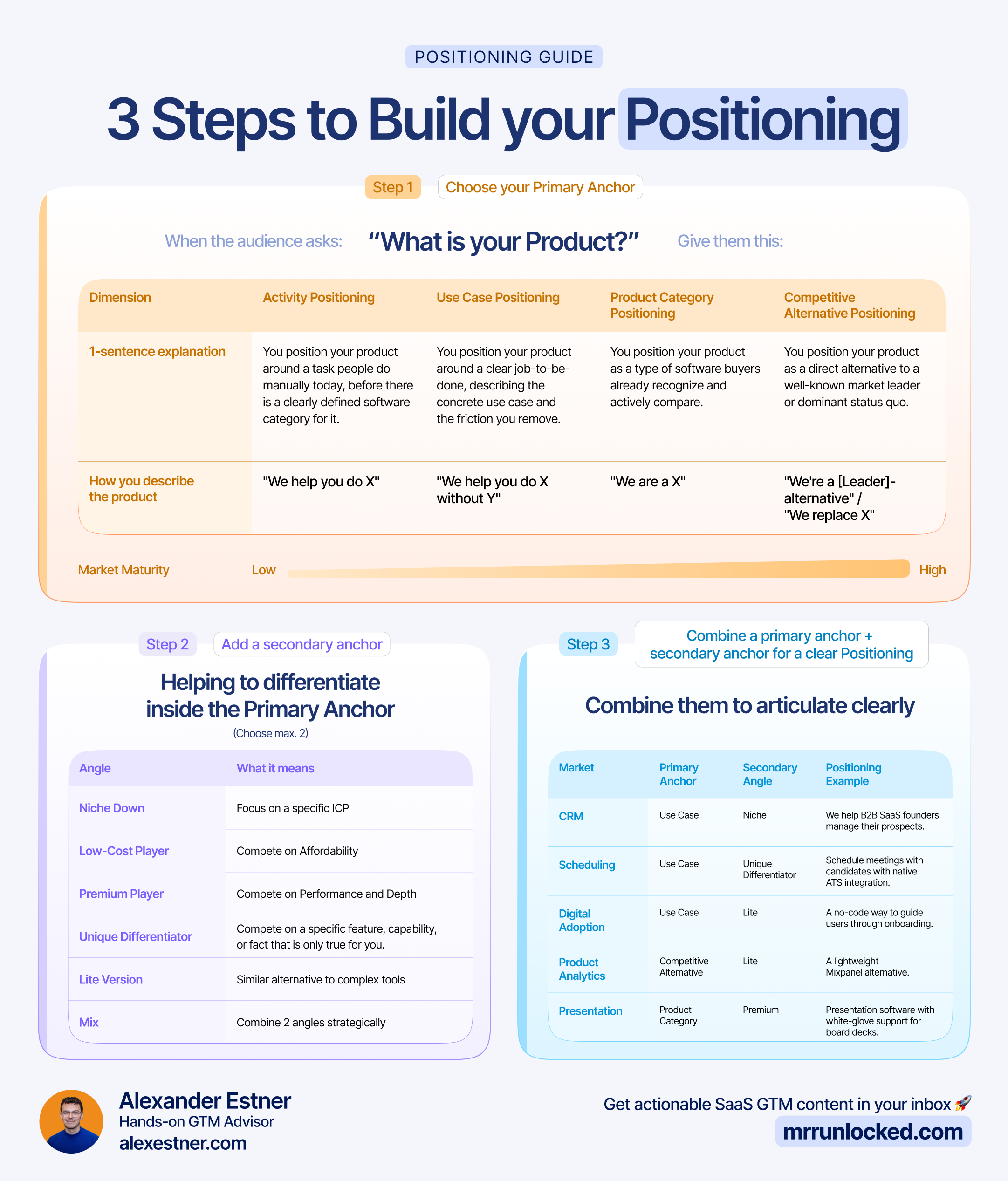
Positioning (why you for them):
What you are: Anchor around one use case, product category, or competitor
How are you different
Make it obvious in <5 seconds (1-sentence positioning statement)
Messaging (how you communicate it):
Focus on clarity —> don’t try to sound super clever
Use the language of your customers
Focus on one core outcome/usecase; don’t communicate everything at once
Repeat the same message everywhere (website, calls, emails, content…)
So let’s do a quick reality check:
You don’t have a GTM foundation yet, if:
You don’t know your ICP, or you're still testing multiple ones
You’re unclear about your positioning, meaning you can’t explain in an easy, short sentence what you are + who you are for + why you are better/different
Your messaging is inconsistent, meaning you see yourself using different words (in your copy, sales calls, content…)
The Stage-Based GTM Playbook
Now the part most founders skip:
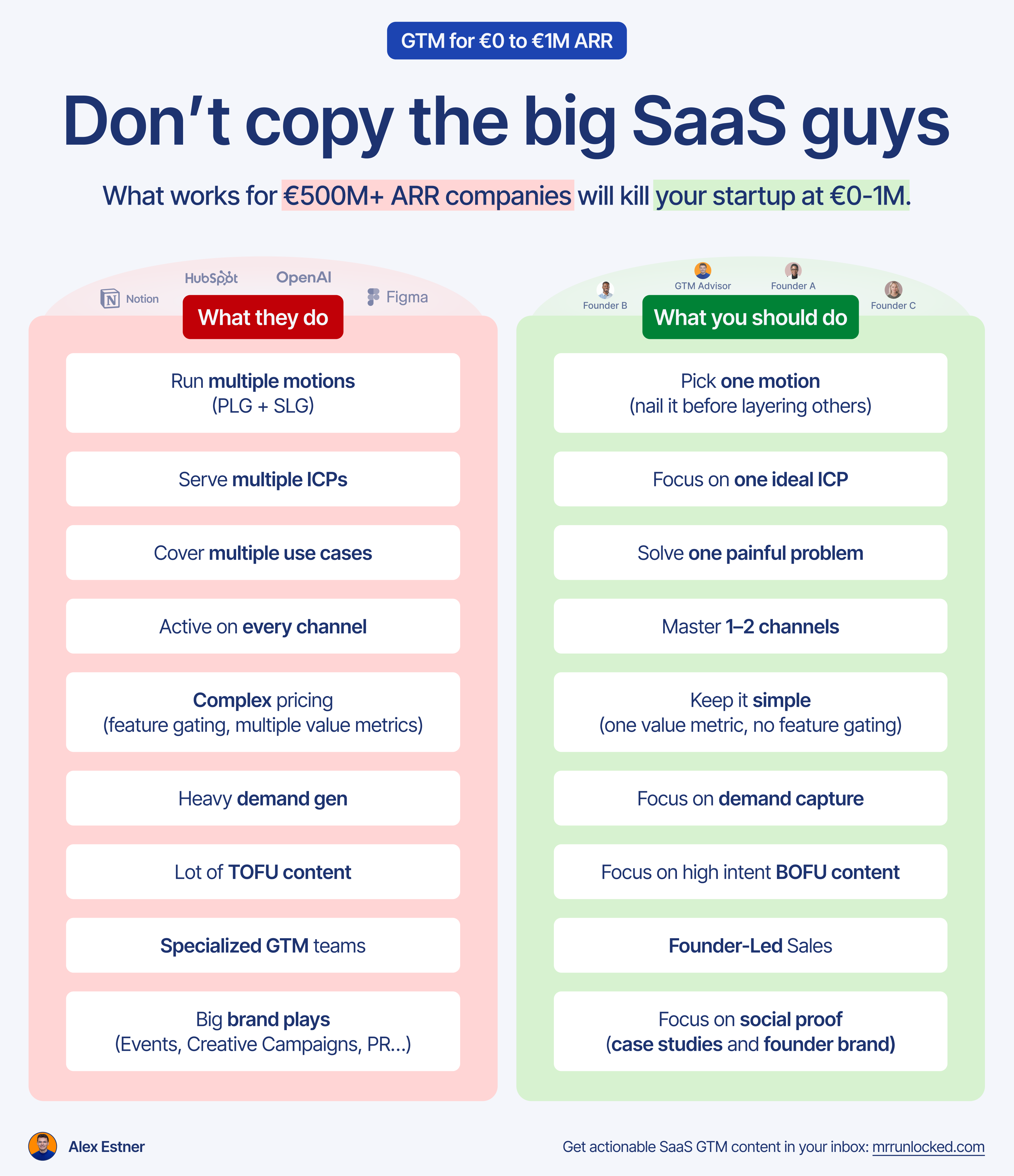
GTM only works if it matches your stage
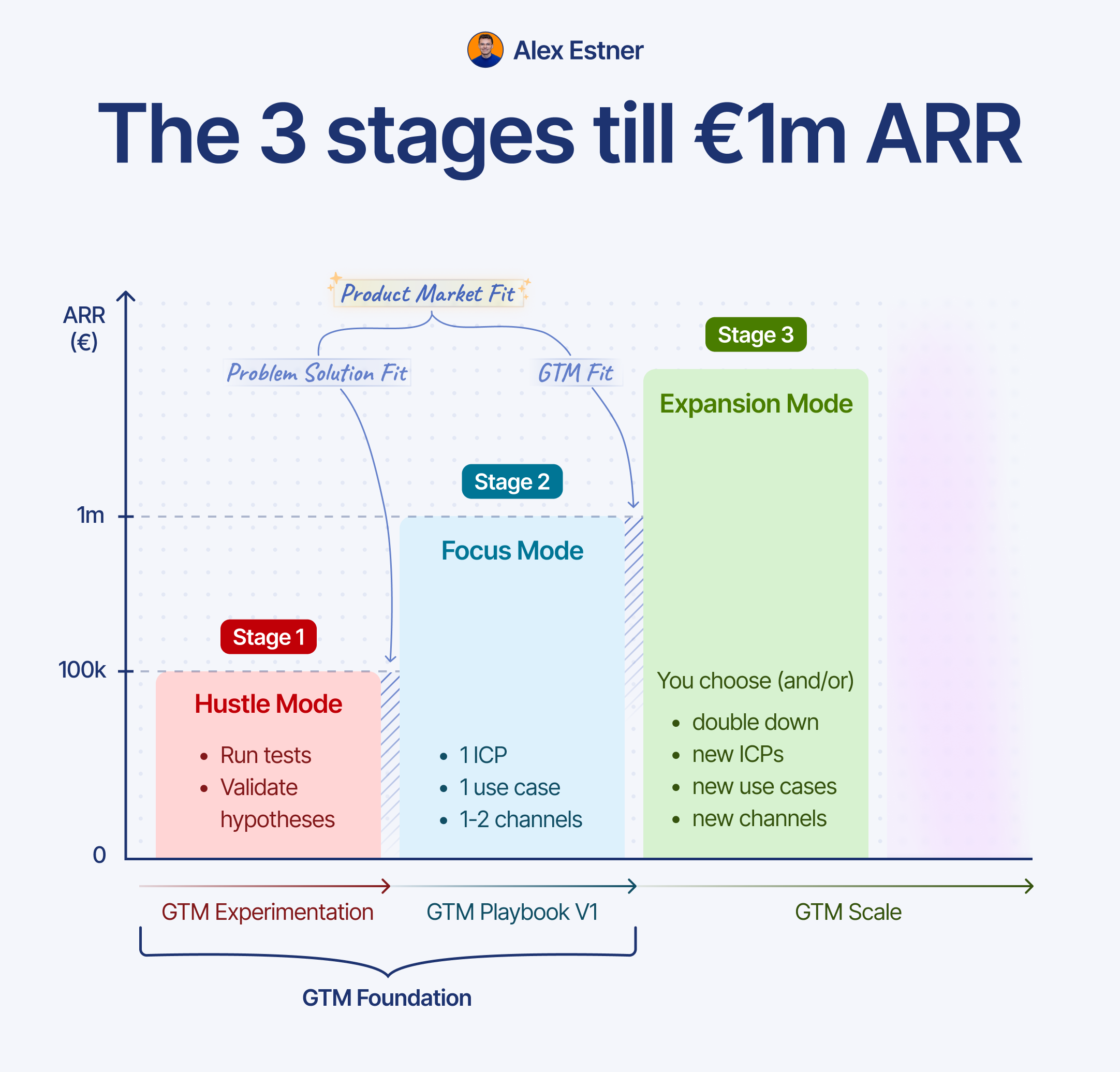
1️⃣ Stage 1: Hustle (0 → ~€100k ARR)
Goal: Find something that works
How to recognize you’re here
ICP is still unclear
Messaging feels inconsistent
Deals are unpredictable
Growth feels random
👉 You don’t have GTM foundation yet; you’re searching for it.
What actually matters
Talk to customers every week
Nothing beats real customer feedback.
This can include cold calls, sales demos, or interviews with lost deals and churns.
Test ICP + messaging in real conversations
You’re still testing, so use the touchpoints you have to see how your messaging resonates with your (future) ICP. Don’t just think internally about it, test it in the trenches: calls, demos, outbound, content are your friend.
Sell manually (founder-led)
You’re the founder. You own GTM.
Don’t outsource selling to an agency, intern, or consultant.
You need direct feedback loops.
Look for pull signals
Once the first customers come in, look for pull signals. Where do you see that things move faster/easier, and what segments are harder to close?
—> fast conversions, repeated patterns, low friction
What “good” looks like
✅ You hear the same problem repeatedly
✅ Prospects understand your value quickly
✅ Some deals feel surprisingly easy to close
Biggest mistakes
❌ Scaling too early (paid channels, hiring sales)
❌ Jumping between ICPs too fast (before getting enough validation)
❌ Overthinking positioning instead of testing it
❌ Avoiding real customer conversations (and just building the product)
👉 If things feel inconsistent: You’re still in Stage 1.
2️⃣ Stage 2: Focus (→ €1M ARR)
Goal: Make GTM predictable
How to recognize you’re here
You found an ICP that converts
Messaging resonates across multiple prospects
Deals close, but not consistently yet
You see traction in 1–2 channels
👉 Something works: now make it repeatable
What actually matters
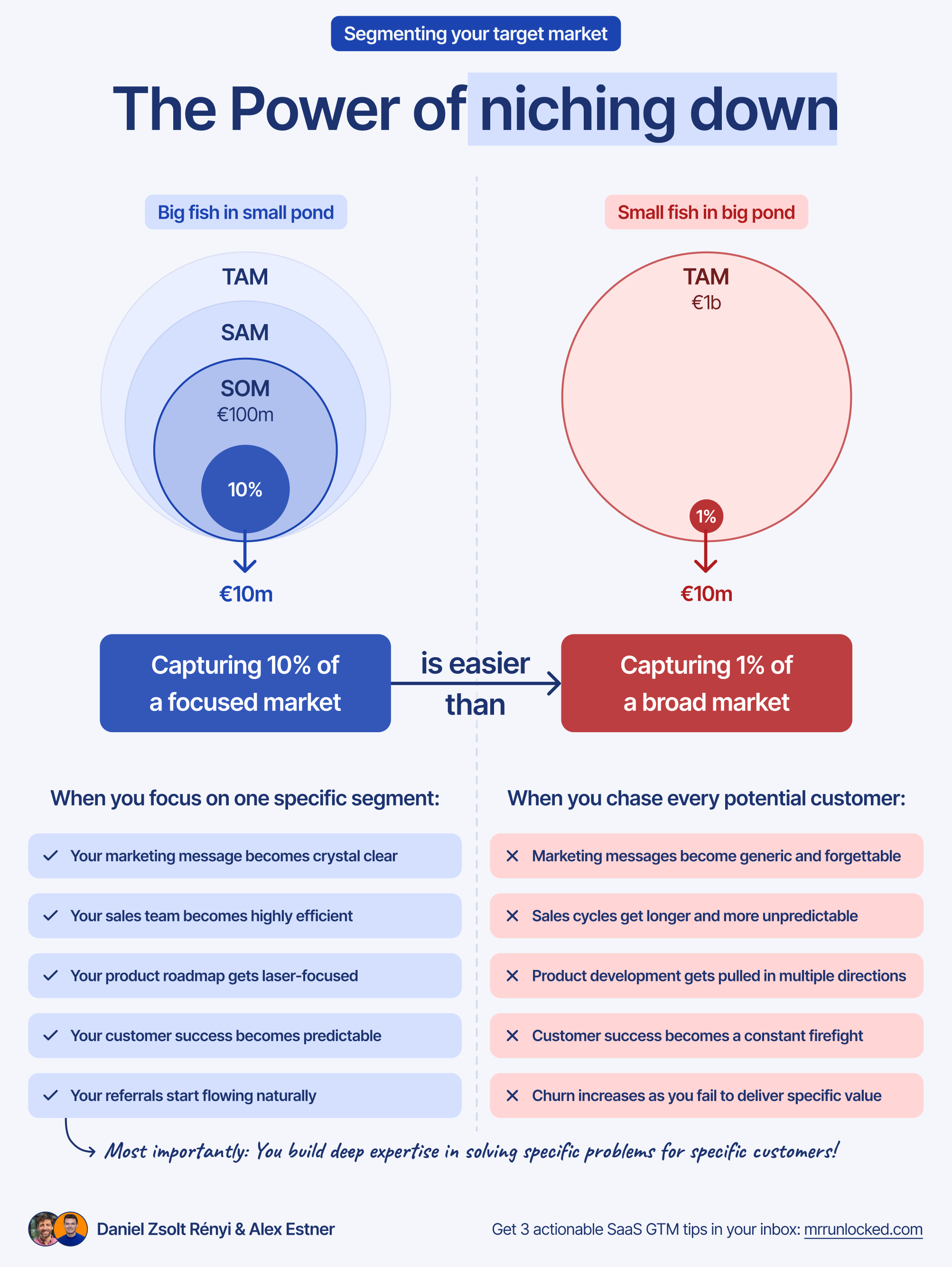
Lock 1 ICP + 1 use case
This is the hardest part. You likely have customers across different segments and use cases.
That’s fine for the hustle phase, but very hard to scale.
So your job is now to niche down and say no to everything else.
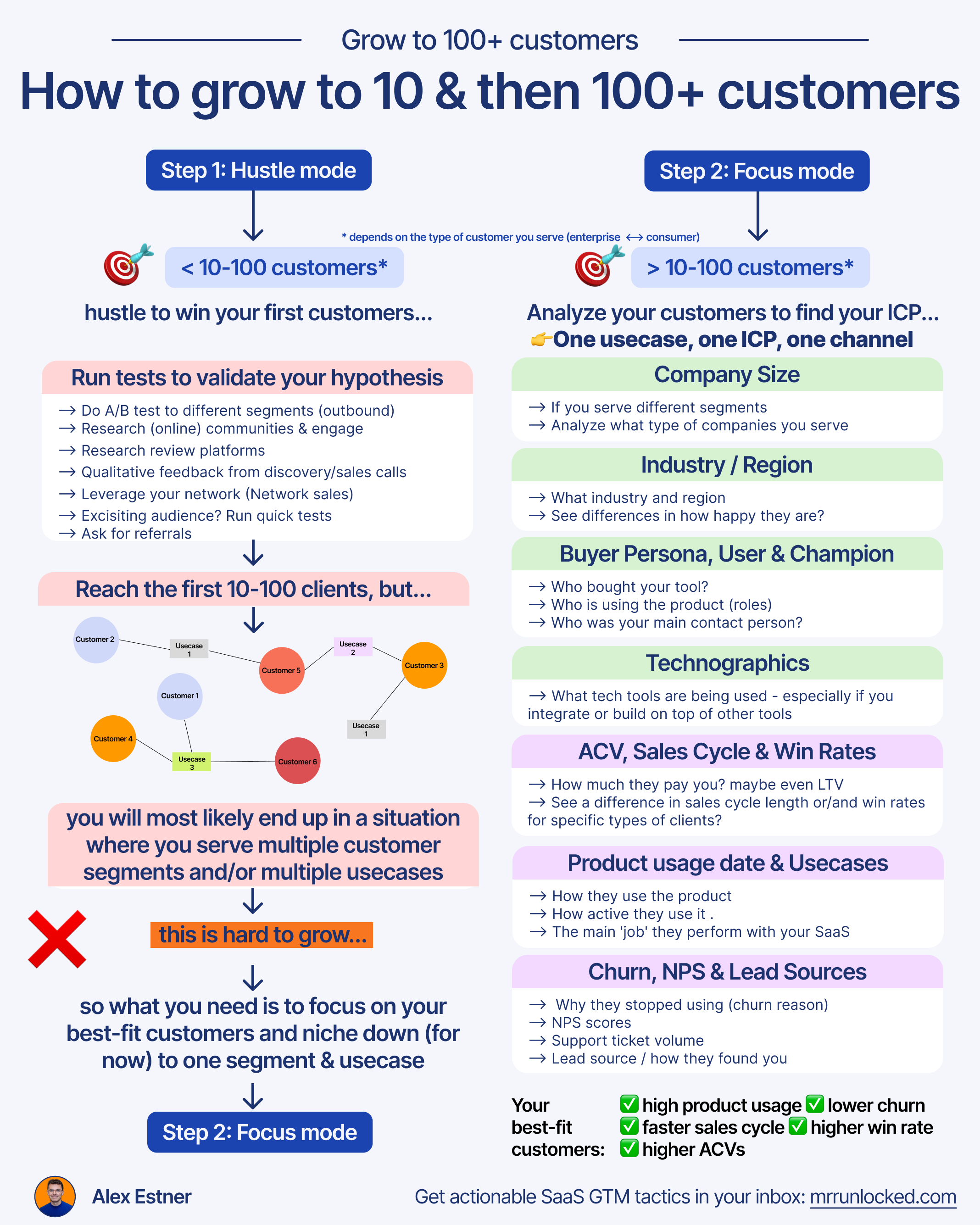
Double down on 1–2 channels max
You’re early; this usually means limited resources. To grow to the first million, you have a higher chance of mastering 1-2 channels (where you already see traction), instead of running multiple channels at the same time.
Build a repeatable sales process
Until now, the founder has handled all sales. So there was no ‘need’ to systemize.
But the next step is to become predictable and build your repeatable playbook.
This means you need to build your first playbook.
—> Same steps in the sales process (e.g., disco —> demo —> pilot —> won)
—> Deal stages in your CRM
—> Tracking conversion rates
—> Analyze lost reasons
—> Draft email templates per stage
—> Collaterals across the full funnel (pricing, case studies, ROI calculations…)
The goal: Find something that is repeatable and that you can teach your first sales hires.
Systemize your messaging
Sounds simple. But too often, when I’m doing my GTM audits, I see that the internal messaging framework (living in Notion or Miro) and the actual customer-facing messaging on their website, outbound, sales demos, blog, and LinkedIn content are completely different. Also, each asset tells a different story.
→ Your job: Create messaging alignment
What “good” looks like
✅ Pipeline becomes predictable
✅ Deals follow similar paths
✅ Customer understand your Positioning
✅ Messaging consistently converts
Biggest mistakes
❌ Adding new channels too early
❌ Expanding ICP (“we can also sell to…”) too early
❌ Constantly changing messaging
❌ Flying blind: Not tracking key metrics
👉 This is where I see most early-stage startups struggle.
Because success here comes from: Focus, not more ideas
Get your GTM Blind Spots revealed: Get a 360° assessment of your current GTM strategy plus a custom 6-month action plan all within 7 days - so you can act with confidence, not guesswork.
3️⃣ Stage 3: Expansion (Post €1M ARR)
Goal: Scale what works
How to recognize you’re here
You can predict pipeline from activity
Messaging consistently converts
Sales is repeatable
You know your numbers and can plan properly
You can ‘teach’ someone else how your ‘playbook’ works
👉 You now have a system. Something you can ‘scale’.
What actually matters
Scale proven channels aggressively
This means more budget, more people, more volume.
Add new channels (if needed)
In case your existing channels are not enough, you can now test new channels on top.
GTM motions
It might also be the right time to add a secondary motion (for instance: partnerships, product-led growth, or outbound/inbound)
Build specialized teams
You now outgrow founder-led sales. So you bring in the first specialized roles in your GTM team.
Protect your core positioning
Don’t make the mistake of changing your core positioning. Just because you hit the 1€ million ARR, doesn’t mean you can now play the same game as the big guys. Keep your positioning advantage.
Option to expand horizontally (new ICP) or vertically (new use cases)
It’s also the time when you could think of expanding into adjacent segments or use cases. Important: You can, but definitely don’t need to.
What “good” looks like
✅ Growth becomes predictable
✅ Your GTM still works/is healthy (even though you added more resources)
✅ Expansion feels like an extension, not something completely new
Biggest mistakes
❌ Scaling too early (with a broken GTM foundation)
❌ Adding too much complexity at once
❌ Losing clarity in positioning
❌ Forgetting your initial wedge
Final Takeaway
GTM foundation work is not about doing more.
It’s about doing the right things at the right stage:
Stage 1 → Find what works
Stage 2 → Make it repeatable
Stage 3 → Scale it
And all of it sits on:
ICP
Positioning
Messaging
Get that wrong → nothing works
Get that right → everything compounds
Okay, that’s it for today.
See you in 2 weeks.
The Ultimate Positioning Guide + Worksheet

3 ways I help founders build a strong GTM foundation 👇
If you’re somewhere between €0 → €1M ARR, I can help you with your GTM.
1️⃣ Free GTM Foundation Library
→ 50+ resources (guides, templates, frameworks)
2️⃣ GTM Audit
→ 360° assessment + 6-month action plan: Your GTM Blindspots revealed
3️⃣ 1:1 GTM Advisory
→ Work directly with me to build your GTM
Thanks! Very well written and incredibly insightful! Will share this with my network to support!
Love the phrase
“You are the FOUNDER, you own the GTM”