


Hey - it’s Alex!
A lot of founders tell me they have a go-to-market strategy.
But when we start working together, and I ask a few simple questions… things often get blurry.
So here’s a quick test.
If you’re building a SaaS/AI company from €0 → €1M ARR (and beyond), you should be able to answer these 17 questions clearly.
So today you have to do the work, not me :)
In case you missed the last 3 episodes:
✅ The Ultimate SaaS Positioning Guide
✅ 10 Quick GTM Fixes you can ship this week
✅ Homepage Teardown: What 6 Top SaaS Companies get Right (and Wrong)
A quick word from our sponsor
📢 Attio — Your CRM wasn’t built for how fast you need to move

Attio is the AI CRM that flexes with your GTM strategy, not the other way around. Connect your email and calendar, and Attio instantly builds your CRM.
Then Ask Attio anything:
Ask “What’s the latest on this deal?” and get comprehensive answers with suggested next steps
Prep for calls in seconds, with context from across your entire business
Keep your pipeline up to date automatically
Ready to move faster?
👉 Reach 30,000+ SaaS operators with sponsored content.
Let’s get into it. 👇👇
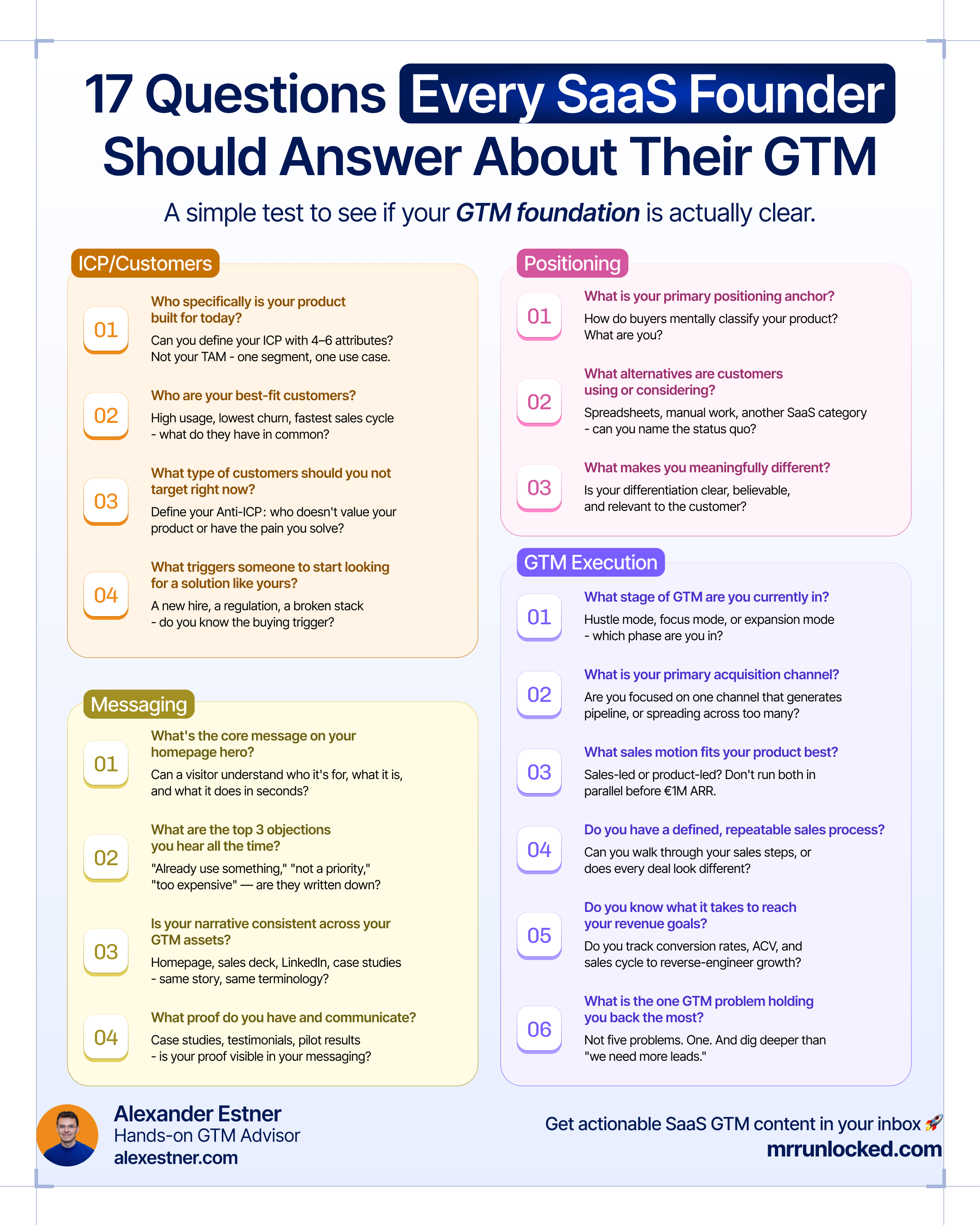
Customers & ICP
1. Who specifically is your product built for today?
Not your TAM.
Your actual Ideal Customer Profile.
Can you clearly define your ICP with 4-6 attributes?
Firmographics,
Technographics,
Persona-specific attributes
In the early stages, you usually need to focus on one segment and one use case to reach product-market fit.
👉 If you struggle here, check out my ICP Framework
2. Who are your best-fit customers?
Look at your current customers and ask:
Who has the highest usage?
Who churns the least?
Who has the fastest sales cycle?
These are signals of your best-fit customers.
What do they all have in common?
👉 If you're unsure, analyze your customers to find your best-fit customers.
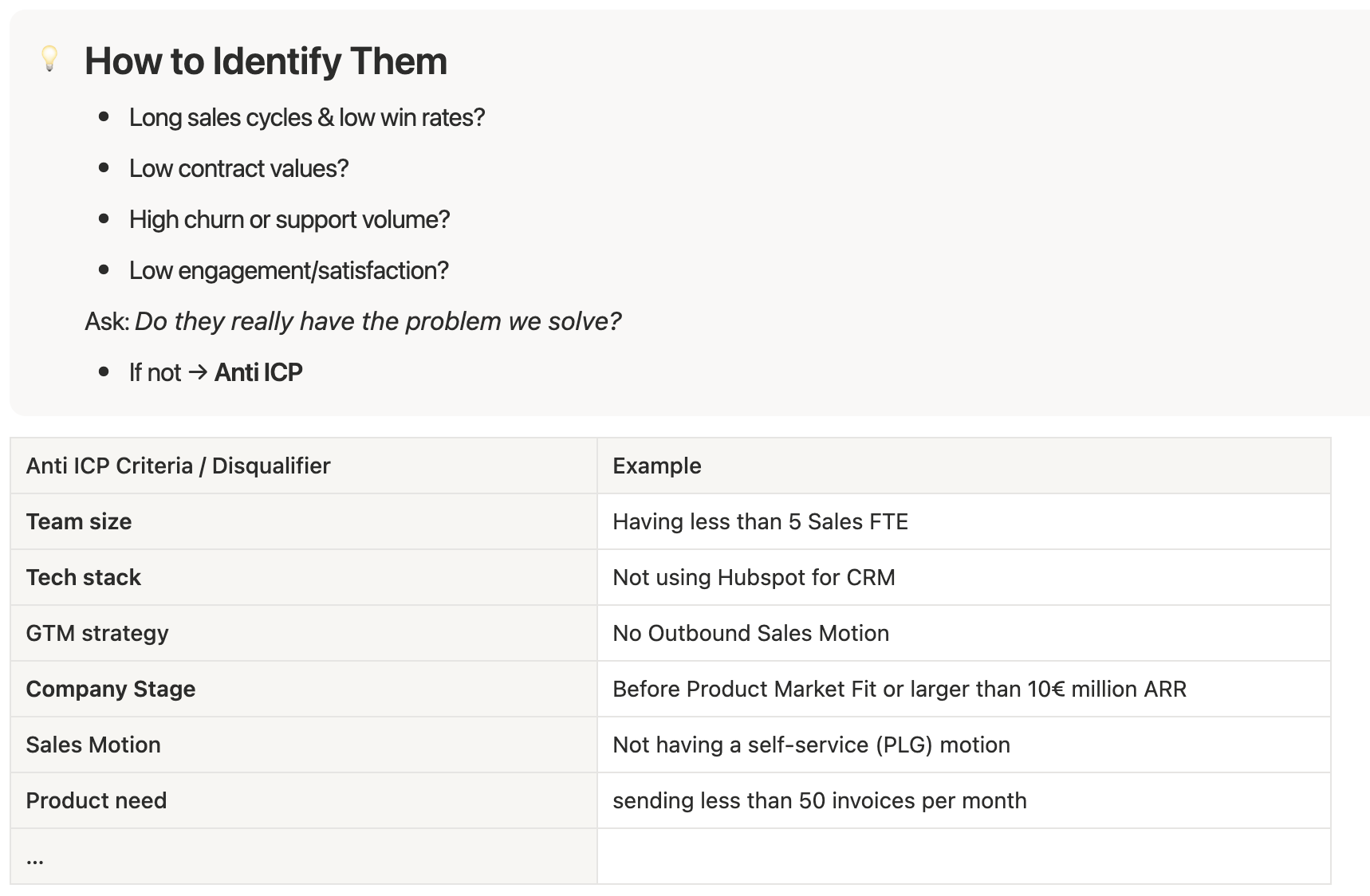
3. What type of customers should you not target right now?
Many early-stage founders try to serve too many segments.
But GTM only becomes repeatable when you narrow your focus.
So define your ANTI-ICP.
Your Anti-ICP represents companies or personas you should not target because they:
Don’t value your product
Don’t have the pain you solve
Don’t fit strategically
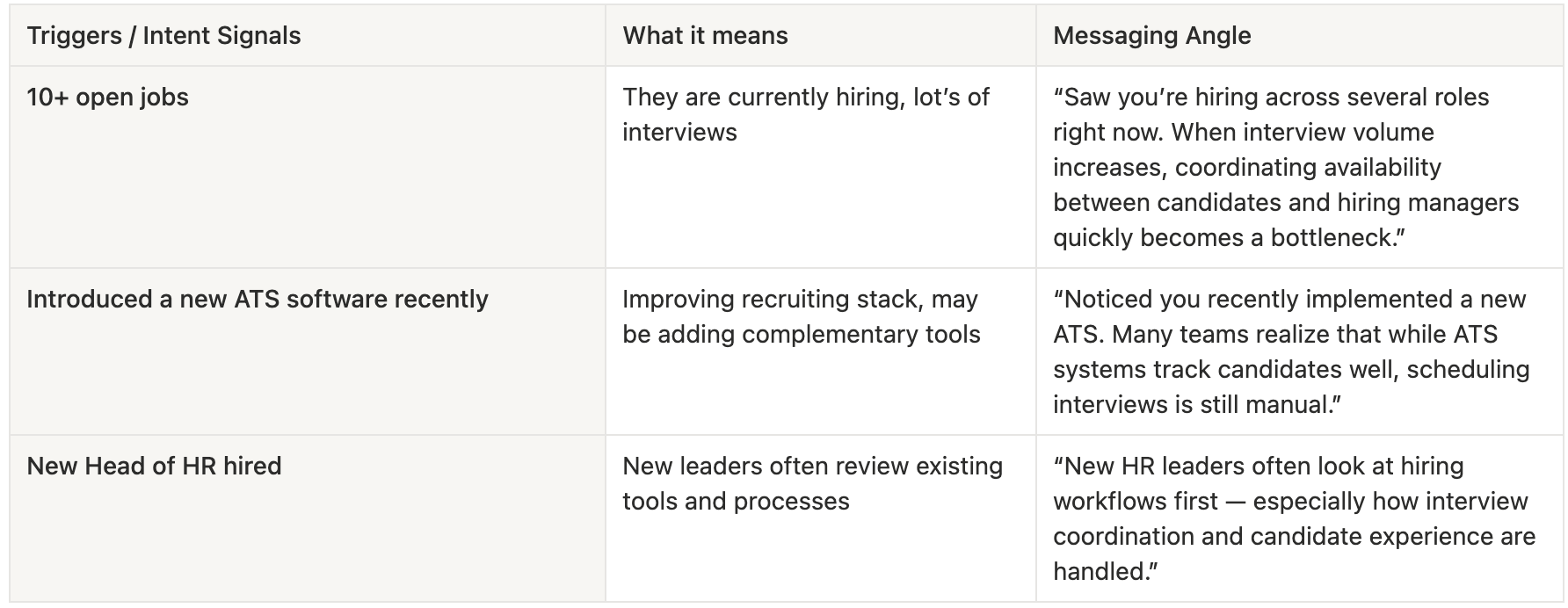
4. What triggers someone to start looking for a solution like yours?
Buying triggers (or intent signals) are events or behaviors that show a company or persona is more likely to buy now.
It’s a sign/proxy that they are currently experiencing the pain you solve, and might actively be looking for a solution.
Every purchase has a trigger:
A new hire
A new regulation
A painful current tech stack
Understanding this moment is critical for messaging and demand generation.
Positioning
5. What is your primary positioning anchor?
Your primary positioning anchor defines what you are.
It helps buyers quickly mentally classify your product.

👉 If you struggle with your positioning, use my new Positioning Guide.
6. What alternatives are customers using/considering?
Every product replaces something. That’s the dominant status quo.
Usually it’s one of these:
spreadsheets
internal tools / patching together multiple tools
doing it manually
another SaaS product
If you can’t clearly name the alternative, positioning becomes very difficult.

7. What makes you meaningfully different?
Once you know your alternatives, you need to explain why your product is better for a specific use case / how you’re different.
Your differentiation needs to be:
clear
believable
relevant to the customer

Messaging
8. What’s the core message on your homepage hero?
Within a few seconds, a visitor should understand:
Who the product is for (ICP)
What is it (Product Category or use case)
What the product does (Capabilities)
👉 If you struggle with your homepage messaging, check out: SaaS Homepage Template and Homepage Teardowns
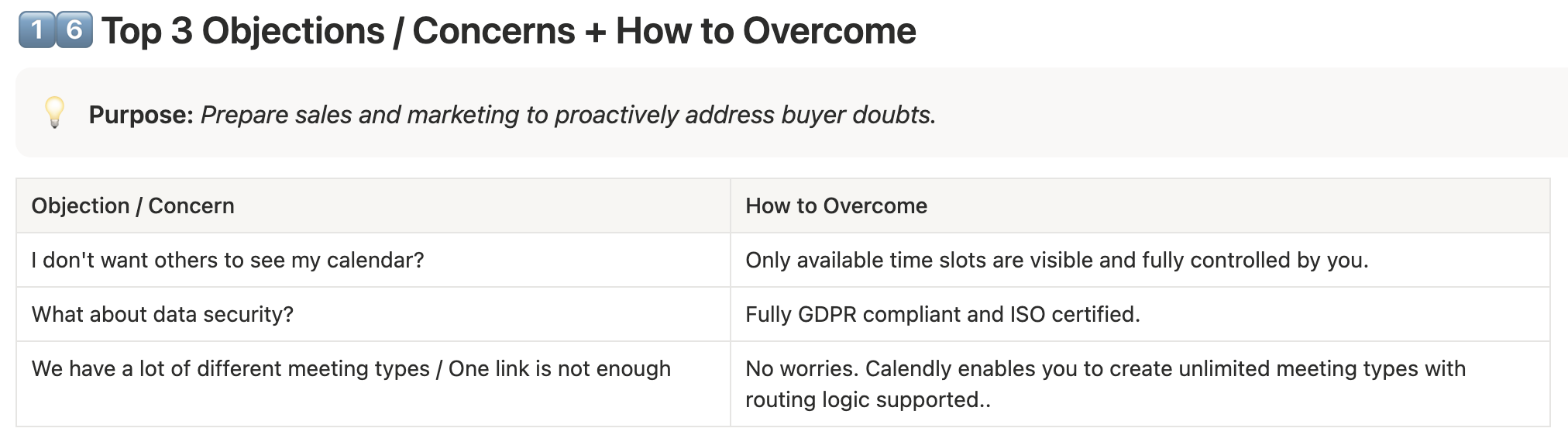
9. What are the top 3 objections you hear all the time?
Most early-stage SaaS hear the same few objections:
“We already use something else”
“Not a priority right now”
“Too expensive”
Great messaging addresses these objections upfront.
Do you have them written down somewhere?
10. Is your narrative consistent across your GTM assets?
Too often I see teams using different messages across their GTM assets.
Review your:
homepage
sales deck
LinkedIn profiles
case studies
Ask yourself:
Do we communicate the same story?
Do we use consistent terminology?
Repetition builds clarity.
Don’t try to reinvent the message for every channel.
11. What proof do you have and communicate?
Buyers need to trust you before they buy.
So what proof do you have that your product really helps them?
Early proof can include:
testimonials
pilot results
quantified outcomes
Templates that you can use:
Trusted by [number of clients] including [testimonial 1], [testimonial 2], [testimonial 3]
[number of product usage] managed on the platform
Trusted by [clients] to manage [volume/impact]
Make this proof visible in your messaging.
GTM Execution
12. What stage of GTM are you currently in?
Most SaaS companies move through three phases:
Hustle Mode – finding the first customers
Focus Mode – defining ICP and repeatable GTM
Expansion Mode – scaling beyond €1M ARR

13. What is your primary acquisition channel?
Early-stage founders often try too many channels at once.
Instead, focus on one primary channel that consistently generates pipeline.
Some channels work great together, for example:
Founder LinkedIn content + (warm/signal) based outbound
(BOFU) Content for SEO and LLMs + Google Ads (for BOFU content)
But you still need to master one channel first.
So make yourself a favor and don’t do too many channels at the same time.
Just yesterday I had an intro call with a founder who told me they were doing:
LinkedIn outbound
3 long-form articles per week
a referral program
an affiliate program
influencer marketing
Google Ads
LinkedIn Ads
They had 23 customers and less than €100k ARR.
That’s not a GTM strategy. That’s GTM chaos.
14. What sales motion fits your product best?
Don’t try to run product-led (your website CTA is ‘Free Trial’) and sales-led (your website CTA is ‘Book a demo’) both in parallel (if you’re < 1€ million ARR).
Each motion requires a lot of resources - you can’t afford to master both.
The right motion depends on:
ACV
Complexity of the product
Market maturity
(how your target customers prefer to buy products)
Hot take:
Unless you’re selling a low-ACV self-serve tool in a crowded market, running demos early is incredibly valuable because every conversation teaches you something.
15. Do you have a defined, repeatable sales process?
Whenever I ask founders to walk me through their sales process, this is where it breaks.
They say:
“First we do this… then maybe another call… sometimes something else.”
Your job is to design a journey. To guide prospects through a set of clearly defined steps.
Look at your last 10 demos:
Did they lead to 10 different next steps?
Or do you see a clear pattern emerging?

👉 If you struggle, check out my advice.
16. Do you know what it takes to reach your revenue goals?
If you don’t track your funnel, you can’t plan growth.
At a minimum, you should know your high-level funnel metrics.
What conversion do you see from:
Product-Led: Website Sessions —> Sign-Ups —> Active —> Won
Sales-led: Discovery Calls —> Qualified/Demos —> Won
Also track:
ACV
sales cycle
With these numbers, you can start reverse-engineering your growth plan.
17. What is the one GTM problem currently holding you back the most?
Not five problems.
Just one.
But dig deeper.
❌Not: “We need more leads.”
✅ “We send 100 ICP-fit DMs per week, but nobody responds.”
If you struggled to answer several of these questions clearly, you probably don’t have a GTM strategy yet; you have GTM activities.
And that’s normal.
Most founders start by experimenting.
But real traction usually appears once the GTM foundation becomes clear.
If you want help building your GTM foundation from €0 → €1M ARR, feel free to reach out.
That’s it for today.
See you in 2 weeks.
3 ways I help founders build a strong GTM foundation 👇
1️⃣ Use my free GTM library with 50+ free resources (guides, templates, workbooks, and tools) to build a strong GTM foundation (helped 5000+ SaaS leaders)
2️⃣ Get a 360° GTM audit of your status quo + a custom 6-month action plan
3️⃣ Work 1-on-1 with me - GTM Advisory for SaaS founders from €0 to €1 million ARR
Great article Alexander!
Early engagement strongly influences distribution on platforms like Substack.
I am building a similar group with founders, AI builders, and GTM operators. Would be great to compare results once your pilot runs.
Let’s Connect!