


Hey - it’s Alex, this time together with partnership expert Bernhard.
Most early-stage founders think partnerships will unlock growth.
So they:
Sign a few partner logos
build integrations
launch a “partner program”
And 6 months later?
Nothing.
No pipeline. No distribution. No leverage.
Just a Notion page and a few “let’s stay in touch” calls.
Here’s the problem:
Partnerships are not a shortcut around broken GTM.
They amplify what already works.
❌ They don’t create demand out of thin air.
❌ They don’t magically fix weak positioning.
❌ They don’t solve unclear ICPs.
❌ And they definitely don’t replace founder-led sales.
We’ve both seen founders waste 3–6 months on partnerships that never produced a single deal.
This guide is meant to help you avoid exactly that and help you make one decision:
Should you invest in partnerships right now - and if yes, where do you start?
In case you missed the last 3 episodes:
✅ 17 must-have questions about your GTM
✅ The Ultimate SaaS Positioning Guide
✅ 10 Quick GTM Fixes you can ship this week
A quick word from our sponsor
I only include sponsors that I would recommend personally. If you’re interested in reaching 27,000+ SaaS operators, sponsor the next newsletter.
📢 Introw — Unlock partnership revenue in minutes

Introw is the AI-powered partner platform that plugs directly into your CRM.
Connect HubSpot or Salesforce, and Introw instantly builds your partner portal.
Then put partnerships on autopilot:
Enable partners with content; onboard them in minutes, not months
Keep partners engaged automatically with deal updates, Slack nudges, and personalized campaigns
Automate commissions
Ready to turn your B2B partners into a revenue engine?
📢 Attio — the AI-native CRM for GTM

Attio is the AI-native CRM with built-in enrichment, flexible workflows, and fast setup. Connect your email and calendar, and Attio instantly builds your CRM.
Their new “Ask Attio” agent changes how you run your CRM: Prep for calls in seconds, update fields automatically, get deal summaries with one click
Let’s get into it. 👇👇
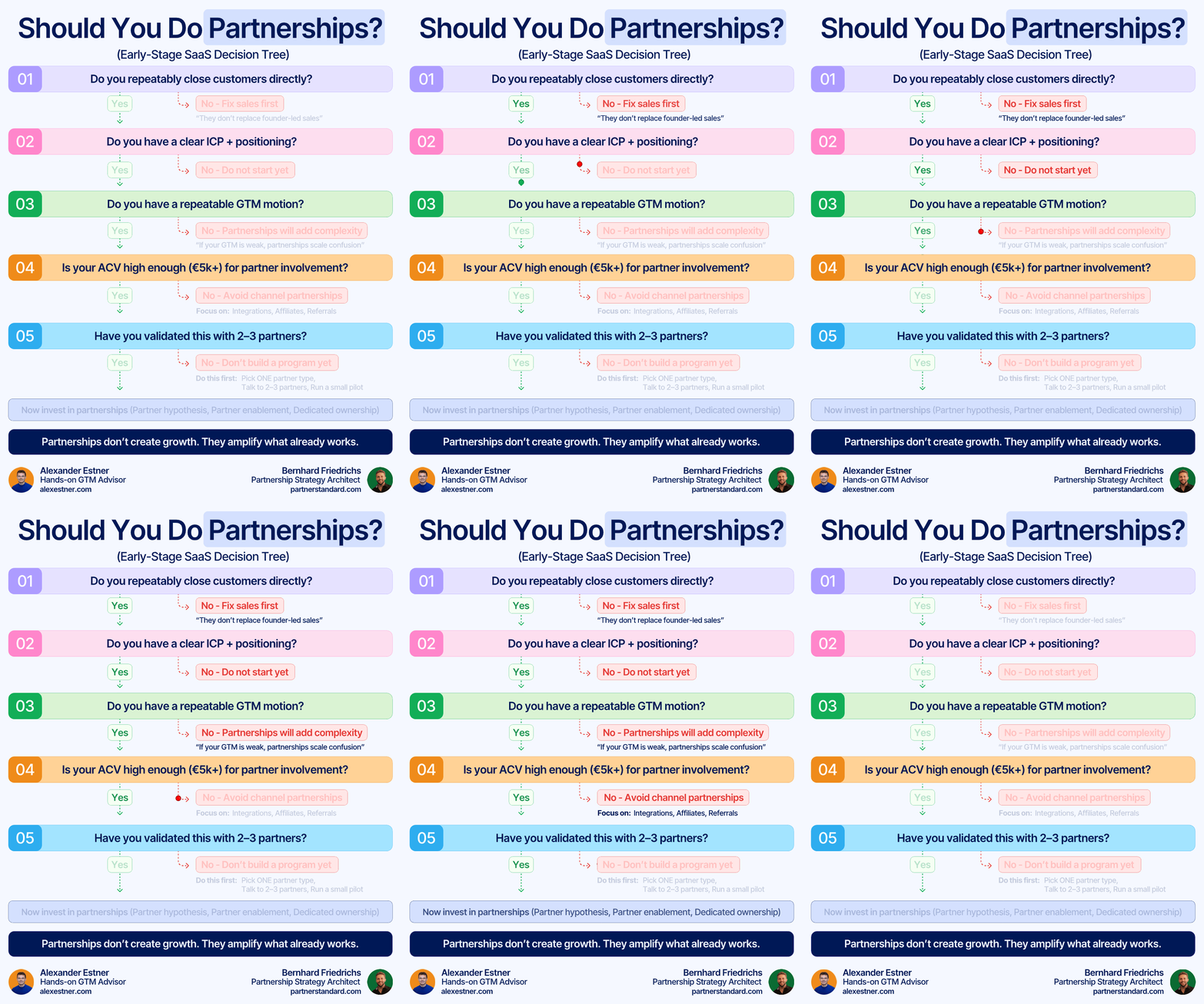
Before you do partnerships, ask yourself
Do not focus on partnerships yet if:
❌ You still can’t explain clearly who your ICP is
❌ You haven’t proven you can close customers directly
❌ Your GTM motion is still inconsistent
❌ Your ACV is too low to support human-heavy partner motions
❌ You secretly hope “partners” will solve your growth problem for you
If your direct motion is not working yet, partnerships will not save you.
They will only add complexity.
If your core GTM is weak, partnerships scale confusion.
That said, not all partnership types are equal. Some are absolutely worth testing early. Others are a complete waste of time at your stage.
👉 Want the full guide?
Access the Partnership Guide for Early-Stage SaaS and AI Founders
It goes deeper into all partnership types, detailed frameworks, and how to avoid the traps.
Real Partnership: What most founders get wrong
Most of what gets called a partnership in SaaS is not a real partnership.
The term gets used for everything:
an API integration
a listing on a marketplace
an affiliate relationship
a co-marketing webinar
a reseller agreement
A real partnership is not just a transaction.
It’s a collaborative relationship.
Long-term.
Shared upside.
Ongoing investment.
The 1+1 = 3+ principle
A partnership should create more value together than either side could create alone.
If that extra value does not exist, you don’t need a partnership.
You need: a vendor, a tool, or a simple commercial agreement.
For early-stage SaaS, that value typically shows up in:
Lifting Customer Lifetime Value (CLV): Through integrations that make your product stickier, or service partners who help customers extract more value.
Reducing Customer Acquisition Cost (CAC): Through co-marketing, warm introductions, or referrals from trusted advisors your prospects already work with.
Speeding Time-to-Market: Through product integrations that fill gaps without building everything yourself, or channel partners who give you immediate distribution.
Reducing Risk: Through diversifying your go-to-market beyond a single motion, and through partners who validate your product in their market.
If it does none of these, it’s probably not worth your time
Partner Value Proposition: What’s in it for them?
This is where most founders get it wrong.
They focus on:
❌ “What can this partner do for us?”The better question is:
✅“Why would this partner invest time, trust, and reputation into us?”
Strong partner value propositions usually include:
1. Revenue potential
Not just commissions—services, retention, expansion.
“Your clients need this. You can wrap services around it. And it helps you become more valuable to them.”
2. Portfolio improvement
Your product helps them:
serve a new customer segment, industry or region
Expand their relevance with existing clients (Upselling path)
3. Competitive advantage
Your product helps them differentiate against their competitors.
Or provides access to innovation that they couldn’t build themselves.
What keeps a partner engaged is this:
You help them build a better business.
The 4 types of Partnerships
Not all partnerships are the same. Every partnership falls into one of four categories:
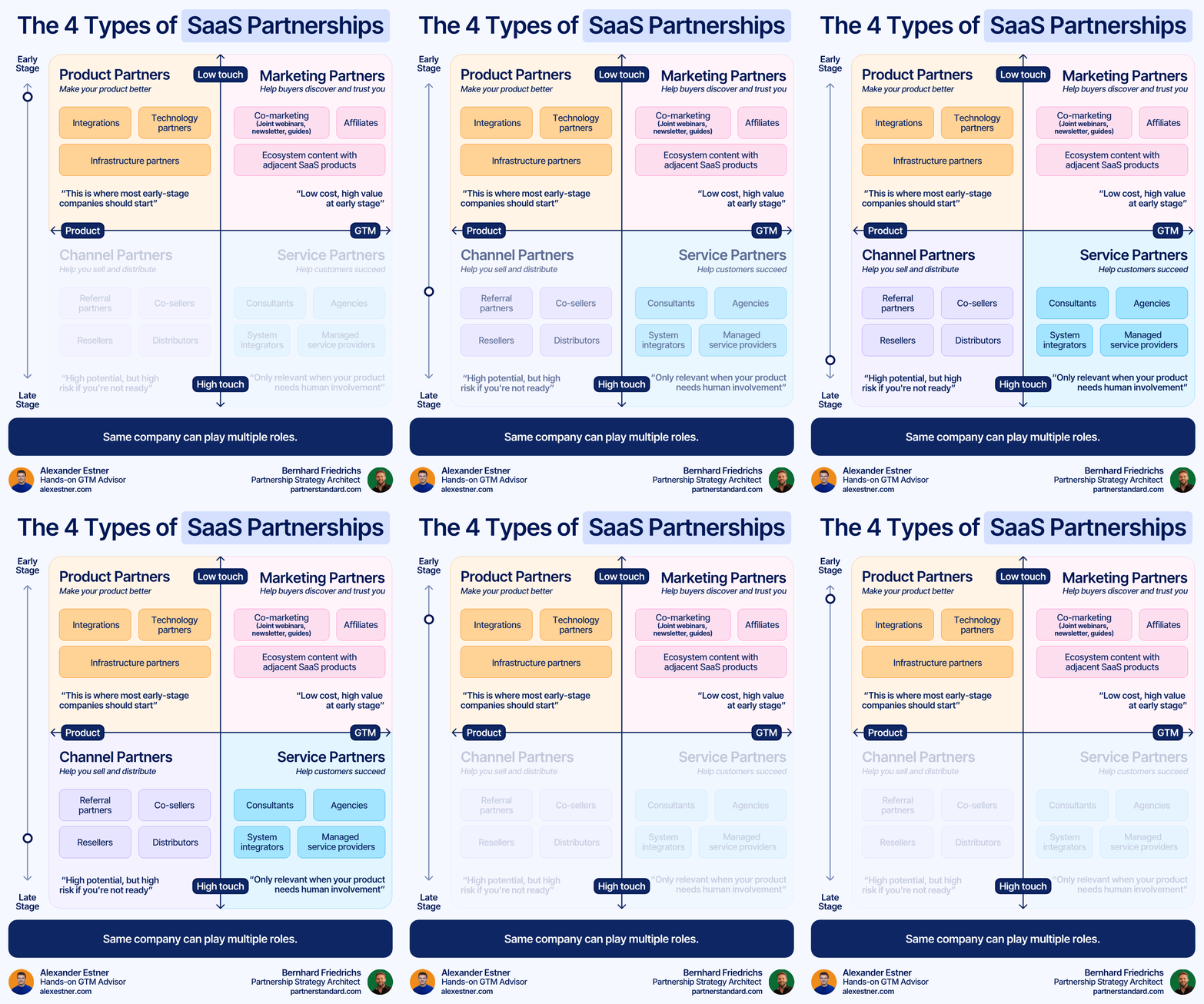
Product partners
Partners that make your product better. They connect it to the tools your customers already use and fill functional gaps. This is where most early-stage companies should start.
Examples:
integrations
technology partners
infrastructure partners
They carry the lowest risk, require no partner enablement infrastructure, and directly improve your product for existing customers.
Marketing partners
After product partnerships, marketing partnerships are usually the most accessible category.
They help your buyers discover and trust you.
They serve three functions:
Awareness (podcasts, newsletters, events),
Credibility (trusted voices validating your solution),
and Conversion (affiliate programs, co-marketing with lead sharing).
Examples:
joint webinars
shared newsletters
co-authored guides
podcast swaps
events
ecosystem content with adjacent SaaS products
The best early-stage version is usually:
Co-marketing with adjacent companies that serve the same ICP but solve a different problem.
That is the sweet spot. You borrow trust, reach, and context without direct competitive tension.
Channel partners
Partners that help distribute or sell your solution.
Examples:
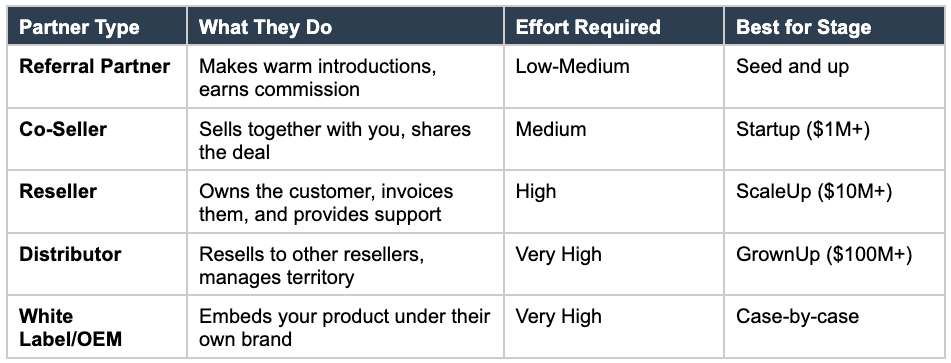
referral partners
co-sellers
resellers
distributors (who bring your product to customers you can’t reach on your own)
High potential, but high risk if you’re not ready.
Service partners
Help customers realize value.
If your product is low-touch and self-serve, you don’t need service partners right now.
They become relevant when your product requires significant human involvement to deliver value.
Examples:
consultants
agencies and implementation partners
system integrators
managed service providers
Most early-stage companies should start with:
Product partnerships first.
Marketing partnerships second.
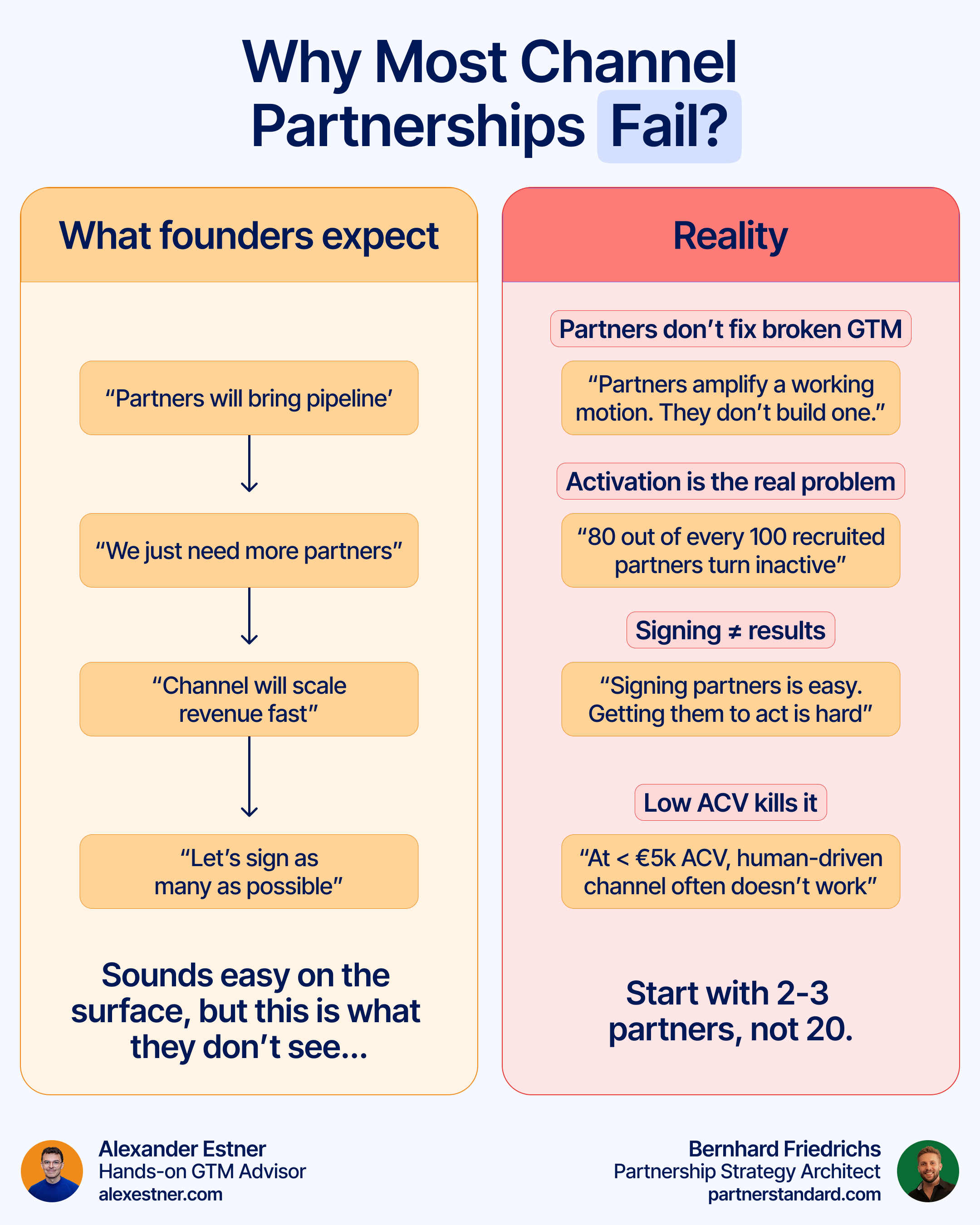
Why most channel partnerships fail
Channel partnerships sound attractive because it feels close to revenue.
But:
1. They can’t fix broken GTM
Partners amplify a working motion. They don’t build one.
2. The activation problem is real
Signing partners is easy. Getting them to act is hard.
A common pattern:
You sign 5 or 10 “partners”
Everyone is excited on the intro calls
Nobody sends leads
4 months later, everything is dead
80 out of every 100 partners turn inactive.
3. Deal size determines viability
At low ACV (< €5k/year), human-driven channel often doesn’t work.
As a rough rule:
below ~€3k–€5k ARR: referral/channel gets hard unless it is very scalable or affiliate-like
€5k–€50k ARR: referrals and co-selling can make sense
above that: deeper channel models become more viable
Partnerships by ACV and Product Complexity
Two key filters that decide what partnerships are right for you.
ACV
Your Average Contract Value directly influences which partnership models make sense:
The higher your ACV, the more partner-heavy models can make sense.
Low ACV (< €5k/year), low-touch (self-serve or light-touch sales)
Partnerships that scale without human intervention work best.
Think:
product integrations (marketplace listings, native integrations)
affiliate programs
lightweight referrals
technology partnerships
Mid ACV €5k–€50k/year), medium-touch
Now referral and co-selling can start to make economic sense. The deal size justifies a warm introduction, and the sales cycle benefits from a trusted recommendation.
Marketing partnerships also deliver strong ROI here, because co-marketing reduces CAC on deals that are large enough to matter.
Higher ACV (€50k+/year), high-touch
Now, resellers, system integrators, and service partners become viable because the deal economics support the partner’s investment in learning and selling your product.
But this is typically beyond the early-stage.
Product complexity
The more implementation and change-management your product requires, the more human help matters.
Simple product → product + marketing partnerships
Complex product → service partners + co-selling
How to Actually Start (Without Wasting 6 Months)
Enough theory.
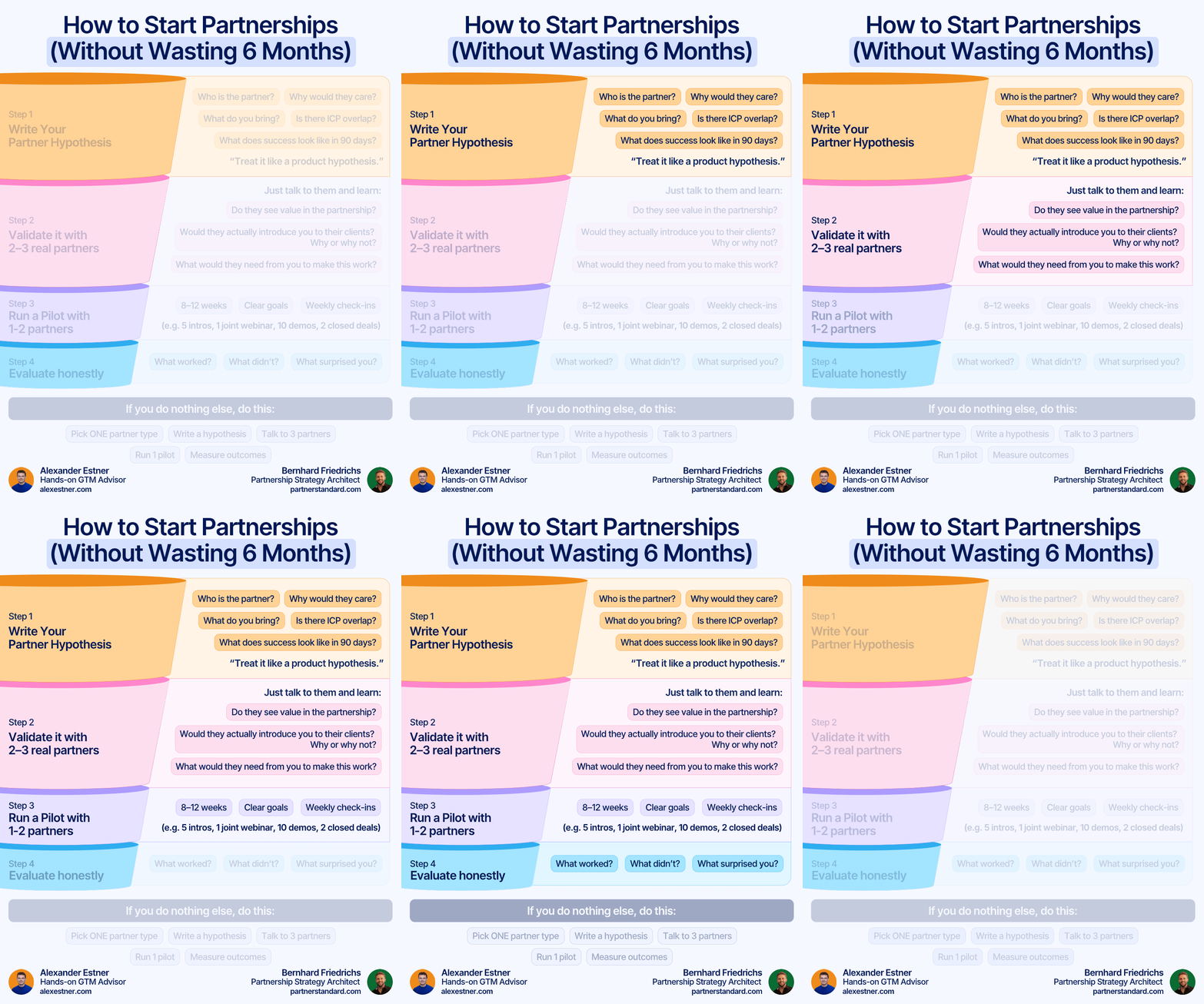
If you want to test partnerships in a smart way, do this.
Step 1: Write a Partner Hypothesis
Who exactly is the partner?
Why would they care?
Why are you relevant to them?
Is there ICP overlap?
What would success look like in 90 days?
Step 2: Talk to 2–3 partners
Do not build:
a portal
a tier structure
a fancy commission model
a partner deck with 40 slides
Just talk to real candidates.
Questions to ask:
Do they see the value you’re describing?
Would they actually introduce you to their clients? Why or why not?
What would they need from you to make this work?
What’s their honest assessment of the partnership’s potential?
Listen carefully. If two out of three tell you the value proposition doesn’t resonate, go back and refine your hypothesis. If they’re enthusiastic but need different support than you expected, adapt.
Step 3: Run a pilot
Work with your first 1–2 validated partners on a simple, time-boxed pilot:
8–12 weeks
Clear mutual goals (e.g., “3 introductions from you, dedicated onboarding support from us”)
Weekly or biweekly check-ins
Honest evaluation at the end
Document everything. What worked? What didn’t? What surprised you? This pilot becomes the blueprint for your partnership approach going forward.
The Most Common Partnership Mistakes & FAQs
Partnerships are full of traps for early-stage founders.
Here are three we see all the time:
❌ Seeing Marketplace Listings as Partnerships
Listing your product on a marketplace (Salesforce AppExchange, HubSpot Marketplace, Shopify App Store) is not a partnership strategy.
It’s a distribution tactic.
And on its own, it rarely drives results.
Marketplaces are crowded.
You’re competing with dozens (or hundreds) of alternatives.
Without:
active promotion
co-marketing
or a truly differentiated integration
Most listings generate near-zero organic traffic at the early stage.
👉 Treat marketplace presence as a checkbox—not a growth engine.
❌ Your Sales Manager Is Not Your Partnership Manager
This happens all the time.
Founders think:
“It’s kind of like sales, so let’s give it to the head of sales.”
Usually wrong.
Sales is transactional.
Partnerships are collaborative.
A sales leader is measured on quarterly revenue.
Partnerships take 6–12 months to produce results.
That creates the wrong behavior:
pushing deals instead of building relationships
treating partners like customers
focusing on short-term wins
Partners feel this immediately and disengage.
👉 If you’re early, the founder should own partnerships.
❌ “We have 5 partners who said they’ll introduce us… but nothing happened.”
This is the most common failure mode.
And it’s almost always an enablement problem.
Not a partner problem.
Signing a partner is 10% of the work.
The other 90% is making them successful.
Most founders don’t give partners what they need:
clear ICP and positioning
simple materials (one-pager, intro blurb)
easy way to introduce you
fast response on intros
regular check-ins
If partners have to figure it out themselves, they won’t.
The takeaway
Two well-enabled partners will outperform twenty inactive ones.
These are just 3 of the most common pitfalls & FAQs.
In the full guide, we’ll break down:
all major mistakes
detailed FAQs
and how to avoid wasting months on partnerships that go nowhere
👉 Get the full guide here
Key Takeaway
Don’t ask:
“How do we get more partners?”
Ask:
“Which one partnership type would create the most leverage for our business right now?”
Then start there.
One hypothesis
One category
One strong partner
One real pilot
That’s how early-stage partnerships actually work.
Okay, that’s it for today.
See you in 2 weeks.
P.S. Check out Bernhard’s website for Partnership Consulting, Assessments, and free content.
3 ways I help founders build a strong GTM foundation 👇
1️⃣ Use my free GTM library with 50+ free resources (guides, templates, workbooks, and tools) to build a strong GTM foundation (helped 5000+ SaaS leaders)
2️⃣ Get a 360° GTM audit of your status quo + a custom 6-month action plan
3️⃣ Work 1-on-1 with me - GTM Advisory for SaaS founders from €0 to €1 million ARR