

Hey - it’s Alex!
This is part 2 of my very special newsletter series, where we bring together insights from multiple founders and experts who have been there, done that, and are now excited to share their learnings with you!
👉 In case you missed part 1: 6 founders sharing their mistakes & tips
In case you missed the last 3 episodes:
✅ Why pitches fail (+ fix yours in 11 slides)
✅ 6 GTM tactics that work surprisingly well for bootstrapped founders
✅ 9 GTM infographics to hit your 1€ million ARR
GTM Foundation Library
If you want to grow your SaaS to 1€ million in ARR, I’ve created a free GTM library with 50+ Infographics for you.

👉 Reach 25.000+ SaaS operators with sponsored content. Sponsor the next newsletter.
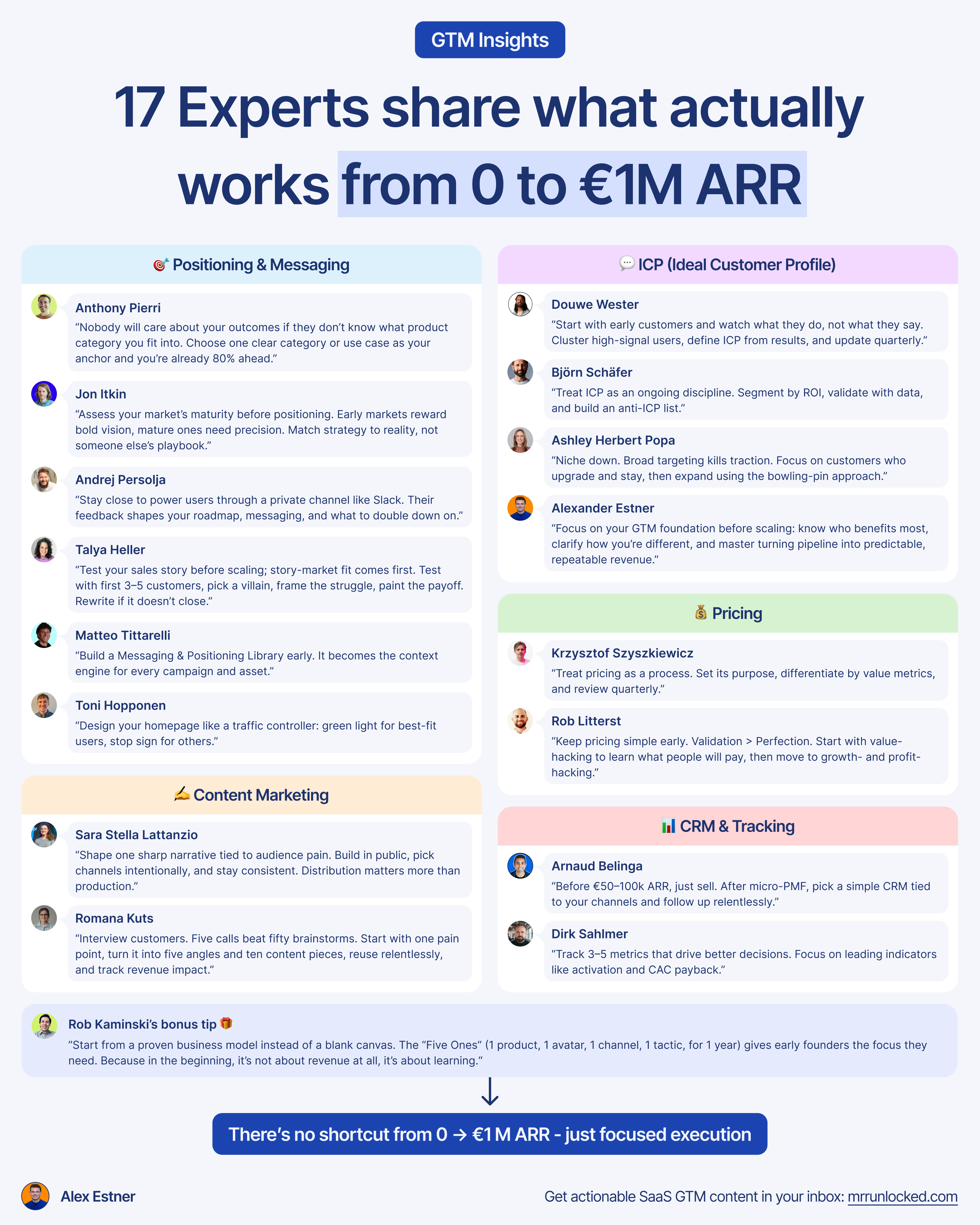
17 experts across Positioning, Messaging, ICP, Content Marketing, Pricing, CRM & Tracking
To make it easier for you to digest, I’ve asked 17 experts from different disciplines to share their best tips.
So you learn about:
✅ Positioning & Messaging
✅ Ideal Customer Profile
✅ Content Marketing
✅ Pricing
✅ CRM & KPI Tracking
Here’s the exact question I asked them:
I’m launching an episode on my newsletter where I’m getting experts across GTM Foundations (messaging, positioning, etc) to share their best tip with founders in the 0-1mil ARR stage.
Given your expertise in xxx would you be up to share one tip / hack / step to follow that founders shouldn’t skip in their 0-1mil ARR journey?
Okay, so let’s get started 👇
#1 Positioning & Messaging
Jon Itkin - Principal, In the Kitchen
Pay close attention to the maturity of your market.
Most advice targeting early-stage companies assumes you’re in an early/forming market. That might not be true. As markets mature, the rules change.
If you’re in an early market:
People will be more receptive to big, bold ideas
Leading with vision and possibility can be great
Buyers are still learning what’s possible
You have room to define the rules
If you’re in a mature market:
Disruption is 10x harder than you think
Built-in norms and expectations already exist
Feature wars won’t save you
You need to pick fights you can win
The trap: AI categories are maturing in weeks, not years. You could launch into whitespace and hit a mature market by your Series A.
What to do: Before you pick a positioning strategy, honestly assess how baked your market is. Then match your approach to that reality, not to what worked for someone else in a completely different context.
Your market defines the battlefield. Not your ambitions.
Relevant further information:
👉 The 95-5 rule: Only 5% are in the market
👉 The 5 stages of awareness: from problem unaware to product aware
Andrej Persolja - Founder, We Fix Boring
I’d say stay (or sometimes) get in touch with your power users (those who use the product the most and are spending the most money.
To do that, you can open a channel to them.
With one of the clients, we opened a Slack group just for power users to get direct access to the founders. That helped us get a pulse on what they want, how they think.
Much easier to keep your positioning/messaging on point when you have access to that data.
We are observing 3 different things:
Product
What are they complaining about? What’s their wish list? Helps keep your product roadmap clean.
Persona
What are their jobs to be done? Helps improve marketing/sales.
Positive feedback
What are we doing better than others, helping us double down on that / not lose that in the growth process.
Relevant further information:
👉 Create your Positioning & Messaging Framework
👉 Get to know your ideal customers
Anthony Pierri - Co-Founder of FletchPMM
Nobody will care about the outcomes you can drive if they don’t know what product category you fit into or what workflow your product supports.
Choose a product category or use case as a primary positioning anchor...and you are 80% better than the rest.

Relevant further information:
👉 SaaS Positioning 101
Talya Heller - Founder, Down To a T
Write your sales story first. Then, test it with the right 3–5 customers.
Founders obsess over product-market fit, but story-market fit comes first. If you can’t sell the problem and the payoff in plain language, you’re not ready to scale anything.
Most founders build a product before they can tell a story that anyone wants to buy. Your first customers aren’t just paying you, they’re shaping your positioning. Treat them like your company’s survival depends on it, because it does.
Here’s how to do it right:
Your first customers will shape your story and perhaps even your product. Aim for at least 3–5 early customers who look like your future, not just whoever will pay.
Simplify your wedge. Focus on one use case that proves your value fast.
Practice your sales story:
Pick a villain. What are customers fighting against? The clearer the enemy, the clearer your story. When we own the problem, we own the solution - that should be the throughline in your marketing, too.
Frame the struggle. Show the cost of doing nothing in business terms (time, money, risk).
Paint the payoff. Describe the moment after your product works, visually, emotionally, and financially.
Treat everything like an experiment: Watch what lands and what falls flat - that’s your positioning data.
If you can’t close with your story, don’t write more code—rewrite the story.
Use their feedback to tighten your GTM, not just your roadmap. The best messaging comes from customer conversations.
Pricing is a part of your positioning, hence it’s a part of the story. Tiers, levers – all should work with your narrative. When it doesn’t, you’re confusing potential buyers and creating doubt, which leads to slower sales cycle and lower win rate.
Collect proof from day one: Turn their wins into case studies; that’s your proof engine.
Document their objections; that’s your competitive intel.
Align your team around the learnings; that’s your story-market fit. Product, sales, and marketing should all tell the same story arc.
Evolve the narrative until customers can retell it better than you can, and your best customers refer others like them back to you.
You don’t find product-market fit. You build it. One story, and a few smart customers, at a time.
Relevant further information:
👉 Create your sales story /POV based on the messaging framework
👉 Product Market Fit: Problem Solution Fit + GTM Fit. The 3 stages to PMF
Toni Hopponen - Founder, Landing Rabbit
Something I learned when building Flockler, a pure self-serve SaaS, from 0-1mil ARR and beyond, is that the homepage’s role is to be the traffic controller at the event parking lot.
✅ The hero should hold a bright green light for your best-fit prospects, the champion users. But also, you need to keep it clear for stakeholders, from colleagues and managers to the CEO.
✅ Vice versa, the hero needs to be a clear stop sign for everyone else. You really want to keep low-quality leads out of your sign ups and demo calls.
The variable audience means your homepage message is always a bit lukewarm. And that’s okay.
The best traffic controllers are clear but calm. Their main job is not to convert. It’s to find the best parking slot for everyone arriving at the destination.
So what does the best homepage look like?
Here are four critical components for my SaaS homepages:
1️⃣ Hero: What, who for, and why should they care
2️⃣ How it works: 3-5 steps on how the app works
3️⃣ Testimonials: Show that others like your best-fit prospects already buy
4️⃣ Use cases: These take the visitor to the right track
When creating your 0-1mil ARR SaaS homepage, don’t try to say everything.
Don’t overplay your hand and just talk to the champion. Focus on a clear message and guide users to landing pages that convert.
Relevant further information:
👉 How to create your SaaS Homepage (incl. Figma Templates)
👉 SaaS Homepage Copywriting Templates
👉 Product Pages for SaaS websites
Matteo Tittarelli - Founder, Genesys
Build a Messaging & Positioning library
I recommend this to be the very first step in every content endeavour because this library forms the context engine for every campaign, landing page, blog post, and asset I create. It has:
Product messaging: capabilities, benefits, differentiators.
ICP, segments, and use cases model.
Competitors, customer references, proof points.
The best part is that you can build it for free in under an hour (with the right inputs).
How I build it: I use a combination of custom GPTs (see below) to speed up the process. Once I have the outputs, I organize them into a central messaging doc, which I upload on my LLMs (eg. Claude, GPT, Clay, Manus) as context to power prompts and asset generation
Why this matters:
Keeping things consistent across outbound and content channels.
Adding messaging when introducing new products, segments, or personas.
Re-positioning or re-messaging against new competitors or categories.
Relevant further information:
👉 Genesys Product Marketing Messanger, ICP Modeler and B2B Positioner
#2 Ideal Customer Profile
Douwe Wester - Co-founder, WhyThey
Most founders try to scale before they actually know who they’re scaling for.
Here’s how to fix that.
Start with early customers, not assumptions. They help you learn, not scale.
Watch what they do, not what they say. Behavior reveals fit faster than feedback.
Depending on your motion, use your first set of customers to find patterns in usage, retention, and expansion.
Cluster those patterns into small, high signal customer groups.
Define your Ideal Customer Profile based on results, not relevance.
Map who actually drives the deal. Buyer, user, blocker, and champion.
Understand what each persona needs to move forward. Information gaps kill momentum.
Build your Ideal Customer Profile as a living system, not a document. Update it every quarter.
Narrow your focus until your message lands without friction.
Growth starts when every motion across marketing, sales, and product serves the same customer.
You don’t find your Ideal Customer Profile. You earn it through motion, iteration, and focus.
Relevant further information:
👉 The power of niching down
👉 How to analyze your early customers to find your ideal customer
Björn W. Schafer - Funky Flywheels
ICP Clarity is Not a Workshop - It’s a Discipline.
Most founders think they know their ICP once they’ve hit early traction. They don’t. What they have is a handful of happy customers, often not a repeatable pattern. Yet.
Here’s what I tell every founder between around 1M ARR:
Stop chasing volume. You don’t need more leads; you need a tighter focus.
Segment by outcome. Ask: Who gets the fastest and most measurable ROI from your product?
Validate with data, not gut. Check your top 10 customers: Where did deals close fastest, with the lowest discount, and fastest Time to Value? That’s your real ICP.
Build your anti-ICP list. Knowing who not to sell to saves you 50 % of wasted pipeline effort.
Operationalize ICP. Everyone, from SDR to CS, should get transparent insights of your ICP segments in your CRM.
Review quarterly. Your ICP will evolve as your product and market mature. Treat it as a living system. As a rhythm 🕺
Relevant further information:
👉 The Ultimate Template to build your ICP
👉 Know your ANTI ICP
Ashley Herbert Popa - Director of Product Marketing, Bynder
Don’t be afraid to niche down with their ICP.
I see a lot of founders who want to sell to everyone trying to get as many companies in the pipeline as possible, but you’re usually selling to no one because your message is too vague and bland.
You don’t have to say no to opportunities that aren’t in your ICP, but niching down can help you and your team to have more focus on who you’re building for and who to target.
Find those customers that are excited to buy and are not just staying with you but bringing revenue by staying with you - i.e., you might have a lot of freemium customers, but if they aren’t willing to upgrade and pay, they’re not seeing the value. Once you have that traction with your ICP, you can use the bowling pin approach, slowly opening up to segments, verticals, or geographies that are similar or have the same problems as your original ICP, and you’ll likely already have product-market fit or close to it.
Milestones are easier to tackle than marathons.
Relevant further information:
👉 How to expand after PMF
👉 The Hidden Cost of serving multiple segments
Alexander Estner - GTM Advisor & Author of MRR Unlocked
Build your foundations first & make your GTM motion repeatable before ‘scaling’.
Too many founders want to find the ‘scalable’ growth hacks too early.
Focus on building a strong foundation first. For me, this includes:
✅ Knowing who benefits the most from your product (aka. Your ideal customer)
✅ Clearly articulating what your product does and why it’s different than competitive alternatives (aka. Positioning & Messaging)
✅ Building a repeatable motion: Know how to create pipeline and turn it into revenue (Growth channels & sales process)

Relevant further information:
👉 A 3-part series on how to build a strong GTM foundation
👉 Scale readiness indicators: The right time to scale
#3 Content Marketing
Sara Stella Lattanzio, B2B Marketing Consultant
The biggest mistake I see is founders investing in content too early or too late.
If there’s no product-market fit, it will only amplify noise. But once you have a working MVP that solves real pain points for a specific audience, and clarity on your target market and unique narrative, content becomes your best compounding engine.
Here’s what I’d advise early-stage founders:
1️⃣ Shape one sharp narrative
You don’t need a content calendar; you need one idea that ties your product and your audience’s pain together and an original perspective. In a crowded market where everyone can ship content and software, your message needs to be as differentiated as your product.
2️⃣ Build in public
This is especially powerful at the early stage, when your motion is still mainly founder-led. It works because it’s authentic; people are invested in the story even if the product isn’t fully baked yet. It’s also a great way to warm up your audience, but the timing matters: do it once you have a working MVP and something real to show. The power lies in the narrative and how good a storyteller the founder is.
3️⃣ Understand demand and choose channels intentionally
Early-stage teams rarely have capacity to cover multiple channels, so pick the ones that fit your audience’s behavior. If there’s existing demand for the topic, search content (yes, YouTube also qualifies as search content) should be a priority. But if you’re introducing a new category, focus on channels where you can educate and shape demand, like social and community. The goal is to align your content type and distribution with how people already discover and learn.
4️⃣ Keep production and distribution in balance
Both matter, but given how flooded the content landscape has become, distribution matters more today. I recommend starting with a long-form piece that captures real insights and depth. It can even be a long video you never publish, but it gives you raw material to create shorter pieces, quotes, or clips. It’s better to do more work up front and distribute across multiple channels or over time instead of constantly starting from scratch.
5️⃣ Play the long game
Content isn’t sales. Most teams give up after a month and wonder why nothing sticks. If you’re starting from zero, commit to at least six months of consistent work before changing course, assuming you nailed the basics first. That’s how content compounds and starts paying off.
Relevant further information:
👉 The Ultimate Content marketing guide
👉 How to create powerful lead magnets
👉 7 tactics to distribute your lead magnet content
Romana Kuts - Founder, SaaStorm
If you’re a B2B SaaS on the journey to $1M ARR, and want to leverage content marketing and SEO to grow, here’s your to-do list:
Interview your customers. 5 calls > 50 brainstorms.
1 pain point → 5 angles → 10 pieces (how-to, case study, teardown, comparison, myth-buster).
Go deep before you go wide. Own one problem space end-to-end.
Ruthlessly reuse. Every blog post → 5 assets: LinkedIn post, email, short, carousel, quote thread.
Make content someone’s job, not a side project. Small team is fine; clear ownership is non-negotiable.
Track revenue, not just rankings. Set up attribution early or you’ll kill content just before it compounds.
Ship weekly; optimise monthly. Consistency beats bursts.
Repeat winners. Turn top posts into a series, webinar, or updated 2026 edition.
Mine CRM notes and call transcripts for headlines. The phrases customers use should be your H1s.
Relevant further information:
👉 The Ultimate guide to create powerful case studies
👉 High intent SEO keywords
👉 35+ LinkedIn post templates
#4 Pricing
Krzysztof Szyszkiewicz - Co-Founder, Valueships
If there’s one thing: Treat Pricing as a Process
Marketing is a process, sales is a process, so why can’t pricing be a process?
Treating it as a process is exactly what the most successful companies are doing.
So what does it mean?
Set a purpose for your pricing
Growth? Margin? Competition? Make sure it aligns with your company’s overall purpose.
Differentiate
In most cases, all-in-one is not ideal at the beginning. Why? Because you need to learn more about your users: their willingness-to-pay, feature preferences, upsell potential, etc. —> Differentiate by core value metrics and features.
Look at the results and iterate (PROCESS)
For example:
If most of your users are on the most expensive plan, you might be too cheap. Think about a price increase.
If most of your users are on the cheapest plan, you might be giving too much value. Think about downsizing.
If nobody expands, check usage. Maybe there’s an opportunity to improve here.
Governance
Set a quarterly pricing meeting in your calendar.
Discuss:
New feature introductions – align with your purpose:
Expansion: add-on or most expensive plan?
Competitive advantage = maybe a sample is available everywhere?
Discounting patterns – is 10% of MRR leaking due to discounts? It might be time to seal it already.
Model refresh/change – remember, no action is also an action if there was a discussion beforehand.
Do yourself a favor: Treat Pricing as a Process – then pricing will give back to you.
Relevant further information:
👉 Ultimate SaaS Pricing Guide
👉 Krzystof and Alex’s discussion on ‘all in-one’ pricing and feature gating
Rob Litterst - Co-Founder, PricingSaaS
The biggest key to pricing early on is recognizing your stage, and not overcomplicating it.
Think in 3 phases:
1️⃣ Value-Hacking (0–€1M ARR)
You’re finding product–market fit. Focus on discovering your value and what people are willing to pay. Keep it simple: your goal is validation, not optimization.
2️⃣ Growth-Hacking
Once people clearly want your product, you can start experimenting with pricing models to scale.
3️⃣ Profit-Hacking
After scaling, focus on driving incremental revenue and improving margins.
These stages (from Mike Maples) are a useful framework for aligning pricing with company maturity. In the early “value-hacking” phase, resist the urge to overthink or overbuild pricing models. Unless you have significant costs (like an AI product), simplicity wins. Validate demand first, refine pricing later.
Relevant further information:
👉 The SaaS Pricing Page Guide
#5 CRM & KPI Tracking
Arnaud Belinga - Co-Founder, Breakcold
Here are the biggest mistakes that founders do when it comes to CRM in their 0-1mil ARR journey
❌ Mistake 1: You pick a CRM too early
For the first 50K ARR, even 100K, you don’t really a CRM. You need to just build and sell your product.
Once you start to have a micro-PMF, start thinking about having a sales CRM to improve your conversions.
❌ Mistake 2: Your 1st CRM is Notion or Spreadsheets
Notion, Airtable and Spreadsheets are not CRMs. They’ll make you lose more time than they should have saved you.
Pick a sales CRM adapted to your needs that connect to the B2B channels where you’re selling (eg. email + LinkedIn or email + phone etc)
❌ Mistake 3: You try to overthink your sales processes
People try to build complex processes with 10+ CRM lists, 20+ tags and 46 Zapier automations.
The truth is that you only need 1 CRM list, 1 pipeline with 6 stages where you turn your inbound SaaS signups into paying customers.
❌ Mistake 4: You don’t follow up enough
If you’re a SaaS, you probably receive inbound SaaS signups.
Not trying to chat with them via LinkedIn or other is making you lose conversions.
There are so many times where I closed annual subscriptions because I followed up a third time someone trying my product on LinkedIn.
This is where your CRM will help you stay organized and win more deals.
Relevant further information:
👉 14 actionable CRM tactics for SaaS founders
👉 3 highly relevant CRM set-ups
Dirk Sahlmer - Partner, FE International
Build your KPI muscle early!
From my experience, too many founders track metrics, but don’t really use them.
Start with decisions, not dashboards.
What do you need to learn to make better decisions? Then track only the 3-5 metrics that answer that.
Look beyond MRR, it’s a lagging metric.
Focus on what drives it - conversion, activation rate, CAC payback, and other leading indicators.
Define metrics precisely.
KPIs must have an owner, a clear formula, and a frequency.
Benchmark, don’t copy.
Industry benchmarks provide useful context, but shouldn’t be seen as commandments.
Make metrics part of your story.
Ideally, you can narrate your business through data, instead of just showing charts (VCs love that).
You don’t need a complex dashboard. You need a simple (living) KPI habit that scales with you.
Relevant further information:
👉 Weekly & Monthly GTM Dashboard
👉 Financial Planing Template
And now, one more bonus tip on the business model.
Rob Kaminski - Co-Founder, FletchPMM
Work from a proven business model, rather than trying to create a new one from scratch.
The underlying thesis of Fletch was rooted in a productized service model demonstrated in the book, Built to Sell. We also took a lot of inspiration from what Greg Hickman from Alt Agencies describes as the “Five Ones”. One product, One Avatar, One Channel, One Tactic, for One Year.
While we innovated the model slightly as we learned, we had confidence that this model would work because it had already worked for other businesses.
I think too many founders start from a blank canvas, and it gets them in a lot of trouble. When they should be focused on building a great product to solve a problem, they end up dealing with business model problems along the way.
These early companies should be maximizing for # of interactions with customers (ie. reps in trying to solve the problem).
Even going to the extreme of offering your products for free is a good way to do this. Because in the beginning, it’s not about revenue at all, it’s about learning.
Learning what the real problem is.
Learning what the best way to solve it is.
Learning what people will pay for a solution.
Learning how to reach your target audience consistently.
Now that’s it for today.
17 experts shared their best tips for your journey to 1€ million ARR.
Now I want to hear your story
👇 Respond to this email and share your mistakes & tips with me. I will feature the best ones in the upcoming episode.
Happy growth 🚀
3 ways I can help you grow your SaaS to €1 million ARR 👇
1️⃣ Use my free GTM library with 50+ free resources (guides, templates, workbooks, and tools) to build a strong GTM foundation (helped 5000+ SaaS leaders)
2️⃣ Get a 360° GTM audit of your status quo + a custom 6-month action plan
3️⃣ Work 1-on-1 with me - GTM Advisory for SaaS founders from €0 to €1 million ARR