


Hey - it’s Alex!
A few weeks ago, a founder asked me a simple question:
“Alex, what do you actually do all day?”
I laughed.
Because, from the outside, my work probably looks completely random.
One day I’m reviewing demos.
The next day I’m rewriting a homepage.
Then I’m analysing pricing.
Then I’m mapping an ICP.
Then I’m reviewing content.
Then I’m helping someone build an outbound campaign.
It looks chaotic.
But after working with more than 30 early-stage founders, I’ve realised:
The work itself is remarkably similar.
Not because founders are identical.
But because the underlying problems are.
Different industries.
Different products.
Different price points.
Different team sizes.
Different GTM motions.
Different resources.
After hundreds of hours of sprint planning, audits, sales call reviews, content reviews, website teardowns, and strategy sessions, I noticed something surprising:
The same 13 workstreams appear almost every single time.
So today, I’m opening up the actual operating system behind my 1:1 GTM Advisory.
In case you missed the last 3 episodes:
✅ Your GTM Foundation on One Page
✅ Pricing Guide 101
✅ The GTM Audit Playbook
A quick word from our sponsor: I include only sponsors I would personally recommend.
Pitch - Create client-ready presentations in seconds

Still wasting time fixing AI-generated slides that don’t look anything like your brand? Pitch Agent draws directly from your approved templates, so every presentation you share is on-brand and polished from the start. Refine your narrative through chat, personalize slides for each client, and share decks via live links with built-in engagement analytics.
📢 “When I think of revenue, I think of Attio.” Shreman Shrestha, Head of Business
Granola’s revenue motion runs on Attio. Here’s what that adds up to:
Zero missed leads and 10X faster access to customer context
Lead triage 83% faster
5 hours saved per week with automated updates
Why This List, Not the 7-Block Chain
If you’ve read my GTM Foundation one-pager, you already know the strategic version:
ICP → Positioning → Messaging → Collaterals → Channels → Sales Process → Pricing.
That’s the chain of decisions.
Today, it’s the delivery system - the actual steps I run inside every 6-month engagement.
Here’s the full list.
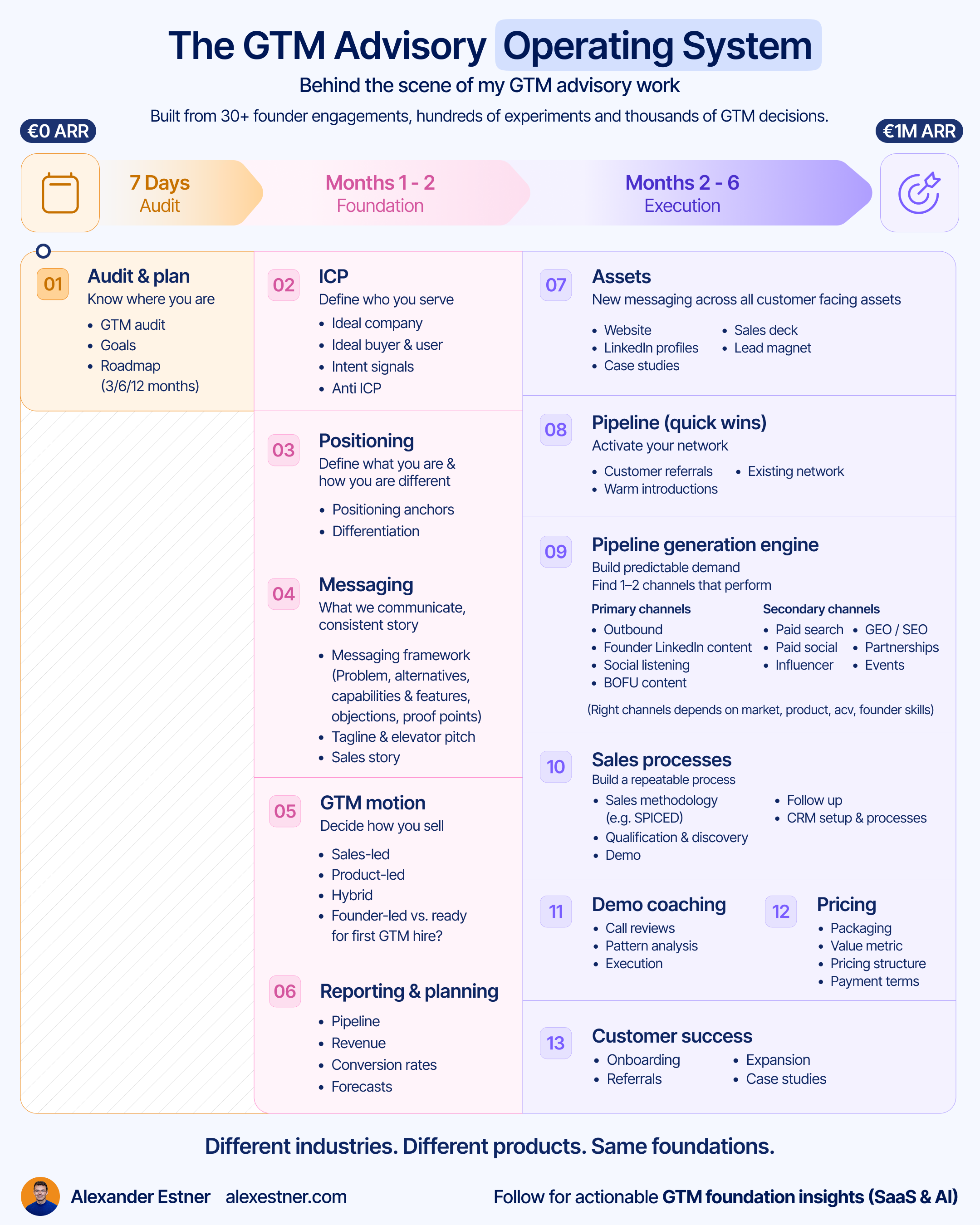
1. Audit & Plan
We always start with the same question:
“Where are we today?”
Before we change anything, we need a clear picture of the current situation.
This includes:
A complete GTM assessment
Identifying quick wins
Defining goals for the next 3, 6, and 12 months
Prioritizing initiatives
Building the roadmap
The goal is to:
Have a shared understanding of what’s working & what’s not working
Where the focus needs to be for the next months
What you should NOT do
Self-check:
If I asked you right now “what are your top 3 GTM priorities for this quarter,” could you answer in one sentence each - or would you list 8 things you’re “working on”?
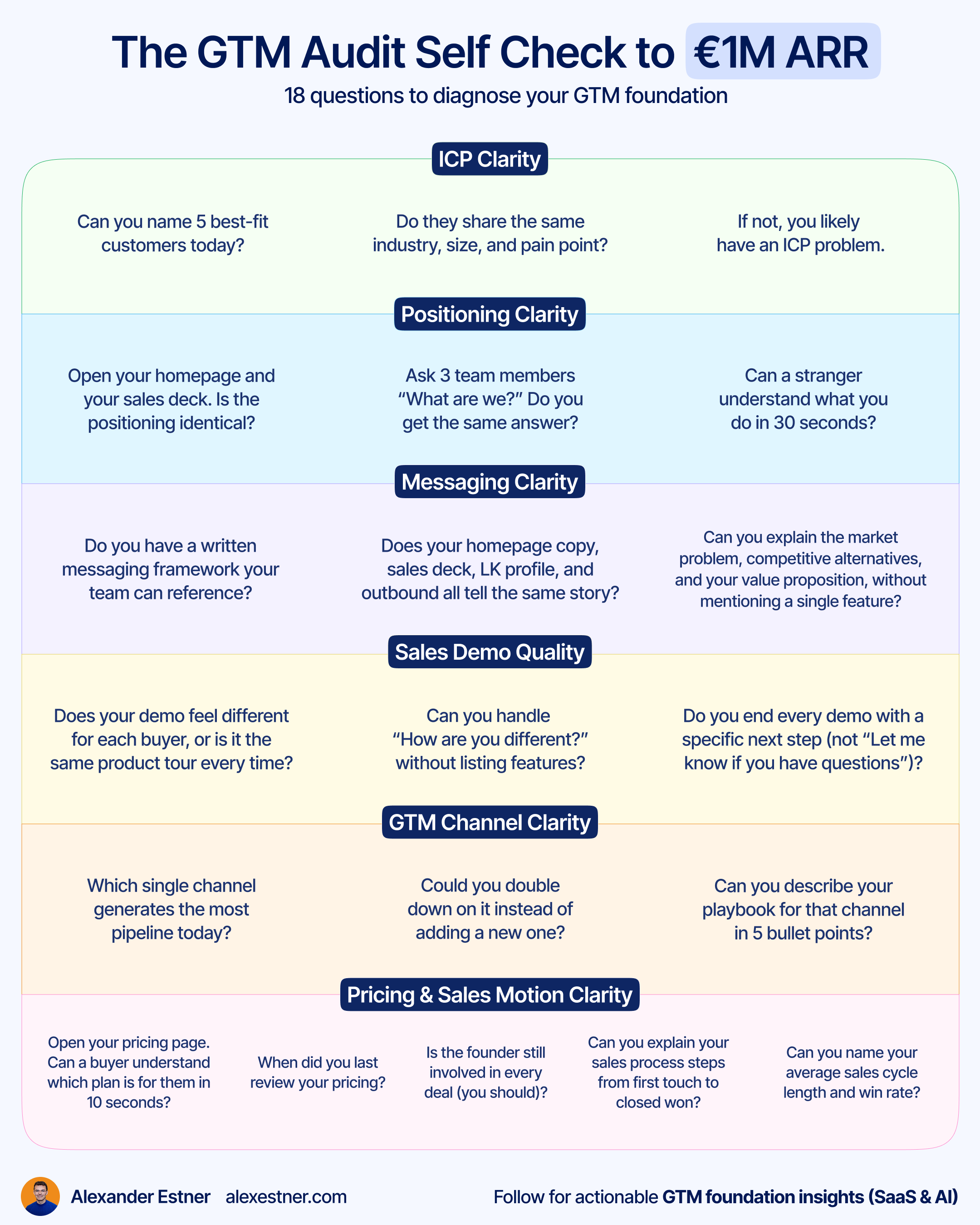
P.S. Book a free call if you want me to run a GTM audit for you.
2. ICP
One of the most common mistakes I see is trying to sell to everyone.
❌ “We sell to companies with 50-500 employees.”
❌ “Our ICP is mid-market SaaS.”
❌ “Anyone who has this problem.”
Those are TAM descriptions, not an ICP.
On top I see is founders refusing to make a choice.
Everyone is a potential customer.
Every feature is important.
Every channel looks promising.
And that’s exactly the problem.
Using my ICP Framework, we define 4 parts:
The Ideal Company - 3-5 firmographics/technographics, not a long wishlist
The Ideal Personas - the champion/user and the economic buyer (often different people)
Intent Signals - the events that show someone is in-market now
The Anti-ICP - who to explicitly disqualify, and why
The clearer the target, the easier everything else becomes.
Everything downstream like positioning, messaging, channel selection - traces back to this.
Self-check:
Can you describe your best-fit customer with 3-5 specific attributes, and can you name the event that triggers them to buy?
3. Positioning
I would estimate that around half of the biggest breakthroughs comes here.
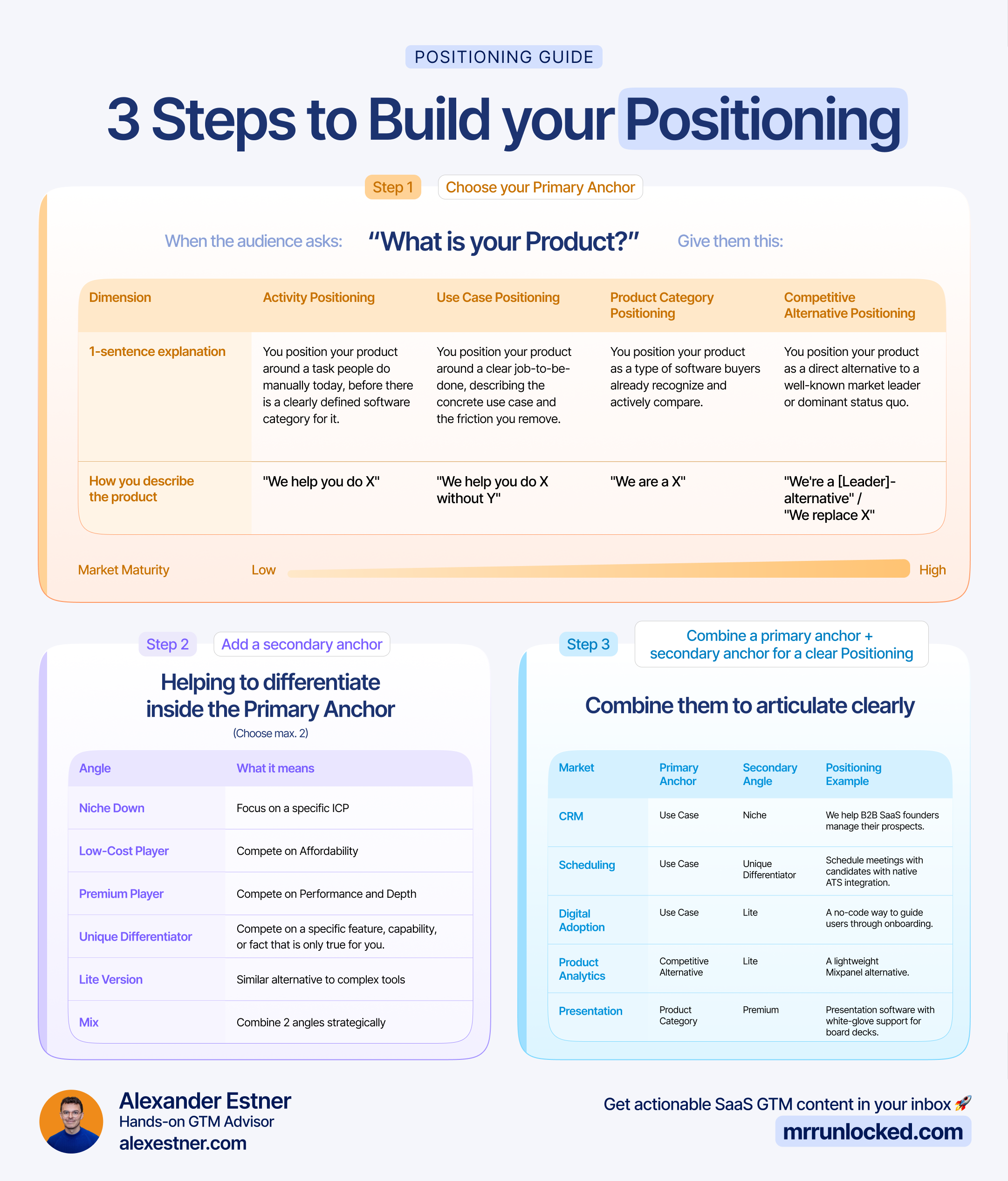
Using my 3-Step SaaS Positioning Framework, we choose a Primary Anchor - the answer to “what are you?”:
Activity Positioning - you replace a manual behavior (”stop scheduling over email”)
Use Case Positioning - you own a job-to-be-done (”schedule interviews without email back-and-forth”)
Product Category Positioning - you’re a recognized category (”the scheduling software for recruiting teams”)
Competitive Alternative Positioning - you replace a known leader (”the Calendly alternative for recruiting teams”)
Then we layer the differentiator inside that anchor, and the competitive landscape it sits in.
Every successful company stands for something specific. Most founders’ assets, on the other hand, still try to speak to everyone.
Self-check:
Open your homepage, your LinkedIn profile and your sales deck side by side. Is the positioning identical? If not, your buyers can’t classify you - and buyers who can’t classify you don’t compare you.
4. Messaging
Messaging follows Positioning and is what actually reaches the market.
Using my 16-point Master Messaging Framework, this covers:
Market insight and the core problem
ICP context and jobs-to-be-done
Competitive alternatives and their limitations
Product capabilities → features → benefits
Proof, objections, and the core messaging blocks (tagline, elevator pitch, proof point)
The messaging framework together with the positioning and ICP document becomes the foundation of everything we do. Especially when it comes to creating the assets (number 6), this is super powerful.
Feed your Claude/ChatGPT with these insights.
Self-check:
Do you have a messaging document that contains all the information? And if I ask you on a call, can you (and your team) actually use your ‘messaging’?
Can you explain the market problem, the alternatives, and your value prop - without mentioning a single feature?
5. GTM Motion
Before picking channels or tactics, we decide how you sell.
Sales-led, product-led, or a hybrid?
Founder-led sales, or ready for a first hire?
1-step (disco-demo combined) or 2-step (discovery, then demo) sales process?
Most early-stage founders never make this decision explicitly.
The motion should follow your ACV, your ICP, product complexity, and market maturity.
Self-check:
Could you describe your GTM motion in one sentence, or does it change depending on who’s asking?
6. Assets
Once we have clarity on ICP, positioning, and messaging, we make sure that all assets follow the foundation.
We typically work on:
The website (homepage, case study page, pricing page, book a demo page, blog…)
LinkedIn profiles (founder + team)
Sales decks
Case studies and testimonials
Lead magnets
Onboarding materials
These assets are your GTM on autopilot - the things buyers look at before, during, and after talking to you.
Buyers often know much more about you than you realise.
By the time you speak to them, they’ve usually visited your website, looked at your LinkedIn profile, read your case studies and compared you with alternatives.
Your assets are often selling long before you ever enter the conversation.
Self-check:
Pull up your website, sales deck, and LinkedIn profile. Do they tell the same story as your internal ICP, messaging and positioning documents say?
Helpful resources if you need to work on your assets:
👉 GTM Foundation Part 2: Channels & Collaterals
👉 The Founder & Team LinkedIn Playbook
👉 SaaS Lead Magnets That Actually Convert
7. Quick Pipeline Wins
Early-stage founders almost always have more opportunities than they realize.
We start with the lowest-hanging fruit:
Customer referrals
Warm introductions (from Investors, Advisors, existing networks)
Current Pipeline (+ lost deals)
Warm pipeline converts faster than anything you’ll pay for.
I’ve seen founders spend thousands of euros on advertising while ignoring dozens of existing customers, investors, advisors and former colleagues who would happily introduce them to the right people.
Self-check:
Have you asked your last 10 happy customers for a referral, directly, in the last 30 days?
8. Pipeline Generation Engine
Once the quick wins are tapped, we build the system that keeps producing repeatable pipeline.
Some channels are a better fit for your primary channels, like:
(Warm/signal based) outbound
Founder LinkedIn content
Social Listening
BOFU content
Others are better once you've found something that works:
Paid Social
Paid Search
Partnerships
GEO/SEO
Influencer/Creator partnerships
Events
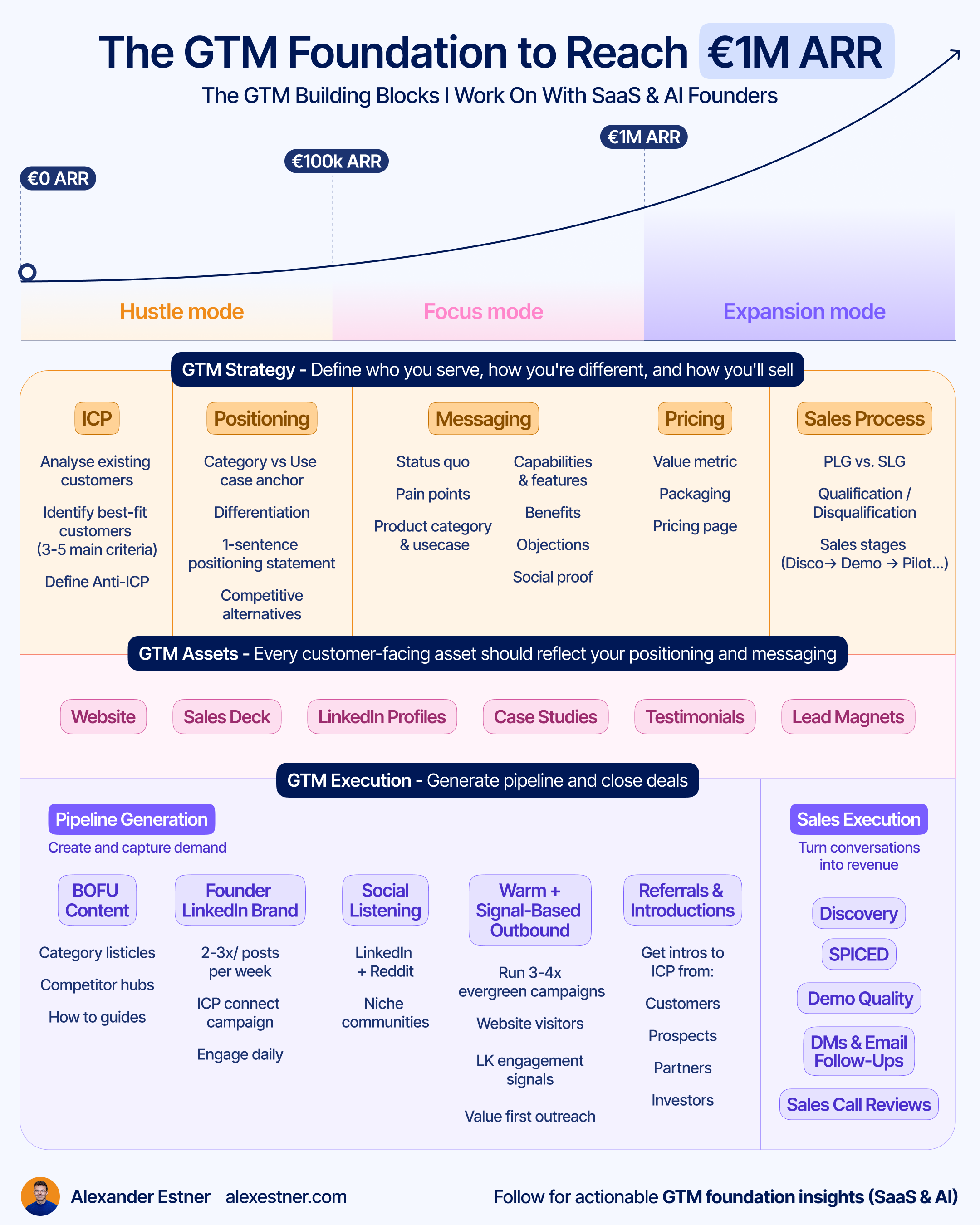
The goal is consistency: a channel you can predict pipeline from every month.
And it starts with focus: 1-2 channels, mastered, before adding a third.
Self-check:
Which single channel drives 50%+ of your pipeline today?
9. Sales Process
A repeatable sales process makes buying and selling easier, both for the founders and buyers.
This includes:
CRM setup
Using a sales framework like SPICED
Qualification frameworks & Discovery structure
Demos (see my Sales Demo Toolbox)
Email templates and follow-up sequences
Regular call reviews
One closed deal doesn’t validate anything on its own.
The goal is to build a system you (or a future first hire) can run predictably.
Self-check:
After your last 5 demos, did every call end with a specific next step, or with "let me know what you think"?
10. Demo Call Coaching
A repeatable process still needs to be executed well - so I review actual calls using my Sales Demo Toolbox.
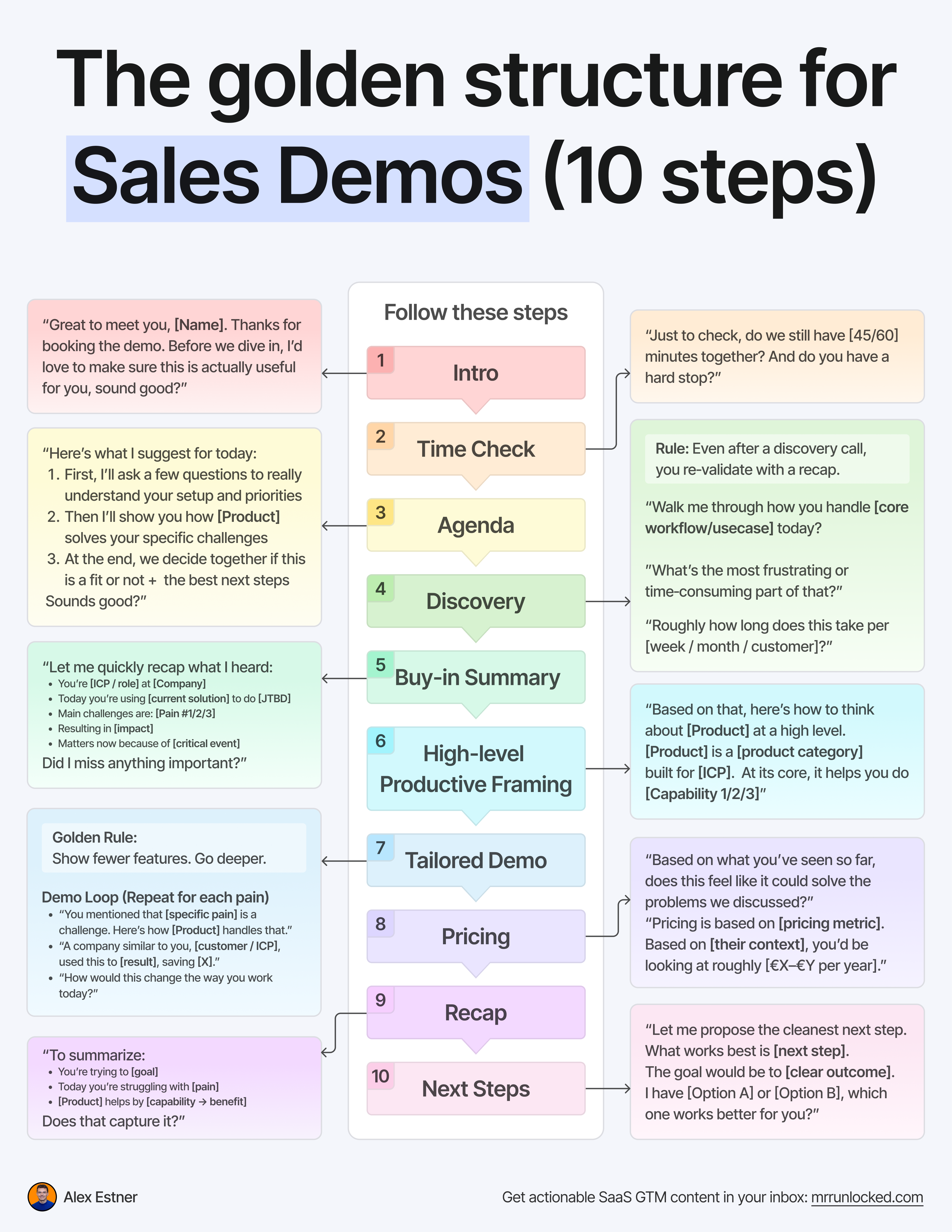
So what we do is 2 things:
I review your sales demos frequently
We set up a sales coaching automation (e.g. with Granola), so every call gets analyzed
Self-check:
After your last 5 demos, did every call end with a specific next step, or with “let me know what you think”?
11. Pricing
Pricing is important, but I realized that it’s less important than most founders think (for your 0-1€ million ARR journey).
We define:
Packaging
The value metric
Pricing structure
Trial and pilot models
Payment terms
At €0-1M ARR, keep it simple: one value metric, reviewed every quarter, beats four tiers with feature gating you can’t justify.
Self-check:
When did you last review your pricing? If the answer is “never,” you’re probably underpricing.
Can you explain your prospect in <30 seconds how your pricing works?
P.S. Here’s my full Pricing Playbook for early-stage founders.
12. Customer Success
Growth doesn’t stop at closed-won.
We work on the first customer success playbook.
This usually includes things like:
Getting them to a case study
Asking for referrals
Spotting expansion potential
Spot churn risks early
Self-check:
Have your last 3 closed-won customers been asked for a referral or a case study - directly, not “if you get a chance”?
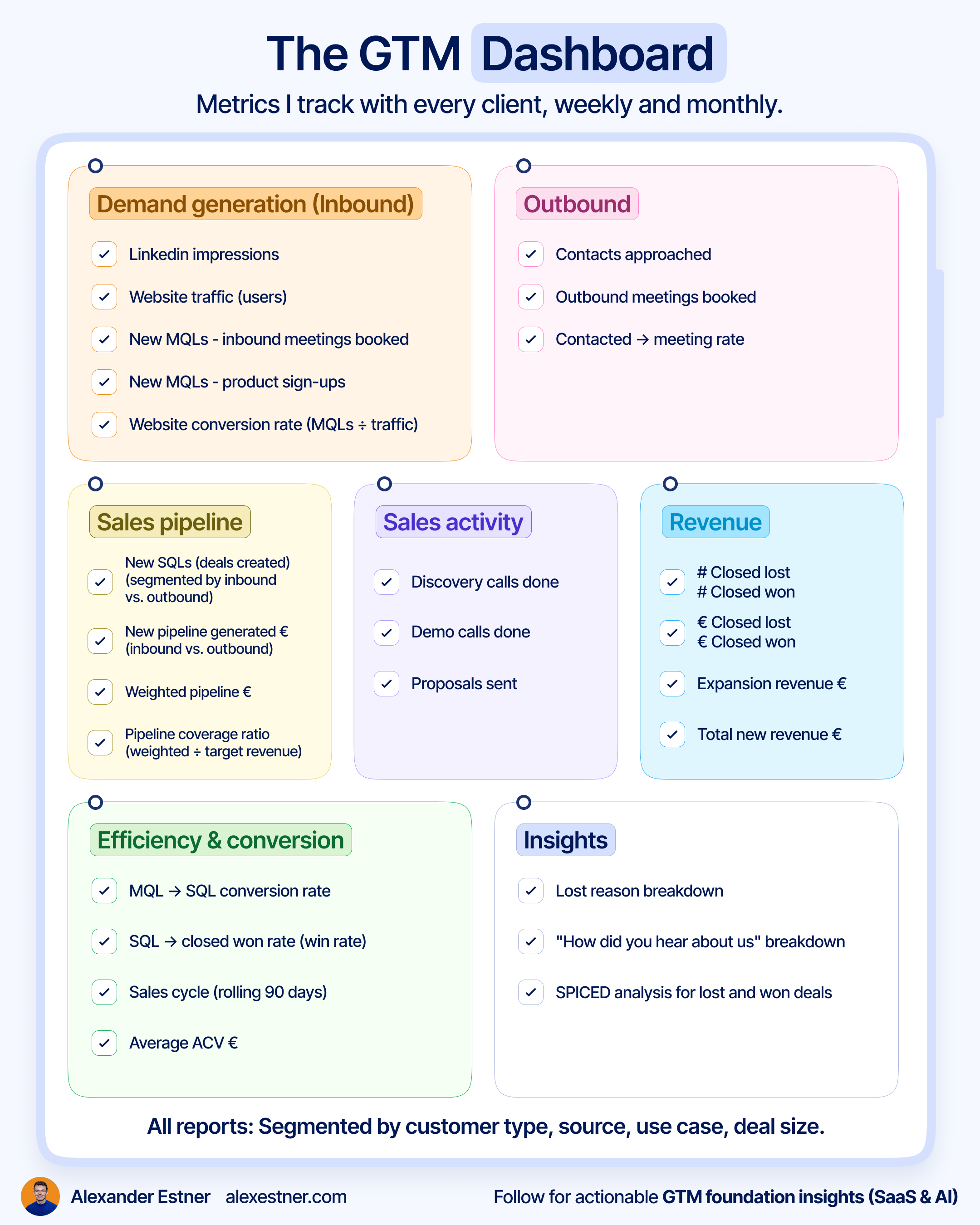
13. Reporting & GTM Planning
We set the Goals in step 1 (as part of the audit), but it’s important that we:
measure weekly/monthly our progress
see if we are on track (or not)
adapt the plan
So we build:
GTM Dashboards
Weekly and monthly reporting
Plus, we revisit priorities every month (after we review the metrics).
Self-check:
Do you have a dashboard that helps you take GTM decisions?
Now you know what I actually do as a GTM advisor.
Happy growth.
Alex
3 ways I help founders build a strong GTM foundation 👇
If you’re somewhere between €0 → €1M ARR, I can help you with your GTM.
1️⃣ GTM Foundation Library
→ More than 50 frameworks, guides, and templates.
2️⃣ GTM Clarity Sprint
→ A complete GTM audit and a six-month action plan delivered in < 7 days
3️⃣ 1:1 GTM Advisory
→ Work directly with me to build your GTM, workstream by workstream
The demo review workstream is the one people underrate most. I've watched founders spend weeks on pricing decks while their actual demo has a 40% drop-off at the same slide every single call, and nobody's watched the recording. Do you have a cadence for demo review, or is it triggered by specific signals like win-rate dips?