


Hey – it’s Alex.
I’ve written a lot about building your GTM foundation: ICP, positioning, messaging, sales process, pricing, channels.
But once you have those things documented, you will face another challenge:
How do you continuously improve them based on what you’re actually learning from the market?
That’s what today’s guest episode is about.
Thibault Le Meur runs Triscale, a GTM consultancy for founder-led B2B tech companies in Europe.
He built two AI agents that run on his own sales pipeline:
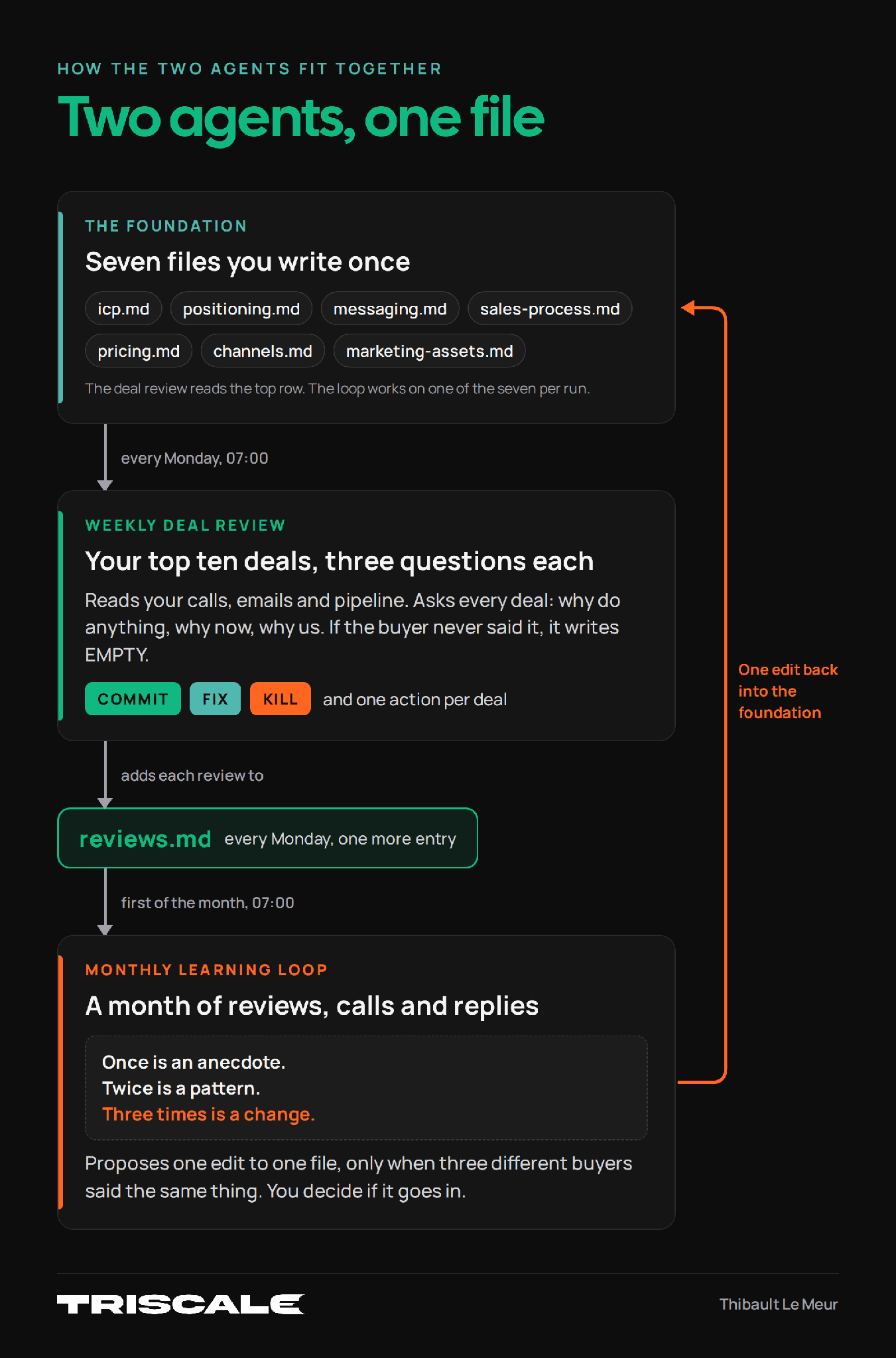
→ A weekly deal review agent that reviews his open deals and checks whether there’s actual buyer evidence for Why do anything? Why now? Why us?
→ A monthly learning loop that looks across those reviews, calls and replies, finds recurring patterns, and proposes updates to his GTM foundation.
Today he shows you how to build both, and what they found in his own deals.
In case you missed the last 3 episodes:
✅ 9 GTM infographics to grow to 1€ million ARR
✅ One founder needs to own GTM
✅ 3 things you can ship today
Today’s article is in collaboration with The Honest Founder.
If you’re a founder building an ambitious company and want a more honest perspective on what comes with it, I recommend subscribing to Xaver Lehmann’s The Honest Founder.
Xaver built and sold his first AI company for $60M and now writes every Tuesday about growth, hiring, fundraising, pressure, burnout, decision-making, and what actually matters beyond the next milestone.
New subscribers also get his 30-page SOE framework for finding and evaluating startup ideas for free.
Over to Thibault 👇
On Thursday 8 October, I ran my deal review agent for the first time, on my own pipeline.
It picked four deals, read every call and email I’d had with each of them, and gave each one a verdict:
COMMIT (on track),
FIX or
KILL.
Two got a FIX and two a KILL.
The KILLs I could live with. The “why us” line stung more.
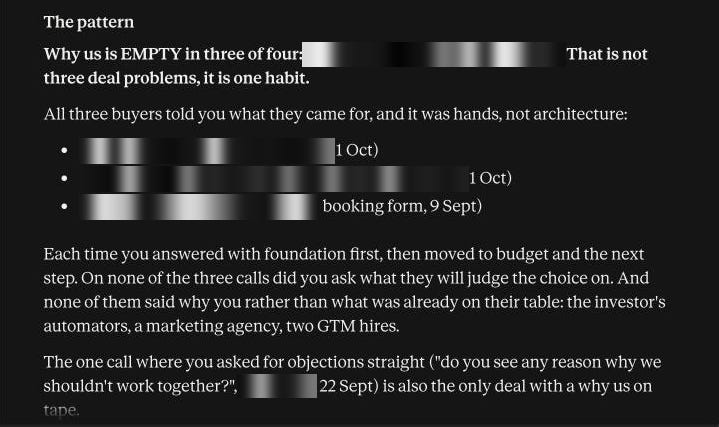
That’s where the buyer’s own reason to pick me should be, and on three of the four deals it said EMPTY.
Underneath, the agent quoted my own calls back to me, with dates. Each of those buyers had told me what they wanted, and I’d pitched them something else.
If you sell on your own, nobody sits you down on Monday morning to ask the awkward questions about your deals: why would this buyer do anything at all, why now, and why us.
So I built two agents:
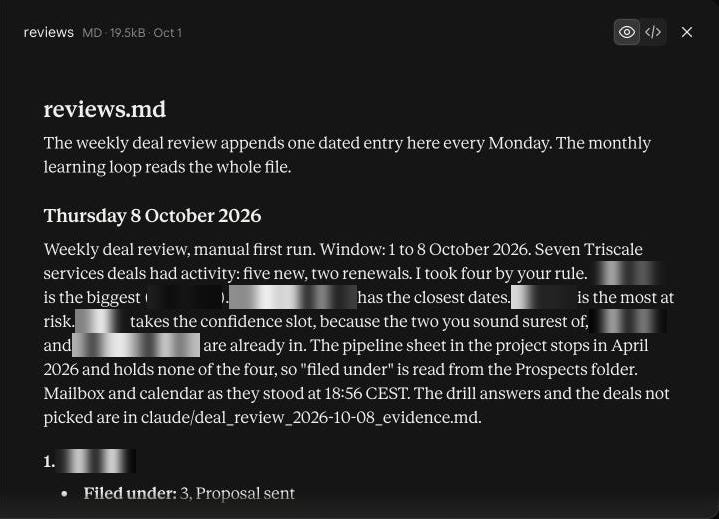
→ A weekly deal review. Every Monday at 07:00 it ranks my open deals, reviews the ten that matter most and writes its verdicts to a file called reviews.md.
→ A monthly learning loop. On the first of the month it reads four weeks of those reviews, plus my calls and replies, and proposes one edit to one of my seven GTM files, but only when three different buyers have said the same thing.
When I wrote this, the deal review had run twice and the loop once, so read this as a report from week one.
The full guide has both prompts, a template for each of the seven files, and screenshots of my setup with names hidden.
Part 1. What the deal review found in my pipeline
That first week the agent took four deals and ran each one through those three questions from John McMahon’s The Qualified Sales Leader.
After my second run, I moved it to the ten that matter most.
All three buyers with an EMPTY on “why us” had asked, one way or another, for someone to do the work. One asked me outright if I’d do the selling myself. Each time I gave my usual pitch (build the GTM foundation first) and went straight to budget and next steps.
The agent summed it up in one line:
You pitch the foundation to a buyer who asked for hands, and you do not ask what they will choose on.
I’ve changed my answer since. When a founder asks whether I do the selling myself, I tell them I build the system and run it with them until their first salesperson can take over.
Asking what the decision will come down to is harder. The one deal with a “why us” on record was the one where I’d asked straight out whether they saw any reason we shouldn’t work together.
My second run had three of the four deals EMPTY on “why us” again, so I’m not there yet.
The deal I’d been surest about is lost now. That first review told me not to send the proposal on its own: book a call to walk them through it, and open with the budget, the signer, and the competing offers. I sent it alone the next day.
The core of the Monday prompt (full version: Full Guide):
THE GATE. Three questions, every deal, no exceptions:
1. Why do anything? What happens to them if they do nothing? Whose job gets harder, which number of theirs suffers?
2. Why now? What event or deadline forces a decision, and is that date theirs or mine?
3. Why us? Which of my differentiators have THEY repeated back, in their own words?
Answer only from what was actually said, and quote them with the date of the call. Where there is no evidence, write EMPTY. Do not infer it, do not fill the gap with something plausible. An EMPTY is more useful to me than a good guess.
If the gate fails, the deal is Discovery, whatever my CRM says.
On Monday, give it half an hour. Read the verdicts, check the quotes behind any KILL, take the actions, and fix any stage the agent says is wrong in your pipeline.
Self-check:
For each of your last five deals, can you quote one thing the buyer said about why they’d pick you?
Part 2. The learning loop, and the buyer my ICP was missing
I ran the loop for the first time that Thursday too, on about five weeks of my calls and replies.
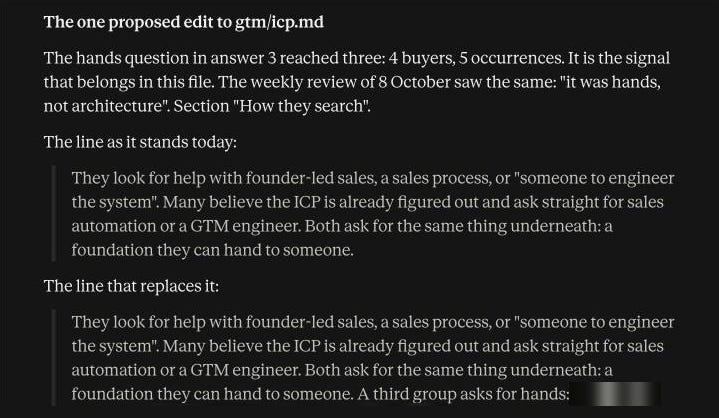
Four buyers asked for someone to do the work for them, including selling.
So the loop proposed one edit to icp.md: a new kind of buyer, who’s shopping for someone to sell for them and compares my fee with what a salesperson costs.
It wrote the edit in reviews.md and didn’t touch icp.md, because whether it goes in is my call. I read it and put it in.
Start the loop on icp.md alone, then add the other files one at a time. Each costs you about thirty minutes a month.
Part 3. What it takes
I use Claude on the Max plan, with Fathom (not sponsored), Gmail, Google Calendar, and one Drive folder per prospect.
On paper, the setup is about three hours. Mine took several sessions.
1. Fill in the seven templates (2 hours). ICP, positioning, messaging, sales process, pricing, channels and marketing assets. The full guide has the structure for each, with placeholders. Start with icp.md and sales-process.md, and put most of your time into the exit criteria: what has to be true for a deal to move to the next stage.
2. Load them into a project (5 min). A Claude project is basically a chat that remembers a set of files.
3. Connect your calls, inbox and pipeline (30 min). The call recorder matters most, because the deal review quotes your buyer's words word for word. Then ask the project to list your deals with their last contact date and to quote one line from your latest sales call. If it improvises or asks you to paste something in, a connection isn’t live.
4. Create reviews.md (2 min). One empty file in the same project, where both agents write.
5. Put both on a schedule (10 min). If you have to remember to open them, you’ll skip them on busy weeks. In Claude that’s Scheduled, in the left sidebar.
What broke in my first week
→ My old pipeline sheet was out of date. The agent noticed and read my Drive folders instead. If your pipeline lives in two places, tell the prompt which one wins.
→ Fathom sometimes mixes up who said what. On several of my calls, it filed a buyer’s lines under my name. Check the quotes behind any KILL against the call before you act on it.
→ My first scheduled Monday run failed. It hit my usage limit after eight seconds, even on the Max plan, and so did a retry that evening. I switched the task to a different Claude model and the next run went through. If your Monday output doesn’t show up, check the task’s run history first.
Where to start
Fill in the templates, run the deal review the next Monday, and add the loop on the first of the month.
Once it’s running, send me your first KILL on LinkedIn, with the names taken out. I’d like to see it.
That’s it for today.
3 ways I help founders build a strong GTM foundation 👇
If you’re somewhere between €0 → €1M ARR, I can help you with your GTM.
1️⃣ Free GTM Foundation Library
→ 50+ resources (guides, templates, frameworks)
2️⃣ GTM Audit
→ 360° assessment + 6-month action plan: Your GTM blind spots revealed
3️⃣ 1:1 GTM Advisory
→ Work directly with me to build your GTM