


Hey – it’s Alex.
One thing I keep seeing with early-stage founders:
They know GTM is important.
But they still try to get themselves out of it too early.
Hire the first salesperson.
Bring in an advisor or agency.
Delegate GTM because there are 20 other things to do.
Or simply never spend enough time on it in the first place.
I understand why.
But especially from €0 → €1M ARR, I’m convinced:
One founder needs to own GTM.
Here are 3 things I mean by that 👇
In case you missed the last 3 episodes:
✅ 3 things you can ship today
✅ 10 GTM principles I recommend to every founder
✅ The 13 GTM Workstreams in my GTM advisory work
This newsletter is sponsored by Zero
Find, win, and grow customers in one place. Zero replaces your CRM and the tools around it.

Zero replaces your CRM — and everything else your GTM stack depends on. One AI-native operating system, one bill, no manual work.
Lead gen
LinkedIn message and email sequencing
Cold calling
The CRM itself
AI agents
Signals
Product and marketing analytics
Customer churn prevention
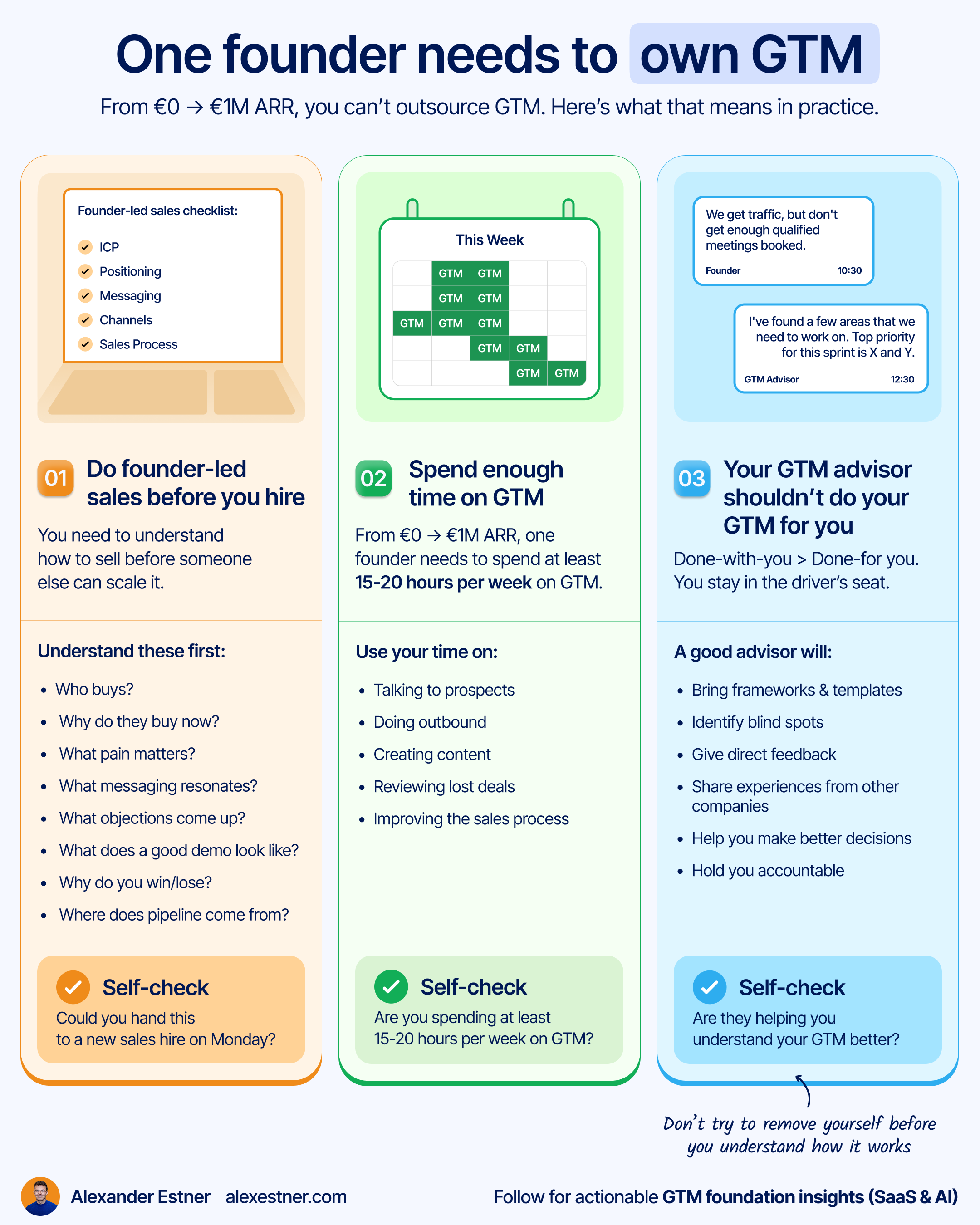
1. Do founder-led sales before you hire someone to sell
I’ve seen this multiple times.
Founder-led sales aren’t really working.
Pipeline is inconsistent.
The sales process isn’t clear.
So the founder hires their first salesperson to fix it.
3–6 months later, not much has changed.
The problem:
The new hire inherited the same unanswered questions the founder had.
Before handing sales over, you should have done enough founder-led sales to understand:
→ Who buys?
→ Why do they buy now? What triggers them to start looking?
→ What pain matters enough to pay for?
→ What positioning & messaging resonate?
→ What objections keep coming up?
→ What does a good discovery + demo process look like?
→ Why do you win/lose deals?
→ Where does qualified pipeline come from?
You don’t need perfect answers or a 50-page GTM playbook.
But you should have:
1. Closed customers yourself
2. Identified the patterns
3. Documented a basic process
Then hire someone to improve it and make it more repeatable.
Your first sales hire should scale a motion that has evidence behind it, not discover the entire GTM from scratch.

Self-check:
If your first sales hire started on Monday, what would you actually hand them?
Could you explain your ICP, triggers, messaging, sales process, common objections and pipeline sources?
Or would the onboarding basically be: “Here’s the product. Now go sell it.”
2. Spend enough founder time on GTM
This is probably the bigger problem I see.
Founders tell me:
“GTM is our #1 priority.”
But then I look at what they actually did over the last week:
Two hours on sales.
One LinkedIn post.
A few follow-ups.
Then another week passes.
And GTM got 3 hours.
Why?
Product was urgent.
Fundraising took longer.
There was an accounting issue.
A customer had a problem.
I get it.
As an early-stage founder, you wear 20 hats.
But from €0 → €1M ARR, I believe one founder needs to spend at least 15–20 hours per week on GTM.
And if GTM is currently your biggest bottleneck, probably more.
Not occasionally. Week after week.
Talking to prospects.
Doing outbound.
Creating content.
Reviewing lost deals.
Testing new messaging.
Improving the sales process.
Whatever your current GTM priorities are.
And if you consistently can’t find those 15–20 hours, I’d work on the reason why.
Accounting? → Outsource it.
Admin? → Delegate or automate it.
Fundraising? → Timebox it.
Strategy? → You're early stage. Execute.
Product? → Ask what really needs founder involvement.
Of course, there will be weeks where something else genuinely needs your attention.
But if GTM gets pushed to next week every week, it’s not actually your #1 priority.
Self-check:
Open your calendar for the last 4 weeks.
How many hours per week did one founder actually spend talking to the market, selling, generating pipeline or improving your GTM?
If the answer is consistently 3–5 hours, I wouldn’t look for another tactic.
I’d fix the time allocation first.
3. Your GTM advisor shouldn’t do your GTM for you
And yes, that’s coming from someone who sells GTM advisory.
But I strongly believe it.
Especially before €1M ARR:
Done-with-you > done-for-you.
Your GTM advisor should:
→ Challenge your assumptions
→ Bring frameworks & templates
→ Help you prioritize
→ Identify blind spots
→ Give direct & hands-on feedback
→ Bring experience from other companies
→ Support you in making the important GTM foundation decisions
→ Hold you accountable
But you stay in the driver’s seat.
→ You’re the one talking to customers.
→ You’re the one testing the positioning.
→ You’re the one seeing which messages get a reaction.
→ You’re the one learning why deals close or don’t.
Of course, that doesn’t mean your advisor should just sit there and ask questions.
I have opinions. I make recommendations. I share what I’ve seen work across other companies. And I’ll tell you when I think you’re making the wrong decision.
But the goal is to help you make better GTM decisions and learn faster.
Not to make those decisions in a black box and hand you the result.
Self-check:
Look at the external GTM support you currently use.
Are those people helping you understand your GTM better?
Or are they becoming the only people who know how it works?
TL;DR
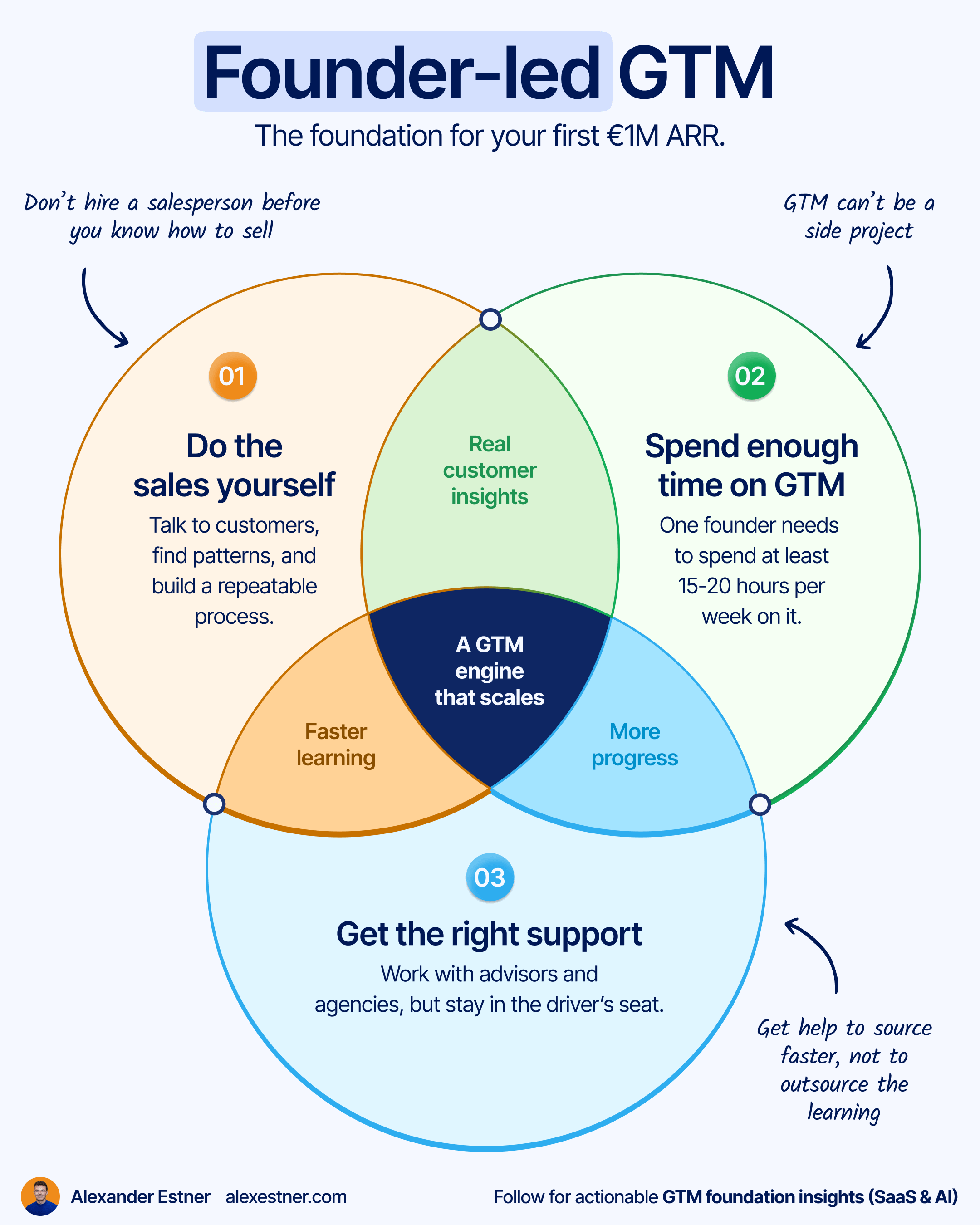
From €0 → €1M ARR, one founder needs to own GTM.
Do founder-led sales before handing sales over.
Spend enough time on GTM every week to actually make progress.
Use advisors and agencies to help you learn faster.
You absolutely want to build a GTM engine that eventually runs without you.
Just don’t try to remove yourself before you understand how it works.
Happy growth
3 ways I help founders build a strong GTM foundation 👇
If you’re somewhere between €0 → €1M ARR, I can help you with your GTM.
1️⃣ GTM Foundation Library
→ More than 50 frameworks, guides, and templates.
2️⃣ GTM Clarity Sprint
→ A complete GTM audit and a six-month action plan delivered in < 7 days
3️⃣ 1:1 GTM Advisory
→ Work directly with me to build your GTM, workstream by workstream